Wegovy After 50: Review Fit, Strength, and Menopause
After 50, a useful Wegovy decision looks beyond the scale to the health benefits you want and how you’ll maintain strength and nutrition.
Being over 50 or postmenopausal doesn’t, by itself, determine whether Wegovy is a good fit. For weight treatment, the key questions are whether you have obesity or overweight with a weight-related condition, what benefit you want, and how you’ll manage possible stomach side effects while maintaining nutrition and strength. Your medical history and other medicines matter too. 1 5
Start with the reason for treatment
Age and menopause are context, not stand-alone reasons to start Wegovy. For weight reduction, Wegovy is indicated for adults with obesity, or with overweight and at least one weight-related condition, alongside a reduced-calorie diet and increased physical activity. It also has a separate indication to reduce major cardiovascular events in adults with established cardiovascular disease and either obesity or overweight. The question is which, if any, treatment goal applies to you. 1
A useful discussion begins with what you want treatment to change: for example, a weight-related health problem or difficulty with daily activities. Ask what would count as a meaningful benefit for you, and how you’ll judge progress beyond the number on the scale. Obesity treatment plans take account of weight, other health conditions, and a person’s goals. A BMI can help describe weight-related risk, but it cannot distinguish fat from muscle or bone; MedlinePlus notes that it may underestimate body fat in older people who have lost muscle. 2
There isn’t one “over 50” body or risk profile. In a pooled analysis of two trials involving people with obesity-related heart failure with preserved ejection fraction, semaglutide improved weight, heart-failure-related symptoms, and measures of physical function over 52 weeks. The effects and safety profile were consistent across the age groups studied, including people 75 and older. That’s useful evidence if you have this kind of heart failure, but it doesn’t establish the same outcomes for everyone considering Wegovy. 7
Make eating and strength part of the plan
Semaglutide reduces calorie intake, likely through its effect on appetite, and delays stomach emptying. That makes a practical question especially useful: if you’re less interested in food, will you still be eating enough to support your needs? An older-adult review identifies muscle loss, side effects, and multiple medicines as considerations during GLP-1 treatment, while noting that evidence specifically in older adults remains limited. 1 5
This doesn’t mean Wegovy has been shown to cause a particular muscle problem in postmenopausal women. It means weight loss alone is an incomplete measure of how treatment is going. Talk through what you usually eat, any difficulty eating enough, and the activities you want to keep doing. Ask how strength-building activity, mobility, and changes in everyday function will fit into follow-up. If eating becomes difficult or you notice a decline in strength or daily activity, those changes deserve attention alongside the scale. 5
A small pilot offers one narrow piece of bone-health evidence. It randomized 20 older adults with overweight or obesity and prediabetes or diabetes, half of them women, to semaglutide 1.0 mg weekly plus lifestyle counseling or lifestyle counseling alone for 20 weeks. Researchers found no significant between-group differences in whole-body bone mineral density or bone-turnover markers. This short pilot used a different semaglutide regimen from the 2.4 mg weekly regimen studied in the heart-failure trials, and it cannot settle longer-term bone questions about Wegovy treatment. 6 7
The Wegovy prescribing information adds a different consideration for later life: in a cardiovascular outcomes trial, participants aged 75 and older reported more hip and pelvis fractures with Wegovy injection than with placebo. It also reports no overall difference in effectiveness between adults aged 65 and older and younger adults. Neither finding tells us whether postmenopausal women have a distinct response. If you’re concerned about falls, fractures, or keeping up daily activities, make those part of how you assess treatment. 1
Review medicines and choose useful follow-up measures
Bring a current list of prescriptions, over-the-counter medicines, and supplements. The most concrete medication check is for diabetes treatment: using Wegovy with insulin or a medicine that prompts insulin release, such as a sulfonylurea, can increase the risk of low blood sugar. Wegovy also delays stomach emptying and may affect absorption of oral medicines that need close monitoring. If you have diabetes or take such medicines, ask what monitoring your treatment plan calls for rather than assuming your existing routine will stay the same. 1
Review your medical history as well. Wegovy should not be used by someone with a personal or family history of medullary thyroid cancer, multiple endocrine neoplasia syndrome type 2, or a prior serious allergic reaction to semaglutide or a Wegovy ingredient. It’s also not recommended for people with severe gastroparesis, a condition in which the stomach empties very slowly. These are more useful treatment-fit questions than age alone. 1
Stomach and bowel side effects can sometimes be severe. Vomiting or diarrhea that makes it hard to drink enough can lead to dehydration and kidney injury; let your care team know if that happens. Persistent or severe abdominal pain, sometimes reaching the back, needs prompt medical attention because pancreatitis has been observed with Wegovy. Gallbladder problems have also occurred during treatment. 1
Agree on measures that reflect your goals. Depending on your circumstances, those might include weight alongside a relevant health condition, strength, walking, or other activities that matter to you. Also decide how you’ll raise trouble eating or drinking, troublesome stomach symptoms, or a change in daily function. Looking at function as well as weight helps you and your clinician see whether the benefits you wanted are showing up in everyday life. 1 2 5
Keep menopause care a separate question
Postmenopause may shape your broader health priorities, but age-group results are not the same as results specifically for postmenopausal women. The older-adult bone pilot reported how many participants were women without reporting a postmenopausal subgroup, and the heart-failure analysis compared age groups rather than menopause status. Neither establishes whether menopause changes semaglutide’s benefits or risks. 6 7
If hot flashes or other menopause symptoms are also on your mind, raise them as their own care question. Menopause guidance evaluates treatments for those symptoms separately; weight loss is listed among options with more limited evidence for hot flashes, not as proof that Wegovy treats them. 3 4
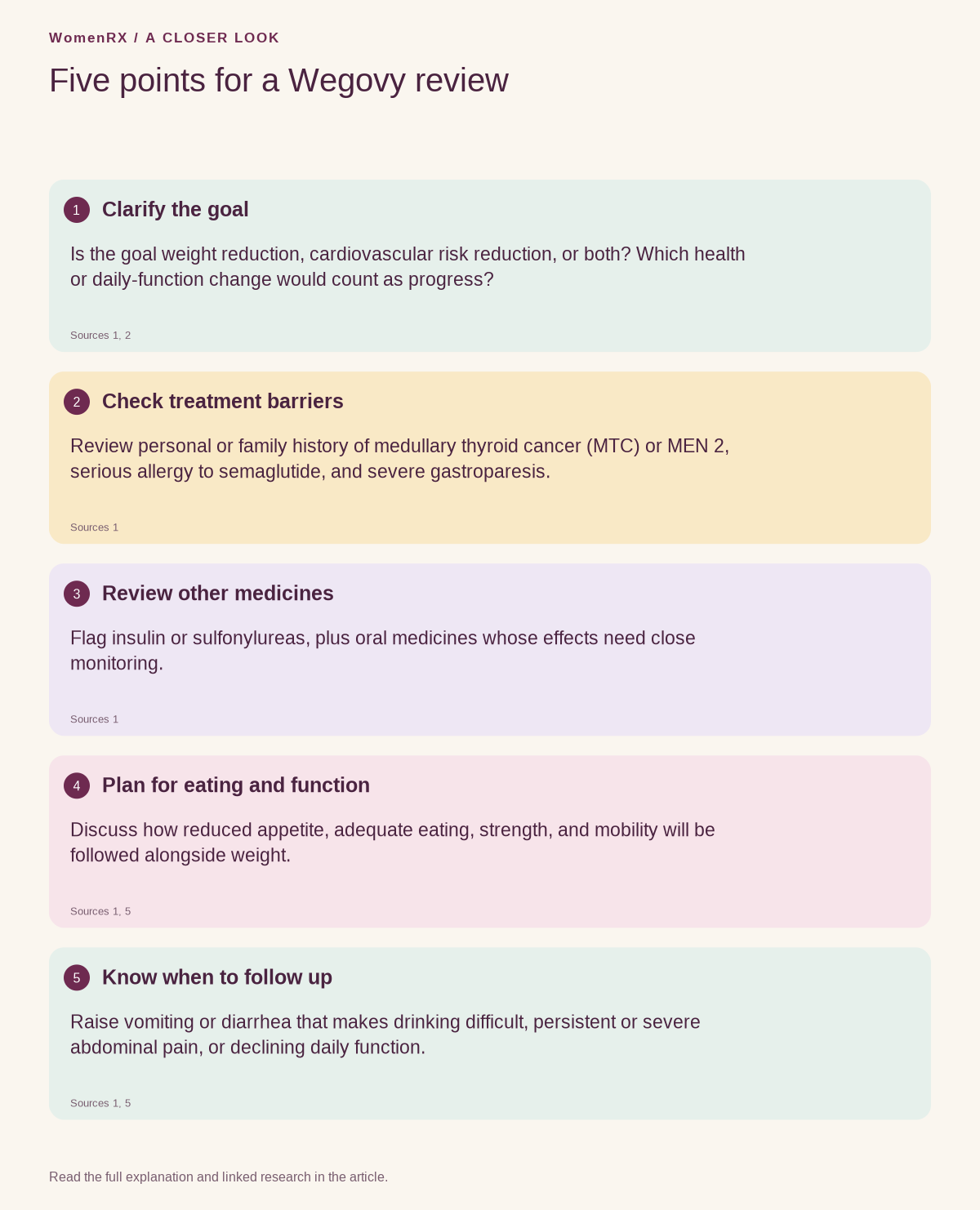
Five points for a Wegovy review
Clarify the goal: Is the goal weight reduction, cardiovascular risk reduction, or both? Which health or daily-function change would count as progress?12
Check treatment barriers: Review personal or family history of medullary thyroid cancer (MTC) or MEN 2, serious allergy to semaglutide, and severe gastroparesis.1
Review other medicines: Flag insulin or sulfonylureas, plus oral medicines whose effects need close monitoring.1
Plan for eating and function: Discuss how reduced appetite, adequate eating, strength, and mobility will be followed alongside weight.15
Know when to follow up: Raise vomiting or diarrhea that makes drinking difficult, persistent or severe abdominal pain, or declining daily function.15
Read the figure as text
Use these prompts to connect treatment fit and safety with the changes you want to see in daily life.- Clarify the goal: Is the goal weight reduction, cardiovascular risk reduction, or both? Which health or daily-function change would count as progress?12
- Check treatment barriers: Review personal or family history of medullary thyroid cancer (MTC) or MEN 2, serious allergy to semaglutide, and severe gastroparesis.1
- Review other medicines: Flag insulin or sulfonylureas, plus oral medicines whose effects need close monitoring.1
- Plan for eating and function: Discuss how reduced appetite, adequate eating, strength, and mobility will be followed alongside weight.15
- Know when to follow up: Raise vomiting or diarrhea that makes drinking difficult, persistent or severe abdominal pain, or declining daily function.15
More questions, answered
Does the small bone study prove semaglutide is safe for bones?
No. In a 20-person, 20-week pilot using semaglutide 1.0 mg weekly plus lifestyle counseling, researchers found no significant between-group differences in whole-body bone mineral density or bone-turnover markers. Its size, duration, and regimen limit what it can tell us about longer-term Wegovy treatment. 6
Sources you can check
- WEGOVY (SEMAGLUTIDE) INJECTION, SOLUTION WEGOVY (SEMAGLUTIDE) TABLET [NOVO NORDISK PHARMACEUTICAL INDUSTRIES, LP] | US prescribing information and patient instructionsAccessed 2026-09-25Return to first citation
- Obesity: MedlinePlusAccessed 2026-09-25Return to first citation
- The 2022 hormone therapy position statement of The North American Menopause Society.“The 2022 Hormone Therapy Position Statement of The North American Menopause Society” Advisory Panel. · Menopause (New York, N.Y.) · 2022Return to first citation
- The 2023 nonhormone therapy position statement of The North American Menopause Society.Menopause (New York, N.Y.) · 2023Return to first citation
- Special Considerations When Using GLP-1 Receptor Agonists in the Treatment of Obesity and Diabetes Mellitus Type 2 in Older Adults.Pendrey AG, Rivera Sierra JA, Alvarez Lobo FA, Ríos Herrera EJ, Fernandez Muñoz YM, Sevilla Martir JF. · Advances in therapy · 2026Return to first citation
- Bone mineral density and turnover response to GLP-1 receptor agonists in older adults with overweight/obesity and prediabetes/type 2 diabetes: a 20-week pilot trial post hoc analysis.Dinkla L, Beavers KM, Robbins R, Akpalu D, Wherry SJ, Miller G, Beavers DP, Espinoza S, Trejo J, Stepanenko A, Cortes TM. · Frontiers in aging · 2025Return to first citation
- Effects of semaglutide in obesity-related heart failure with preserved ejection fraction across the age spectrum: Findings from the STEP-HFpEF programme.Pandey A, Moroney M, Verma S, Borlaug BA, Butler J, Davies MJ, Kitzman DW, Shah SJ, Petrie MC, Rönnbäck C, Domdey A, Rasmussen S, Chinnakondepalli KM, Patel S, Kosiborod MN. · European journal of heart failure · 2025Return to first citation