Topical Vitamin C: What It Can Do for Skin
Vitamin C is a reasonable option for uneven tone or early signs of sun damage, but the formula and your skin concern matter more than the ingredient name alone.
Topical vitamin C may improve visible uneven tone and signs of photoaging, but results from one serum don’t guarantee results from another. L-ascorbic acid is the best-studied form; stability and delivery matter. 67 These studies don’t establish its use for melasma or sunscreen-equivalent protection. 4568 Check the formula, then try it on a small area before using it across your face.
Start with the skin concern, not the vitamin
If you’re considering a vitamin C serum for dull-looking, uneven skin or early signs of sun damage, there’s a reasonable case for trying one. Reviews of topical L-ascorbic acid describe clinical evidence for improvements in photoaging and pigmentation. The harder question is how much a particular bottle will do for your skin: studies use different formulas, delivery methods, and measures of improvement, so their results don’t translate neatly into a product ranking. 67
That distinction matters when a label promises firmer skin, fewer wrinkles, and faded spots all at once. A study of 49 women using one 12% L-ascorbic acid serum found improvements in several skin-aging measures after 84 days, but it compared participants with their own starting measurements, not with a group using a serum without vitamin C. It can’t tell you how much of the change was caused by vitamin C alone. 8
Another controlled study included 66 healthy Chinese women in its analysis and assessed a 10% vitamin C formulation over 12 weeks. It reported changes in measured skin color and biological markers. It included a blank comparison group, without specifying what that group applied; the findings also weren’t a test of wrinkle treatment or melasma treatment. Taken together, these studies offer a reason to consider topical vitamin C, not a promised result for every concern. 5
What to look for on the label
Ingredient: L-ascorbic acid, also called ascorbic acid, has the strongest clinical track record among the forms discussed in a recent systematic review. Other vitamin C derivatives may be formulated for stability or comfort, but the evidence doesn’t establish that every derivative works equally well for every goal. 67
Formula and container: L-ascorbic acid is inherently unstable, which is why formulation approaches such as pH adjustment and encapsulation are studied. In one clinical trial, researchers kept vitamin C powder separate from its liquid base until use and used opaque, light-protective containers. That doesn’t mean every effective serum must use that design. It does mean that a percentage on the front of a bottle tells you less than it appears to about how the product will perform over time. 56
The rest of the routine: There’s no need to add several new active products at once to find out whether vitamin C suits you. Before applying a new serum across your face, try it on a small area of intact skin and see how your skin responds. If that area feels uncomfortable or looks irritated, stop using the product rather than pushing through. If it stays comfortable, follow the product’s directions and keep other new actives out of the experiment so you can tell how this formula suits you. A favorable tolerability result for one studied serum isn’t a guarantee for another formula or for every person. 8
Vitamin C’s antioxidant effects are sometimes described as photoprotection. That means researchers are studying how it may limit some effects of UV-related oxidative stress. Those findings don’t establish that a vitamin C serum provides protection equivalent to sunscreen. 46
If the patches might be melasma
A patch of uneven color isn’t automatically the same concern as general dullness or photoaging. The topical vitamin C studies described above don’t establish that a serum treats pregnancy-related pigmentation or melasma, and they don’t provide pregnancy-specific outcomes. 578
There’s also no basis here for saying vitamin C works differently because you’re a woman. Some relevant serum studies enrolled women, but that isn’t a comparison of effects by sex. 58
One use case that needs a different decision
Everyday application to intact skin is not the same as putting a serum on skin immediately after a procedure. In a small split-face trial involving 64 Chinese adults treated with ablative laser for acne scars, a combination serum containing vitamins C and E plus ferulic acid improved several short-term recovery measures compared with saline. That result belongs to a specific post-laser setting and can’t be credited to vitamin C alone. 3
Don’t treat it as a reason to pair your serum with at-home microneedling. A systematic review found rare, sometimes difficult-to-treat granulomatous reactions after microneedling; topical vitamin C was implicated in many of the 15 reported cases, although the cause was often not confirmed by testing. 2
Finally, keep skincare and nutrition separate. Vitamin C from food is essential for normal collagen production and other body functions. That fact doesn’t show that taking extra vitamin C will reproduce the results of a topical serum on facial pigmentation or photoaging. 17
Before You Choose a Vitamin C Serum
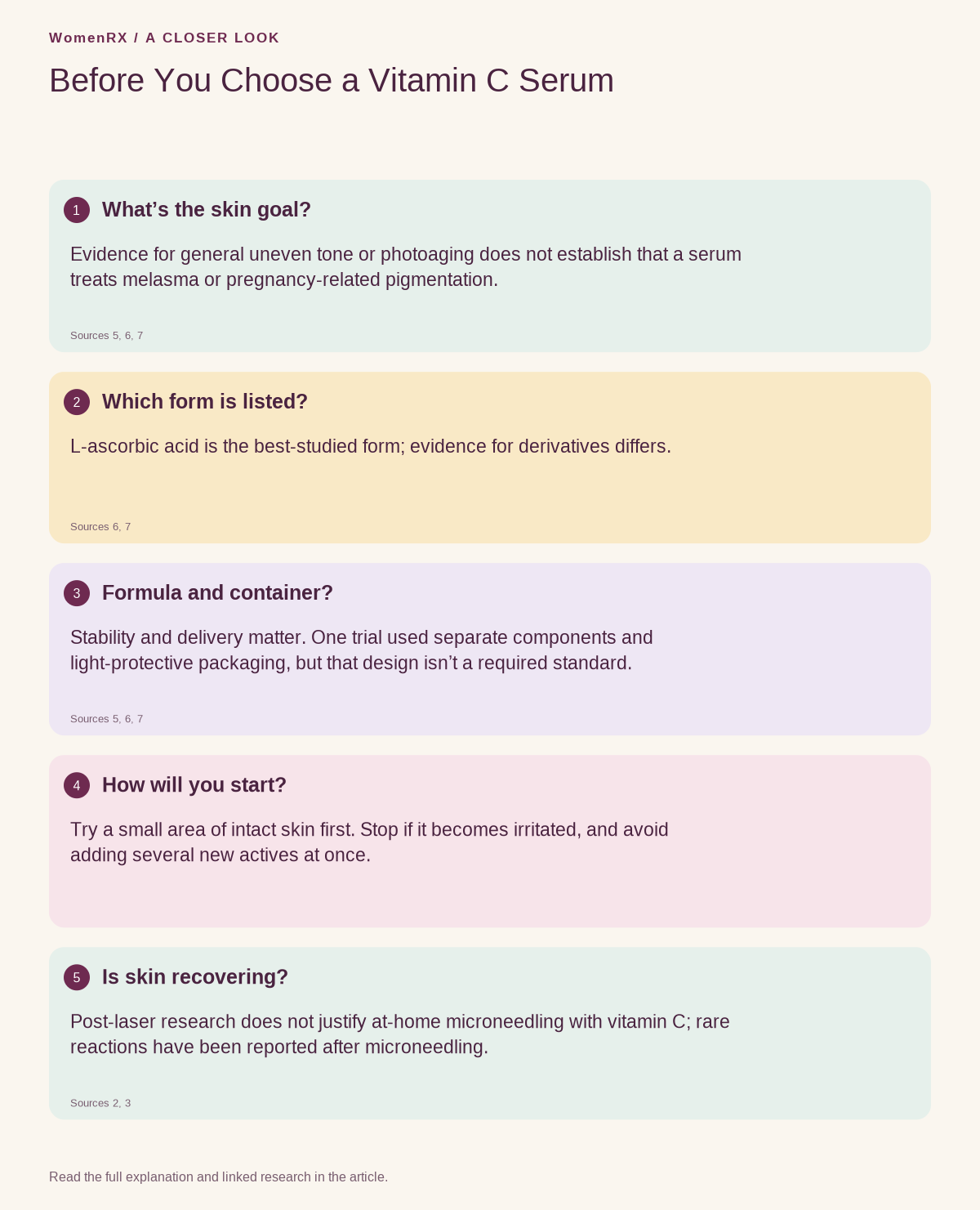
What’s the skin goal?: Evidence for general uneven tone or photoaging does not establish that a serum treats melasma or pregnancy-related pigmentation.567
Which form is listed?: L-ascorbic acid is the best-studied form; evidence for derivatives differs.67
Formula and container?: Stability and delivery matter. One trial used separate components and light-protective packaging, but that design isn’t a required standard.567
How will you start?: Try a small area of intact skin first. Stop if it becomes irritated, and avoid adding several new actives at once.
Is skin recovering?: Post-laser research does not justify at-home microneedling with vitamin C; rare reactions have been reported after microneedling.23
Read the figure as text
Use these questions to match a product to your concern without treating the label as a guarantee. Does the formula fit your goal and the rest of your routine?- What’s the skin goal?: Evidence for general uneven tone or photoaging does not establish that a serum treats melasma or pregnancy-related pigmentation.567
- Which form is listed?: L-ascorbic acid is the best-studied form; evidence for derivatives differs.67
- Formula and container?: Stability and delivery matter. One trial used separate components and light-protective packaging, but that design isn’t a required standard.567
- How will you start?: Try a small area of intact skin first. Stop if it becomes irritated, and avoid adding several new actives at once.
- Is skin recovering?: Post-laser research does not justify at-home microneedling with vitamin C; rare reactions have been reported after microneedling.23
More questions, answered
Is a higher vitamin C percentage always better?
Not necessarily. Clinical results depend on the complete formulation and how vitamin C is delivered, not just the percentage printed on the label. The studied 10% and 12% serums also had different designs and outcomes, so their percentages aren’t a head-to-head comparison. 5678
Should I take vitamin C supplements instead of using a serum?
They answer different questions. Dietary vitamin C is an essential nutrient; evidence about an oral supplement’s effect on facial skin shouldn’t be treated as evidence that it performs like a topical product. 17
Sources you can check
- Vitamin C - Health Professional Fact SheetAccessed 2026-09-25Return to first citation
- Granulomatous Reactions From Microneedling: A Systematic Review of the Literature.Friedmann DP, Mehta E, Verma KK, Harris R. · Dermatologic surgery : official publication for American Society for Dermatologic Surgery [et al.] · 2025Return to first citation
- Reparative Effects of a Topical Antioxidant Serum Containing Vitamin C, Vitamin E, and Ferulic Acid After Ablative Fractional CO2 Laser Treatment for Atrophic Acne Scars: A Randomized, Investigator-Blinded, Split-Face, Controlled Trial.Shi Y, Xu S, Zhang W. · Journal of cosmetic dermatology · 2026Return to first citation
- Topical vitamin C: a useful agent for treating photoaging and other dermatologic conditions.Farris PK. · Dermatologic surgery : official publication for American Society for Dermatologic Surgery [et al.] · 2005Return to first citation
- Study on the Multiple Efficacies of Vitamin C Serum in Anti-Glycation, Anti-Carbonylation, Antioxidation, and Anti-Inflammation of Human Skin Based on In Vivo Tests.Zi Y, Liu J, Liu Q, Pan Y, Jiang X. · Journal of cosmetic dermatology · 2026Return to first citation
- Vitamins and the skin: Vitamin C in dermatology.Badash A, Garibay A, Petronic-Rosic V. · Clinics in dermatology · 2026Return to first citation
- Clinical Applications of Vitamin C in Dermatology: A Systematic Review.Boghosian T, Mendez H, Boghosian N, Sayegh M, Beer J, Tosti A. · The Journal of clinical and aesthetic dermatology · 2026Return to first citation
- Clinical Efficacy of a 12% Pure Vitamin C Serum Across All Skin Phototypes: An Integrated In Vitro-In Vivo Evaluation.Addor FAS, Odeimi J, Rezze GG, Fernandes E, Feiges M, Haykal D, Rey AB. · Dermatology and therapy · 2026Return to first citation