How to Choose a Vitamin C Serum Without the Hype
A serum’s percentage and packaging can help you understand its formula, but neither tells you how well it will work on your skin.
Start with the named vitamin C ingredient, then check the complete formula, storage instructions, and directions for use. Human studies have measured changes with specific serums, but they haven’t shown that a higher percentage or one package design is best. If you’re adding a serum to an established routine, judge how the actual product fits rather than copying a study’s schedule. 1 2

Read the ingredient name before the percentage
A prominent “10% vitamin C” or “12% vitamin C” tells you how much a product claims to contain, not which formula will work better. In one controlled study, researchers tested a particular 10% vitamin C serum. Another study tested a 12% serum that identified its vitamin C as L-ascorbic acid. These weren’t head-to-head tests of concentrations or forms. 1 2
When you compare labels, look for the specific vitamin C ingredient, not just “vitamin C” on the front of the box. Then read the rest of the ingredient list. For example, the studied 12% L-ascorbic acid product also contained vitamin E, salicylic acid, glycerin, and hyaluronic acids. Its results can’t be credited to L-ascorbic acid alone, and they can’t be transferred to every serum with “12%” on the label. 2
You may also see a derivative such as sodium ascorbyl phosphate on a label. The two human serum studies discussed here don’t compare that ingredient with L-ascorbic acid. The useful distinction is what a label identifies, not a claim that the named form is automatically better.
Packaging answers a different question from effectiveness
L-ascorbic acid presents formulation challenges: it is prone to oxidation, and delivery through the skin depends on more than its stated concentration. That’s why storage and packaging deserve attention. They still aren’t a substitute for evidence that the finished serum produces a noticeable benefit. 2
The studied products illustrate two different approaches. The 10% product kept vitamin C powder separate from its liquid vehicle until participants mixed it; both parts came in opaque containers. The 12% product came in UV-protective glass, and its researchers described a manufacturing process intended to limit oxidation. Neither study compared those packages or established how long a different product remains active after opening. 1 2
A practical comparison at the shelf is: Does the product identify its vitamin C form? Does it give storage and use directions you can follow? Is a benefit claim based on testing of this finished formula, or on vitamin C in general? A dark bottle, a high percentage, or a claim of “stability” can help you ask better questions. None proves a clinical result on its own.
What results from specific serums can tell you
In a randomized, double-blind controlled study, 66 healthy Chinese women completed 12 weeks: 35 used a specially prepared 10% vitamin C serum, and 31 were in a blank control group. Researchers reported changes in measured skin color and several skin markers in the topical group. The design offers evidence about that product under the study’s conditions, not a forecast for every 10% serum. 1
In a separate open-label study, 49 women across skin phototypes I-VI used one 12% L-ascorbic acid product. After 84 days, researchers reported changes in skin thickness and measures of firmness and elasticity compared with participants’ starting measurements. Because the product contained multiple ingredients, those findings don’t isolate the contribution of vitamin C. 2
That distinction matters when a label promises brighter or firmer-looking skin. There’s a difference between a measured change with a tested formula and proof that another formula, at the same percentage, will give you the same result.
Make room for the serum you actually buy
Before adding a serum, read its directions alongside the products you already use. One study’s participants applied its freshly mixed serum after cleansing and toning, morning and evening. That was a protocol for a particular product, not a tested schedule or layering order for all vitamin C serums. The other studied formula included salicylic acid, a detail you’d miss if you looked only at its vitamin C percentage. 1 2
If your goal is to see what a new serum adds, keeping the rest of your routine familiar makes the comparison clearer. Follow the directions for the product you choose rather than adopting the number of drops or frequency from a different formula’s study. These studies did not test how their serums perform when layered with retinoids, exfoliating acids, or every other product that might already be on your shelf. 1 2
If pregnancy-associated pigmentation is your concern
The serum studies reported skin-color or appearance measures, but neither reports results specifically for pregnancy-associated pigmentation or pregnancy-specific safety outcomes. 1 2 For guidance on a particular product during pregnancy, ask your prenatal care clinician or dermatologist to review the full product label and ingredient list. Looking at the ingredient list yourself is useful, but it doesn’t by itself settle whether the complete formula is suitable for your pregnancy. These studies cannot answer that product-specific question.
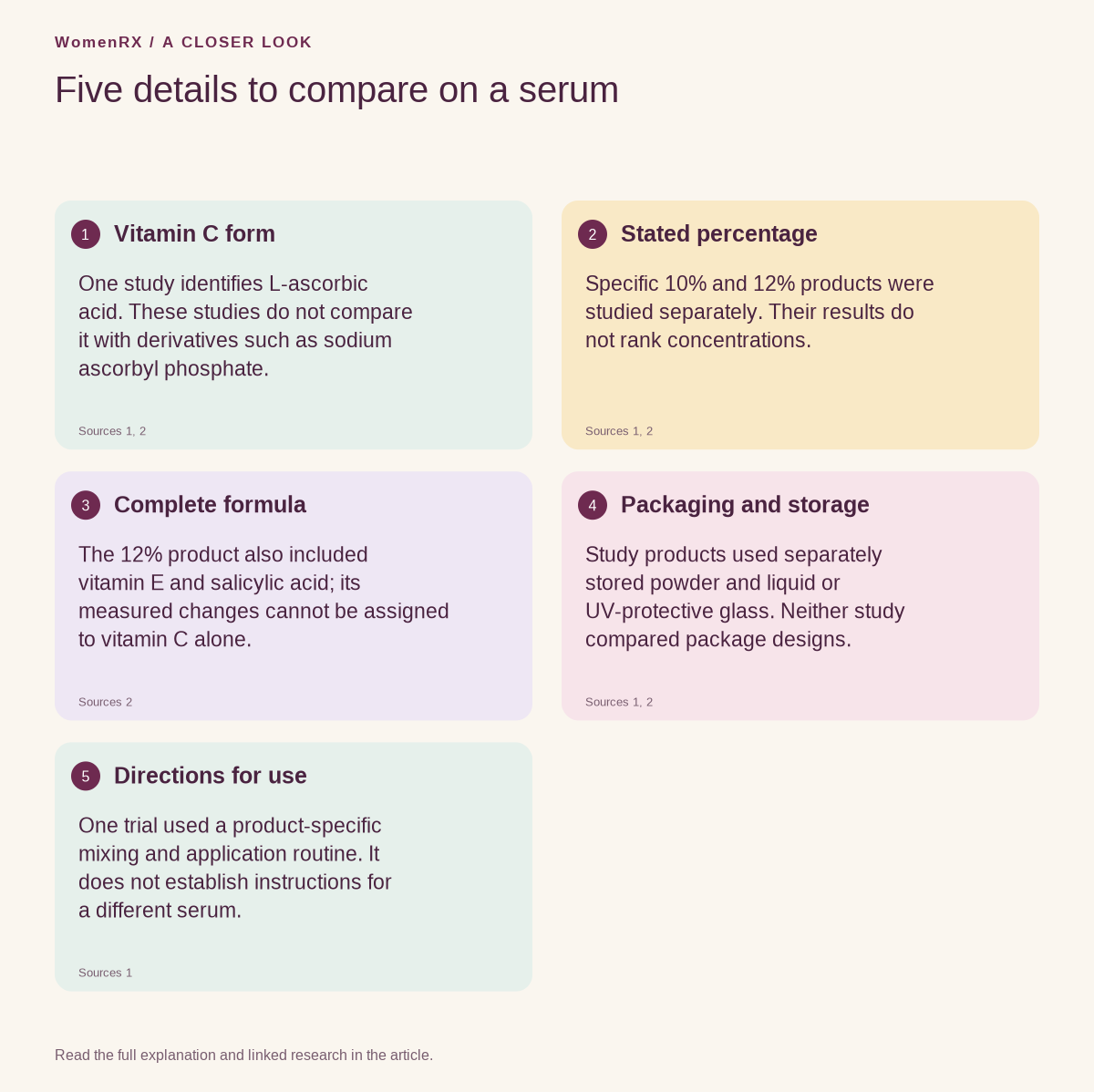
Five details to compare on a serum
Vitamin C form: One study identifies L-ascorbic acid. These studies do not compare it with derivatives such as sodium ascorbyl phosphate.12
Stated percentage: Specific 10% and 12% products were studied separately. Their results do not rank concentrations.12
Complete formula: The 12% product also included vitamin E and salicylic acid; its measured changes cannot be assigned to vitamin C alone.2
Packaging and storage: Study products used separately stored powder and liquid or UV-protective glass. Neither study compared package designs.12
Directions for use: One trial used a product-specific mixing and application routine. It does not establish instructions for a different serum.1
Read the figure as text
A label can answer some useful questions, while leaving clinical performance unresolved.- Vitamin C form: One study identifies L-ascorbic acid. These studies do not compare it with derivatives such as sodium ascorbyl phosphate.12
- Stated percentage: Specific 10% and 12% products were studied separately. Their results do not rank concentrations.12
- Complete formula: The 12% product also included vitamin E and salicylic acid; its measured changes cannot be assigned to vitamin C alone.2
- Packaging and storage: Study products used separately stored powder and liquid or UV-protective glass. Neither study compared package designs.12
- Directions for use: One trial used a product-specific mixing and application routine. It does not establish instructions for a different serum.1
More questions, answered
Is 12% vitamin C better than 10%?
These studies can’t answer that. They tested different finished products in different groups, rather than comparing 12% with 10% in the same trial. 1 2
Sources you can check
- Study on the Multiple Efficacies of Vitamin C Serum in Anti-Glycation, Anti-Carbonylation, Antioxidation, and Anti-Inflammation of Human Skin Based on In Vivo Tests.Zi Y, Liu J, Liu Q, Pan Y, Jiang X. · Journal of cosmetic dermatology · 2026Return to first citation
- Clinical Efficacy of a 12% Pure Vitamin C Serum Across All Skin Phototypes: An Integrated In Vitro-In Vivo Evaluation.Addor FAS, Odeimi J, Rezze GG, Fernandes E, Feiges M, Haykal D, Rey AB. · Dermatology and therapy · 2026Return to first citation