Do Peptide Products Improve Wrinkles and Skin Firmness?
A few specific peptide-containing products have improved measured skin outcomes, but the findings don’t transfer automatically to a different cream or serum.
Some peptide-containing products have improved wrinkle or other skin measurements in human studies. The strongest topical example here is a controlled trial of one cyclized peptide serum, not proof that all peptide serums work. An eye cream was also evaluated in 101 participants, but its multiple ingredients make the peptide’s contribution unclear. Oral collagen studies answer a different question. 1 5 3
Start with the formula, not the word “peptide”
If you’re choosing a serum for crow’s-feet or a cream for firmer-looking skin, the label may tell you it contains peptides. It won’t tell you whether that formula produced a noticeable result in a human study. Peptides vary, and so do the other ingredients and the way a product delivers them. Researchers testing one topical peptide specifically identified stability and passage through skin as formulation challenges. 1
That’s why a promising result for cyclized hexapeptide-9 (CHP-9) can’t be assigned to a product containing GHK-Cu or palmitoyl pentapeptide-4. It also can’t be assigned to a different CHP-9 formula without testing it. The useful question is narrower: what finished product was studied, against what comparison, and what changed?
What happened in the topical studies?
In a randomized, double-blind trial, healthy volunteers with aging skin used either a CHP-9 serum, a retinol serum, or a serum without either active ingredient for 56 days. Researchers measured the number, area, and roughness of crow’s-feet and forehead wrinkles. The CHP-9 group improved on those measures; the researchers reported larger effects than with the tested retinol serum on all of those outcomes except crow’s-feet roughness. That’s encouraging evidence for the tested CHP-9 serum over the study period, not a verdict on every peptide product or every retinol product. The reported details don’t establish how results varied by participants’ sex or age. 1
A smaller, four-week study followed 22 people with noticeable wrinkles around the eyes using a product containing zinc-α2-glycoprotein (ZAG) peptide. It reported improved skin density and elasticity and reduced wrinkle depth. The study description doesn’t identify a comparison group, so it’s harder to separate a product effect from changes that might have happened without it. It also doesn’t isolate what the peptide contributed within the product. 4
An eye cream containing peptides, plant extracts, and antioxidants was evaluated in two ways described in the study report. Researchers reported improvements with the cream used alongside a Fotona 4D skin procedure; that combined treatment can’t reveal which part produced the changes. The report also describes a large-scale evaluation of the eye cream in 101 participants over eight weeks, with a model estimating that participants appeared 2.25 years younger afterward. The description doesn’t establish whether that evaluation excluded the procedure, and it doesn’t specify the participants’ menopausal status. The result is a modeled change in perceived age, not a change in biological age. The multi-ingredient formula also can’t show whether its peptides caused the result. 5
These studies measured different things. A change in measured wrinkle roughness isn’t the same outcome as a change in modeled perceived age, and neither tells you whether someone looking in the mirror would find the difference worthwhile. When a product makes a claim, look for a result that matches what you hope to change.
Why an oral collagen result doesn’t settle a serum question
Oral collagen peptides have their own human evidence, but swallowing a supplement and applying a serum aren’t interchangeable. In one randomized, placebo-controlled trial, 77 healthy women took a specific bioactive collagen-peptide product or placebo for 12 weeks. Compared with placebo, the collagen group improved on measured hydration, water loss through the skin, and dermal density. The trial also assessed participants after a four-week period off the product. It did not test a topical cream. 3
Another randomized, placebo-controlled study gave 70 healthy adults an oral collagen-peptide product or placebo for eight weeks and reported improvements in facial wrinkle, hydration, and elasticity measures, among others. Its product and study population differed from the 77-woman trial. Neither result tells you how a peptide serum will perform. 2 3
What this means if menopause is part of your question
One oral collagen study specifically enrolled 77 healthy women, but that doesn’t make it a test of menopause-related skin changes. In the eye-area research, the women used to develop a perceived-age model were separate from the 101 participants in the eye-cream evaluation; the report doesn’t specify the latter group’s menopausal status. The reported findings don’t establish results by menopausal status, so they can’t tell you whether a peptide cream works differently before or after menopause. 3 5 1 4
A practical way to weigh a product claim is to keep four details together: the named peptide, the finished formula, the route, and the measured outcome. A controlled result for the same topical formula is more directly useful when choosing a serum than an oral-supplement study or a study of a different peptide. And “anti-aging” in these studies means changes in skin measurements or appearance, not longer life or whole-body rejuvenation. 1 2 3 4 5
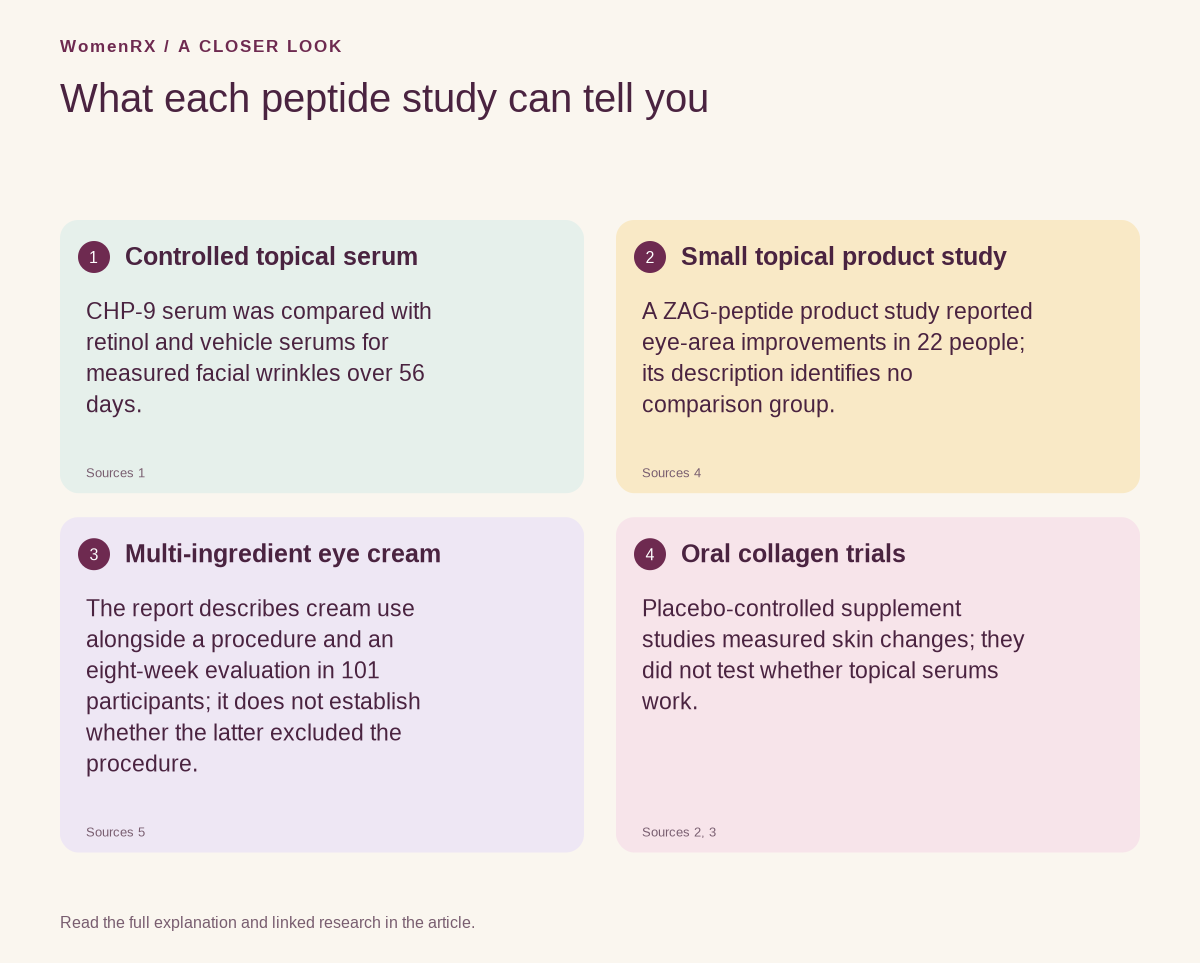
What each peptide study can tell you
Controlled topical serum: CHP-9 serum was compared with retinol and vehicle serums for measured facial wrinkles over 56 days.1
Small topical product study: A ZAG-peptide product study reported eye-area improvements in 22 people; its description identifies no comparison group.4
Multi-ingredient eye cream: The report describes cream use alongside a procedure and an eight-week evaluation in 101 participants; it does not establish whether the latter excluded the procedure.5
Oral collagen trials: Placebo-controlled supplement studies measured skin changes; they did not test whether topical serums work.23
Read the figure as text
Match a claim to the product and comparison actually studied; the routes and outcomes below answer different questions.- Controlled topical serum: CHP-9 serum was compared with retinol and vehicle serums for measured facial wrinkles over 56 days.1
- Small topical product study: A ZAG-peptide product study reported eye-area improvements in 22 people; its description identifies no comparison group.4
- Multi-ingredient eye cream: The report describes cream use alongside a procedure and an eight-week evaluation in 101 participants; it does not establish whether the latter excluded the procedure.5
- Oral collagen trials: Placebo-controlled supplement studies measured skin changes; they did not test whether topical serums work.23
More questions, answered
Does the CHP-9 trial show that peptides work better than retinol?
No. It compared one CHP-9 serum with one retinol serum over 56 days. The reported advantage on most measured wrinkle outcomes belongs to that comparison; it doesn’t establish a ranking of peptides against retinol products in general. 1
Sources you can check
- Novel Cyclized Hexapeptide-9 Outperforms Retinol Against Skin Aging: A Randomized, Double-Blinded, Active- and Vehicle-Controlled Clinical Trial.Chang H, Tao K, Yang Y, Wang Y, Ge M, Wang X, Tang S, Yu H. · Journal of cosmetic dermatology · 2025Return to first citation
- Skin Anti-Aging and Moisturizing Effects of Low-Molecular-Weight Collagen Peptide Supplementation in Healthy Adults: A Randomized, Double-Blind, Placebo-Controlled Clinical Trial.Lee E, Ahn DK, Kim JH, Lee S, Kim HJ, Lee HK, Shin JH. · Journal of microbiology and biotechnology · 2025Return to first citation
- The Sustained Effects of Bioactive Collagen Peptides on Skin Health: A Randomized, Double-Blind, Placebo-Controlled Clinical Study.Wang Y, Zhu W, Luo W, Ma Y, Zhou Y. · Journal of cosmetic dermatology · 2025Return to first citation
- Evaluation of the anti-aging effects of Zinc-α2-glycoprotein peptide in clinical and in vitro study.Lee SG, Ham S, Lee J, Jang Y, Suk J, Lee YI, Lee JH. · Skin research and technology : official journal of International Society for Bioengineering and the Skin (ISBS) [and] International Society for Digital Imaging of Skin (ISDIS) [and] International Society for Skin Imaging (ISSI) · 2024Return to first citation
- Establishment and application of perceived age prediction model for the periocular aging research of Chinese Han women.Wang Q, Li N, Wang M, Jin Y, Ye R, Du L, Hu F. · Skin research and technology : official journal of International Society for Bioengineering and the Skin (ISBS) [and] International Society for Digital Imaging of Skin (ISDIS) [and] International Society for Skin Imaging (ISSI) · 2024Return to first citation