Do Peptide Skin-Care Products Live Up to Their Claims?
One peptide cream has a reported wrinkle finding, but the best evidence for a serum is a study of that finished formula.
Some topical peptide products have been studied, but the evidence is narrower than many skin-care claims suggest. A review reports reduced wrinkle volume and depth with one cream containing Matrixyl; its broader wrinkle finding was largely driven by oral peptides. When evaluating a serum, look for a controlled human study of the finished topical formula that measured the result being promised. 1
A label that says “peptides” doesn’t tell you whether a product will soften a wrinkle, improve texture, or make skin look firmer. Peptides differ, and so do the creams and serums that carry them. The useful question is more specific: What was tested, on whom, and what visibly changed?
Start with the claim, not the ingredient buzzword
Peptides are chains of amino acids. Skin-care research describes several types with different proposed jobs. Signal peptides are investigated for their effects on processes involving skin structure; carrier peptides can carry trace elements such as copper. Other types are studied for possible effects on muscle signaling or enzymes involved in breaking down structural proteins. Those descriptions explain why researchers are interested, not what a product has been shown to do on someone’s face. 1
For example, “contains copper peptides” identifies a type of ingredient. It doesn’t establish that the product lifts skin. “Reduces the appearance of fine lines” is a different, testable claim. To assess it, you’d want a study measuring fine lines in people who used the topical product, ideally compared with a suitable control.
What the human evidence actually covers
A 2026 systematic review and meta-analysis examined 19 randomized trials involving 1,341 participants. It combined research on oral and topical peptides for skin-aging outcomes. The authors reported improvements in hydration and brightness particularly with oral formulations. They described the pooled wrinkle effect as modest and found that its apparent benefit was largely driven by oral polypeptides. That pooled result cannot tell you how much a topical serum will change your wrinkles. 1
The review also describes reduced wrinkle volume and depth with one cream containing Matrixyl, a peptide compound. That’s a more relevant example for a topical shopper, but it remains a finding about a particular cream and measured outcomes. It doesn’t establish that a different cream containing a similarly named ingredient will perform the same way, or that the tested cream lifts skin or reverses skin aging. That finding doesn’t tell you how large or how quickly the visible change was. 1
These reported findings also don’t establish whether peptide results differ by sex or life stage. They shouldn’t be presented as a special benefit for women, or as evidence about skin changes during perimenopause or postmenopause. 1
Why the bottle matters as much as the peptide
A peptide’s proposed action is only part of the story. For a topical ingredient to produce a claimed effect, the formulation needs to keep it sufficiently stable and deliver it where it could act. Peptide size, other chemical properties, and the product’s vehicle can affect passage through the outer skin barrier. Enzymes in skin may also break peptides down. 1 3
There’s a tradeoff here that a dramatic ingredient claim can hide. In laboratory research on newly designed antioxidant peptides, a chemical change increased penetration through porcine skin, but its effects on biological activity and cell compatibility varied by peptide and concentration. Better penetration alone did not guarantee a better overall candidate. These experiments help explain why formulation matters; they do not show that a retail serum improves wrinkles. 2
This is why an ingredient study and a finished-product study answer different questions. If a brand points to a lab result for a peptide but sells a multi-ingredient cream, the lab result supports interest in that ingredient, not the cream’s promised appearance change. Likewise, a study of an oral collagen-peptide supplement is not a trial of a topical peptide.
A quick way to read the evidence behind a promise
Suppose a serum promises “firmer-looking skin” and cites a study. Check four things before treating that citation as evidence for the bottle:
- The product: Was the tested item the finished topical formula, or only an isolated peptide, oral supplement, or different cream?
- The comparison: Was there a control product or other appropriate comparison? A before-and-after photo alone makes it harder to tell what caused a change.
- The outcome: Did researchers measure firmness, or something else, such as hydration or wrinkle depth? Those findings aren’t interchangeable.
- The people and timeframe: Does the study describe who participated and when results were measured? Without those details, it’s hard to judge how closely the result fits your expectations.
Those questions aren’t a demand that every jar come with a large trial. They help you decide how much weight to give a claim. A broader review of skin-aging interventions flags small samples, short study periods, subjective measures, and inadequate controls as recurring reasons to be cautious about sweeping conclusions. 4
If the evidence is a controlled human study of the same formula and the exact outcome advertised, you have a stronger basis for considering the claim. If it’s a mechanism, an oral-peptide study, or that single reported Matrixyl-cream finding applied to another bottle, keep the expectation narrower. 1 2
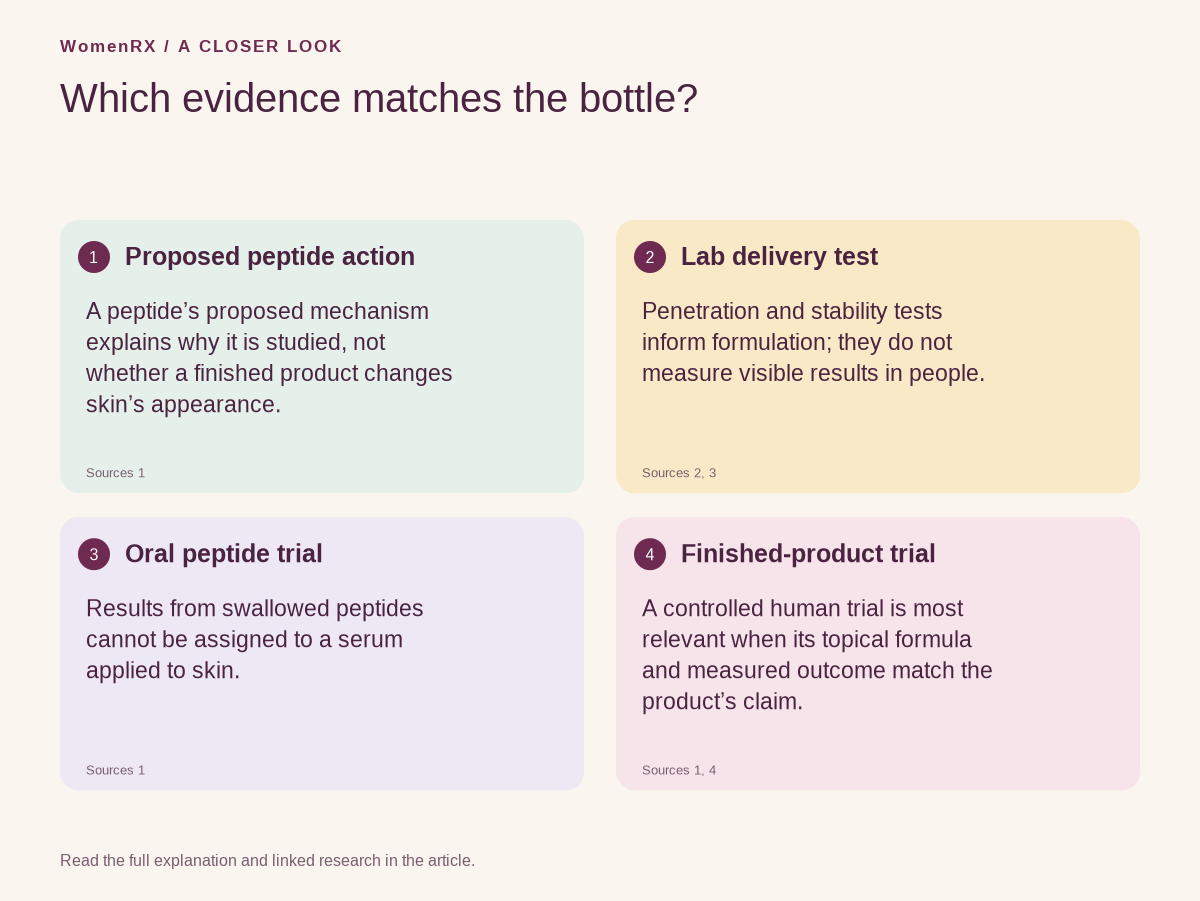
Which evidence matches the bottle?
Proposed peptide action: A peptide’s proposed mechanism explains why it is studied, not whether a finished product changes skin’s appearance.1
Lab delivery test: Penetration and stability tests inform formulation; they do not measure visible results in people.23
Oral peptide trial: Results from swallowed peptides cannot be assigned to a serum applied to skin.1
Finished-product trial: A controlled human trial is most relevant when its topical formula and measured outcome match the product’s claim.14
Read the figure as text
Four kinds of findings can sound similar in an ad, but they answer different questions.- Proposed peptide action: A peptide’s proposed mechanism explains why it is studied, not whether a finished product changes skin’s appearance.1
- Lab delivery test: Penetration and stability tests inform formulation; they do not measure visible results in people.23
- Oral peptide trial: Results from swallowed peptides cannot be assigned to a serum applied to skin.1
- Finished-product trial: A controlled human trial is most relevant when its topical formula and measured outcome match the product’s claim.14
More questions, answered
Does research on oral collagen peptides support a peptide serum?
Not directly. Oral and topical products use different routes of delivery. In the randomized-trial review, the pooled wrinkle finding was largely driven by oral polypeptides, so it should not be read as a result for a topical serum. 1
If a peptide penetrates skin in a lab test, will it improve wrinkles?
That test answers a delivery question, not a cosmetic-outcome question. Laboratory work found that a change improving penetration did not consistently improve biological activity or compatibility. A human study measuring wrinkles would be needed to support that promise. 2
Sources you can check
- Oral and topical peptides for skin aging: systematic review and meta-analysis of randomized controlled trials.Nukaly HY, Halawani IR, Irtaza HM, Alturkistani T, Serafi MR, Alhawsawi W, Bogari HO, Ahmed FA, Alhaddad Y, Shadid A, Alharithy R, Jfri A. · Frontiers in medicine · 2026Return to first citation
- Balancing skin permeation and antioxidant activity in C16-conjugated antioxidant peptides.Wang D, Lu Y, Min H, Li H, Chen C, Wang J. · Colloids and surfaces. B, Biointerfaces · 2026Return to first citation
- Application of 2D-Chromatography System for the Determination of Cosmetic Peptides in Skin Homogenates.Errante F, Pallecchi M, Menicatti M, Giovannelli L, Rovero P, Bartolucci G. · Journal of mass spectrometry : JMS · 2026Return to first citation
- Topical and systemic skin aging interventions: Evidence, pitfalls and perspectives.Gürtler AL, Sirois JP, Heckenbach IJ, Scherf-Clavel O, Scheibye-Knudsen M, Heinz A. · Biochemical pharmacology · 2026Return to first citation