What Peptides Are, and How Their Products Differ
“Peptide” describes a kind of molecule, not a promise of a particular benefit: its purpose, route, and evidence depend on the specific product.
Peptides are short chains of amino acids. Some occur naturally and act as signals in the body; some medicines contain a peptide or a modified version, while other medicines target pathways involving peptides. Skincare peptides and oral collagen fragments are different again. The label alone doesn’t tell you whether a product works: check the exact ingredient, route, intended use, and human evidence.

One word, several different uses
A peptide is a short chain of amino acids. Some peptides are made in the body and help carry signals; others are designed or adapted for a specific medical purpose. The same word also appears on skincare labels and protein supplements, even though those products aren’t interchangeable with medicines.
A useful way to sort them is to ask: What exact molecule is this, what is it meant to do, and what evidence supports that use? “Peptide” by itself answers none of those questions.
Peptides that signal in the body
Hormones are one familiar example. Glucagon is a 29-amino-acid pancreatic hormone involved in blood-glucose regulation. The gut hormones GLP-1 and GIP help regulate insulin and glucagon secretion after eating; their effects on appetite and metabolism have also made their receptors targets for medicines. 3 5
Peptides can have other roles, too. Calcitonin and parathyroid hormone are involved in calcium and bone regulation. CGRP, another naturally occurring peptide, is involved in migraine biology. These examples show why “peptide” is a broad molecular description, not the name of one treatment or one effect. 4 6
A peptide medicine is the molecule, not just its target
A peptide medicine contains a peptide or a modified peptide used for a medical purpose. For example, long-acting medicines that activate GLP-1 receptors are in clinical use for type 2 diabetes. Separately, some migraine treatments dampen signaling by CGRP, a peptide. Targeting a peptide pathway doesn’t by itself mean the treatment is a peptide medicine. 4 5
Medicines may also be modified to work differently from the body’s original peptide. Native GLP-1 is rapidly inactivated, which limits its use as a medicine; longer-acting receptor agonists were developed to address that challenge. So a drug inspired by a natural signal isn’t necessarily identical to it, and its effects depend on its design and how it acts in the body. 5
This is why route alone doesn’t classify a product. An injection can deliver a medicine, but the word “peptide” doesn’t establish that an injectable product is an approved medicine or that it has evidence for the advertised purpose. Look for the exact ingredient and the specific medical use being claimed.
Cosmetic peptides: promising idea, thinner clinical evidence
Some skincare ingredients are designed to influence skin-cell signaling or the extracellular matrix. Cosmetic peptides are often marketed for wrinkles, collagen stimulation, or improved skin quality. Those are claims to evaluate, not benefits guaranteed by the word “peptide.” A review of aesthetic applications reports that much of the supporting evidence comes from laboratory studies rather than randomized clinical trials. 1
For a skincare claim, ask whether research tested the same ingredient, in a similar formulation and route, on people, and measured the result you care about. Evidence about a molecule in a laboratory does not by itself show that a finished topical product produces a visible benefit.
Protein fragments in supplements
Hydrolyzed collagen peptides are a different case: they’re fragments of collagen consumed as food supplements. In digestion, collagen is broken down into smaller peptides, including dipeptides and tripeptides, which can then enter the bloodstream. That process doesn’t make the supplement equivalent to a peptide medicine designed to act on a specific receptor. 2
One randomized, double-blind, placebo-controlled trial studied 160 adults with osteoarthritis, including 111 women and 49 men. Participants received a particular hydrolyzed collagen product or placebo for eight weeks; the study reported better joint scores in the collagen group at weeks four and eight. That result applies to that product, population, condition, and timeframe. It does not establish that collagen peptides treat unrelated conditions or that all collagen supplements have the same effect. The results cited here are not broken down by sex. 2
A quick claim check
Before treating a peptide claim as meaningful, work through four questions:
- What is the exact molecule or ingredient? “Peptides” is too broad to assess.
- What is the intended use and route? A topical cosmetic, oral protein fragment, and targeted medicine have different purposes.
- Was the claimed outcome tested in people? Laboratory mechanisms can suggest a possibility, but don’t prove a benefit in everyday use.
- Does the study match the claim? Check the product or molecule, population, condition, route, outcome, and timeframe. A result in people with osteoarthritis, for instance, isn’t evidence of a skin or menopause benefit.
Peptides aren’t a distinct women’s-health category. A claim about fertility, pregnancy, menopause, or another women’s health concern needs evidence for that specific use and group; the general label doesn’t supply it.
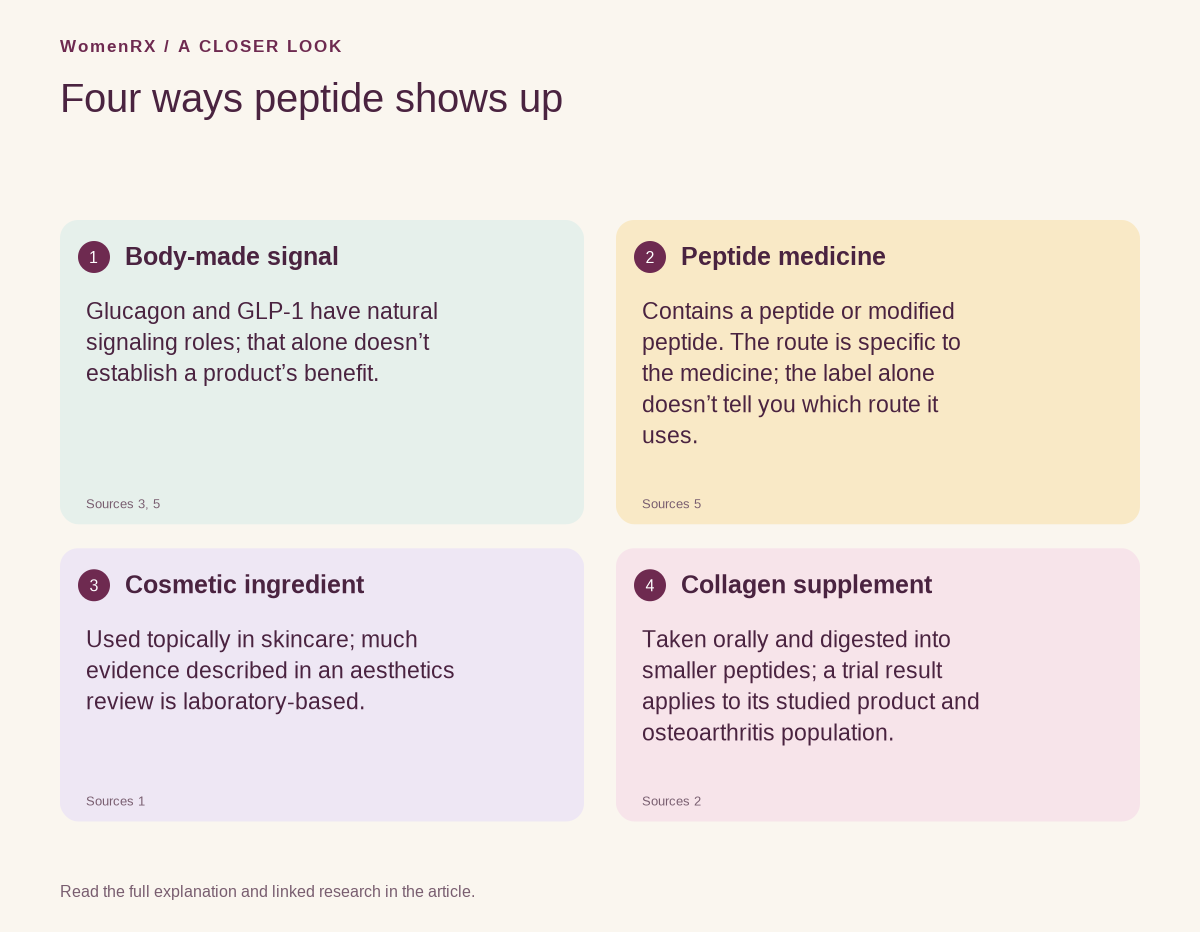
Four ways peptide shows up
Body-made signal: Glucagon and GLP-1 have natural signaling roles; that alone doesn’t establish a product’s benefit.35
Peptide medicine: Contains a peptide or modified peptide. The route is specific to the medicine; the label alone doesn’t tell you which route it uses.5
Cosmetic ingredient: Used topically in skincare; much evidence described in an aesthetics review is laboratory-based.1
Collagen supplement: Taken orally and digested into smaller peptides; a trial result applies to its studied product and osteoarthritis population.2
Read the figure as text
The same label can describe a body-made signal, a medicine, a skincare ingredient, or a protein fragment, with different purposes, routes, and evidence.- Body-made signal: Glucagon and GLP-1 have natural signaling roles; that alone doesn’t establish a product’s benefit.35
- Peptide medicine: Contains a peptide or modified peptide. The route is specific to the medicine; the label alone doesn’t tell you which route it uses.5
- Cosmetic ingredient: Used topically in skincare; much evidence described in an aesthetics review is laboratory-based.1
- Collagen supplement: Taken orally and digested into smaller peptides; a trial result applies to its studied product and osteoarthritis population.2
More questions, answered
Does “naturally occurring” mean a peptide product is safe?
No. A natural role in the body doesn’t establish that a particular product, dose, route, or use is safe or effective. Those questions depend on the specific molecule and evidence for the way it’s used.
Are collagen peptides the same as peptide medicines?
No. Hydrolyzed collagen is a dietary protein broken into smaller fragments during digestion. A peptide medicine is designed or selected for a specific medical action; the shared word doesn’t make the products equivalent. 2 5
Sources you can check
- Peptides in Facial Plastic Surgery: Emerging Applications in Aesthetics and Rejuvenation.Shomorony A, Denton AJ. · Facial plastic surgery : FPS · 2026Return to first citation
- Evaluation of the Efficacy and Safety of CollaSel PRO® Type I and Type III Hydrolyzed Collagen Peptides in the Treatment of Osteoarthritis: A Double-Blind, Placebo-Controlled, Randomized Clinical Trial.Demir-Dora D, Tuna S, Kurtoglu ED, Gursoy S, Balci N, Tezman S, Erenmemisoglu A. · Journal of clinical medicine · 2025Return to first citation
- Engineering Glucagon via Molecular and Formulation Strategies: From Natural Hormone to Effective and Stable Therapeutics.Li X, Wang Y, Chen Z, Tan Z. · Chembiochem : a European journal of chemical biology · 2025Return to first citation
- A narrative review of the calcitonin peptide family and associated receptors as migraine targets: Calcitonin gene-related peptide and beyond.Garelja ML, Hay DL. · Headache · 2022Return to first citation
- Molecular Pharmacology of the Incretin Receptors.Al-Sabah S. · Medical principles and practice : international journal of the Kuwait University, Health Science Centre · 2016Return to first citation
- The roles of parathyroid hormone and calcitonin in bone remodeling: prospects for novel therapeutics.Carter PH, Schipani E. · Endocrine, metabolic & immune disorders drug targets · 2006Return to first citation