Peptides and GLP-1 Medicines Aren’t Opposites
A GLP-1 medicine can be a peptide-based drug, but the word “peptide” alone tells you little about what an online product does or how it was evaluated.
“Peptide” describes a type of molecule. GLP-1 helps regulate appetite and calorie intake; GLP-1 receptor agonist medicines activate its receptor. Semaglutide is a GLP-1 receptor agonist; tirzepatide activates both GLP-1 and GIP receptors. An online product advertised simply as a “peptide” is not automatically equivalent to either medicine. To compare products, you need the exact ingredient, formulation, and approval status, not just the category name.156
The names answer different questions
If you’re comparing a prescribed GLP-1 medicine with something advertised online as a “peptide,” the labels can make them sound like alternatives. They aren’t two separate categories. Peptide describes the molecule’s structure. GLP-1 helps regulate appetite and calorie intake, and a GLP-1 receptor agonist activates its receptor. Peptide-based medicines can have very different targets and uses, so the shared word doesn’t establish a shared effect.157
Semaglutide is a GLP-1 receptor agonist. Tirzepatide is a useful distinction: it activates both the GLP-1 and GIP receptors, rather than being a GLP-1-only agonist. Its U.S. prescribing information describes its peptide structure and dual-receptor action. In everyday conversation, these medicines may get grouped together as “GLP-1s,” but the exact ingredient still matters.15
An ingredient name is only the start of the comparison
An approved medicine has a specific ingredient, formulation, intended use, and prescribing information. For example, the review of semaglutide identifies Ozempic as approved for type 2 diabetes and Wegovy as approved for overweight or obesity. Zepbound’s prescribing information identifies tirzepatide as its ingredient and warns against using it with another tirzepatide-containing product or a GLP-1 receptor agonist.15
A listing that says only “peptide” leaves the central question unanswered: Which molecule is it? Even a listing that names semaglutide or tirzepatide may describe a compounded product rather than the approved medicine. Compounding can fill a need, but a compounded product does not itself go through FDA drug approval. That difference does not prove every compounded product is defective. It does mean the approved medicine’s evidence and product information cannot simply be transferred to every differently made formulation.56
Formulation differences can be substantial. In a search of compounding websites conducted in early 2025, researchers identified products that combined semaglutide or tirzepatide with other ingredients, as well as single-ingredient products offered in sublingual or orally disintegrating forms. The researchers said it had not been established whether the sublingual or orally disintegrating formulations offered advantages over innovator oral tablets. Their website findings describe the products they found, not every compounded product on the market.4
There’s a quality question, too. In laboratory testing of sampled compounded tirzepatide products combined with forms of vitamin B12, researchers found an impurity produced by a chemical reaction between ingredients. The clinical effects of that impurity were unknown. This is a reason not to assume an added ingredient makes a product better, not evidence that all compounded tirzepatide has the same impurity.3
Pregnancy plans make the exact medicine matter, too
The pregnancy instructions aren’t interchangeable. Wegovy’s prescribing information says to stop semaglutide at least two months before a planned pregnancy. For someone using Wegovy for weight reduction, it also says to discontinue it when pregnancy is recognized. Zepbound’s tirzepatide and Saxenda’s liraglutide prescribing information each say to discontinue the medicine when pregnancy is recognized. These are instructions for those named medicines, not a stopping schedule for everything marketed as a peptide.819
There’s another distinction if you use birth control pills: Zepbound’s labeling says tirzepatide may make oral hormonal contraceptives less effective because it delays stomach emptying. It advises using a non-oral method or adding a barrier method for four weeks after starting Zepbound and for four weeks after each dose increase. That warning belongs to tirzepatide’s product information, not to the word “peptide” as a whole.1
What to check before treating two products as interchangeable
Start with the exact ingredient and formulation, not the broad claim on the sales page. Is the product an approved, named medicine, a compounded preparation made with a named ingredient, or something described only as a peptide? If it’s compounded, ask what differs from the approved product, including its other ingredients and how it’s taken. Those differences matter because evidence for one formulation may not answer questions about another.46
Then check whether you’re comparing products intended for the same purpose. A shared receptor target does not make every medicine identical, and tirzepatide’s labeling specifically advises against combining it with another tirzepatide product or a GLP-1 receptor agonist. If you already use one of these medicines, a second product advertised as a peptide is worth identifying before treating it as an add-on.1
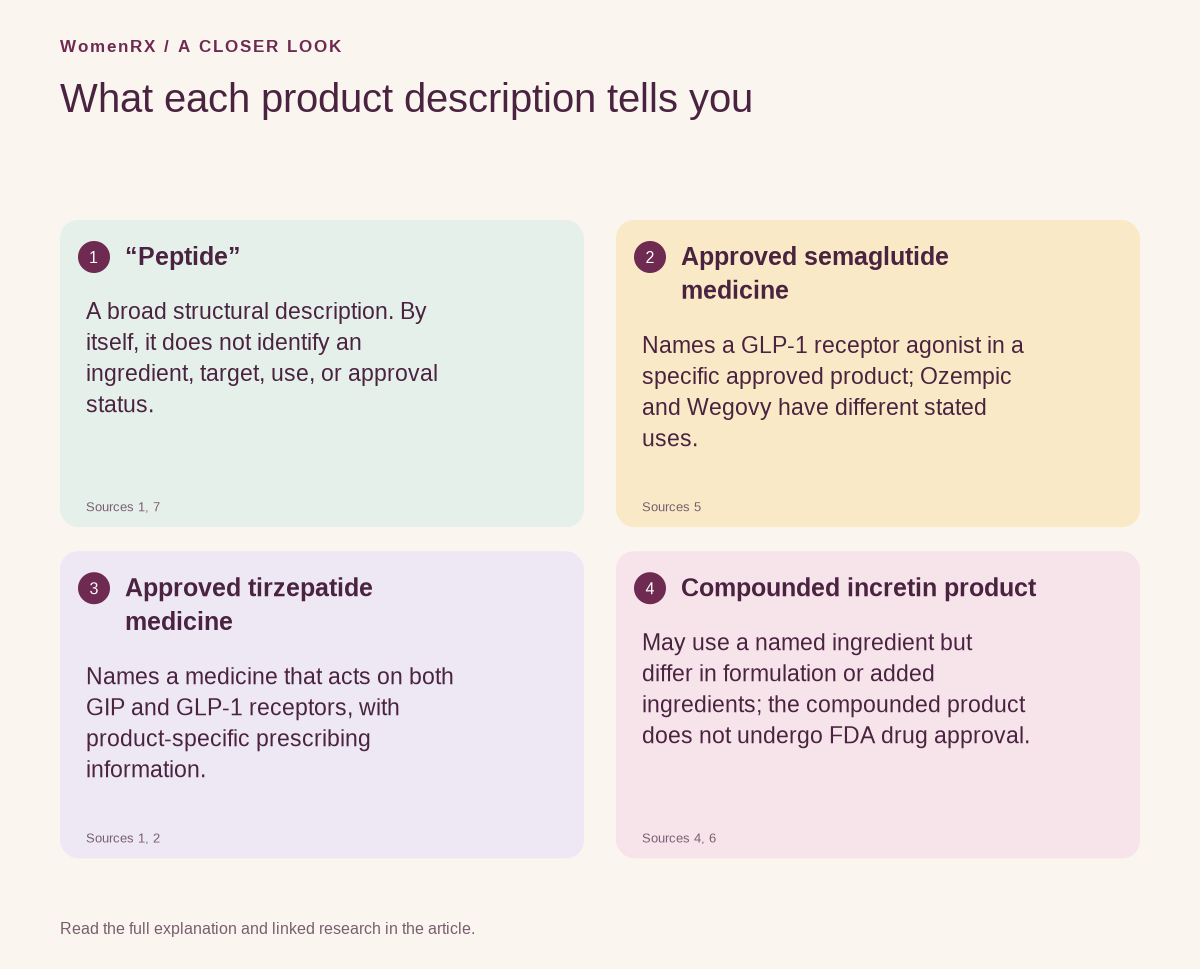
What each product description tells you
“Peptide”: A broad structural description. By itself, it does not identify an ingredient, target, use, or approval status.17
Approved semaglutide medicine: Names a GLP-1 receptor agonist in a specific approved product; Ozempic and Wegovy have different stated uses.5
Approved tirzepatide medicine: Names a medicine that acts on both GIP and GLP-1 receptors, with product-specific prescribing information.12
Compounded incretin product: May use a named ingredient but differ in formulation or added ingredients; the compounded product does not undergo FDA drug approval.46
Read the figure as text
The same broad word can appear alongside products with very different levels of specificity and evaluation.- “Peptide”: A broad structural description. By itself, it does not identify an ingredient, target, use, or approval status.17
- Approved semaglutide medicine: Names a GLP-1 receptor agonist in a specific approved product; Ozempic and Wegovy have different stated uses.5
- Approved tirzepatide medicine: Names a medicine that acts on both GIP and GLP-1 receptors, with product-specific prescribing information.12
- Compounded incretin product: May use a named ingredient but differ in formulation or added ingredients; the compounded product does not undergo FDA drug approval.46
More questions, answered
Is compounded semaglutide the same as an approved semaglutide medicine?
The ingredient name may be the same, but the formulation may not be. Compounded products do not undergo FDA drug approval, and researchers have documented products with added ingredients or different ways of taking them. Evidence for an approved formulation should not be assumed to apply unchanged to those versions.46
Sources you can check
- ZEPBOUND (TIRZEPATIDE) INJECTION, SOLUTION ZEPBOUND (TIRZEPATIDE) INJECTION, SOLUTION ZEPBOUND KWIKPEN (TIRZEPATIDE) INJECTION, SOLUTION [ELI LILLY AND COMPANY] | US prescribing information and patient instructionsAccessed 2026-09-25Return to first citation
- MOUNJARO (TIRZEPATIDE) INJECTION, SOLUTION MOUNJARO KWIKPEN (TIRZEPATIDE) INJECTION, SOLUTION [ELI LILLY AND COMPANY] | US prescribing information and patient instructionsAccessed 2026-09-25Return to first citation
- A novel, widespread impurity in mass-compounded tirzepatide/B12 products: potential patient safety implications.Jordan B, Arbogast L, Clemens M, Huang L, Snyder M. · Expert opinion on drug safety · 2026Return to first citation
- Compounded Semaglutide and Tirzepatide Products Use Unique Formulations but Efficacy and Safety Largely Unknown.Belcourt J, Sapowadia A, White CM. · The Annals of pharmacotherapy · 2026Return to first citation
- Navigating compounded semaglutide: what health care providers need to know.Liu G, Jarema M, Mo M, Stievater T. · The American journal of managed care · 2025Return to first citation
- Compounded incretins in clinical practice: An opinion of the endocrine and metabolism practice and research network of the American College of Clinical Pharmacy.Courtney LA, Clements JN, Isaacs D, Pitlick JM, Reece SM, Whitley HP. · Diabetes & metabolic syndrome · 2025Return to first citation
- FDA-Approved Drugs Containing D-Amino Acids: A Historical and Developmental Perspective.Tran L, Nguyen TD, Gad AG, Shaaban E, Tai TH, Tram NT, Nguyen Khanh Tran H, Le MT, Huy NT. · Drug development research · 2026Return to first citation
- WEGOVY (SEMAGLUTIDE) INJECTION, SOLUTION WEGOVY (SEMAGLUTIDE) TABLET [NOVO NORDISK PHARMACEUTICAL INDUSTRIES, LP] | US prescribing information and patient instructionsAccessed 2026-09-25Return to first citation
- SAXENDA (LIRAGLUTIDE) INJECTION, SOLUTION [NOVO NORDISK PHARMACEUTICAL INDUSTRIES, LP] | US prescribing information and patient instructionsAccessed 2026-09-25Return to first citation