Do GLP-1 Weight-Loss Medicines Work Differently by Sex?
One tirzepatide trial found numerically larger weight-loss estimates for women, but that isn’t proof women respond better.
There’s a hint of a difference, not a settled conclusion. In a Japanese trial subgroup, women had numerically larger estimated weight-loss effects with tirzepatide than men, but the analysis described responses as generally similar and doesn’t establish that the sex difference was statistically meaningful. A broader review found a pattern in female-dominant study groups, which can’t tell us how an individual woman compares with an individual man. 2 1
The short answer: a signal, not a rule
Some trial analyses report larger average weight-loss estimates for women than men. The clearest sex-disaggregated example in the findings discussed here comes from tirzepatide, a medicine that acts on both GIP and GLP-1 receptors. The results point to a possible difference, but they don’t show that women generally lose more weight than men on these medicines. 2
That distinction matters. A difference between two subgroup estimates is not, by itself, proof that sex caused the difference. To support that conclusion, researchers need to test whether treatment effects differ between groups, often with a sex-by-treatment interaction analysis. The SURMOUNT-J report describes weight reduction as generally similar across subgroups and gives numerically larger estimates for women; the reported findings don’t establish a statistically meaningful sex-by-treatment difference. 2
What one tirzepatide subgroup found
SURMOUNT-J was a randomized, placebo-controlled trial in 225 Japanese adults with obesity disease and without diabetes. In a prespecified subgroup analysis, estimated treatment differences in percent body weight at week 72 were numerically larger for females than males: −17.5% versus −15.1% with tirzepatide 10 mg, and −24.9% versus −18.1% with 15 mg. These are estimates comparing treatment with placebo within each sex subgroup, not a guarantee of what any one person will lose. 2
The same report says weight reduction was generally similar across subgroups. The overall study was relatively small, and the reported findings don’t establish that the difference between the female and male estimates was statistically significant. The participants were Japanese adults without diabetes, so those estimates don’t automatically apply to people with diabetes or to every population taking tirzepatide. 2
Why a study-level pattern isn’t a women-versus-men answer
A 2025 network meta-analysis included 19 randomized trials and 29,506 adults with overweight or obesity. Its meta-regression reported greater weight-loss outcomes in female-dominant study cohorts. That is a pattern across groups of studies, not a comparison of individual women and men randomly assigned within the same trial. Cohorts can differ in more than sex, so this finding is suggestive rather than a direct test of whether women respond differently. 1
The distinction is practical: “female-dominant studies had larger outcomes” doesn’t mean “a woman can expect to lose more than a man taking the same medicine.” And it doesn’t identify a biological explanation. These analyses report sex categories; they don’t tell us how gender-related circumstances, such as differences in treatment access or daily life, affect weight-loss outcomes.
Don’t carry one result across medicines
Tirzepatide’s subgroup estimates shouldn’t be treated as estimates for semaglutide or liraglutide. The network meta-analysis included several medicines, but its abstract-level finding about female-dominant cohorts doesn’t provide a drug-by-drug, individual-level comparison between women and men. The sex-specific result described above is from a particular tirzepatide trial in Japanese adults without diabetes. 1 2
So far, the useful takeaway is modest: sex-disaggregated findings are worth studying, but these results don’t establish a reliable average advantage for women across GLP-1 medicines. They also can’t predict an individual response. The study, medicine, diabetes status, and how the subgroup analysis was done all matter when interpreting a difference.
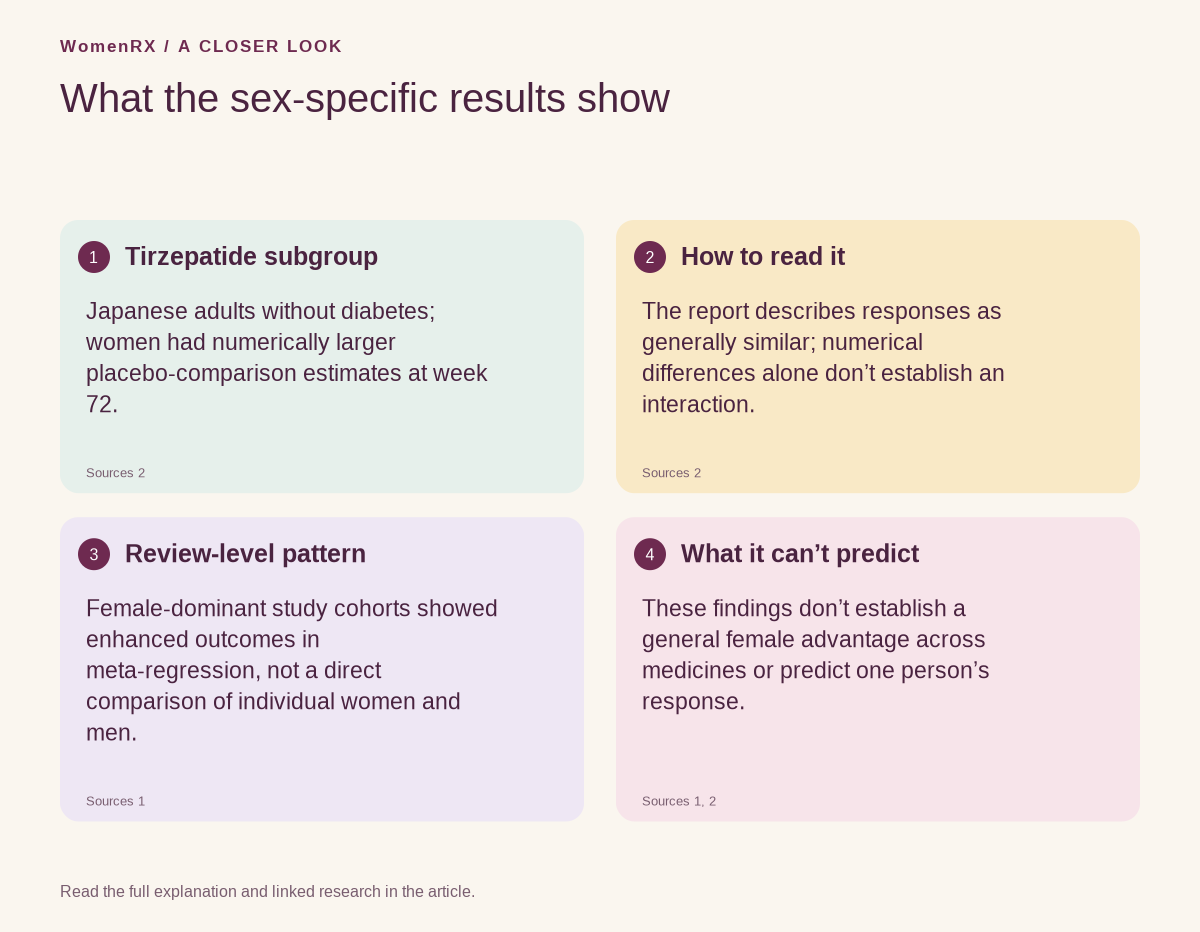
What the sex-specific results show
Tirzepatide subgroup: Japanese adults without diabetes; women had numerically larger placebo-comparison estimates at week 72.2
How to read it: The report describes responses as generally similar; numerical differences alone don’t establish an interaction.2
Review-level pattern: Female-dominant study cohorts showed enhanced outcomes in meta-regression, not a direct comparison of individual women and men.1
What it can’t predict: These findings don’t establish a general female advantage across medicines or predict one person’s response.12
Read the figure as text
These findings offer different kinds of clues. A subgroup estimate, a pattern across study cohorts, and proof of a treatment difference are not interchangeable.- Tirzepatide subgroup: Japanese adults without diabetes; women had numerically larger placebo-comparison estimates at week 72.2
- How to read it: The report describes responses as generally similar; numerical differences alone don’t establish an interaction.2
- Review-level pattern: Female-dominant study cohorts showed enhanced outcomes in meta-regression, not a direct comparison of individual women and men.1
- What it can’t predict: These findings don’t establish a general female advantage across medicines or predict one person’s response.12
More questions, answered
Does this mean a woman should expect to lose more than a man?
No. The tirzepatide subgroup estimates were numerically larger for women in one Japanese trial, but the report described weight reduction as generally similar across subgroups. Those group averages don’t predict what a particular person will lose. 2
Are sex and gender the same in these trial results?
No. The reported subgroup analyses compare female and male categories. They don’t assess gender-related factors or show whether those factors influence treatment outcomes. 1 2
Sources you can check
- Efficacy and Safety of GLP-1 Receptor Agonists, Dual Agonists, and Retatrutide for Weight Loss in Adults With Overweight or Obesity: A Bayesian NMA.Sinha B, Ghosal S. · Obesity (Silver Spring, Md.) · 2025Return to first citation
- Association of baseline characteristics with clinical outcomes of tirzepatide treatment in Japanese patients with obesity disease: A subgroup analysis of the SURMOUNT-J trial.Yokote K, Fukushima Y, Shingaki T, Oura T, Ogawa W. · Diabetes, obesity & metabolism · 2026Return to first citation