GLP-1 Medicines and Depression: What a Mood Change Means
A new mood symptom deserves attention, even though current studies do not show that GLP-1 medicines cause depression.
If your mood changes while taking a GLP-1 medicine, tell your prescriber and seek mental-health support rather than trying to decide on your own whether the medicine caused it. Studies have found mixed results for depression, and a reported event does not establish a drug effect. 356 If you’re thinking about suicide, call or text 988; in a life-threatening situation, call 911. 7
What the research is actually measuring
“Depression risk” can mean several different things: a new depression diagnosis, worsening symptoms in someone already being treated, or a report of suicidal thoughts. Those outcomes shouldn’t be treated as interchangeable. And when a mood change starts during treatment, the timing matters, but timing alone can’t tell you its cause.
Reports of suicidal thoughts have prompted researchers to examine individual GLP-1 medicines. A systematic review found reporting signals involving liraglutide and semaglutide, but concluded that the reports did not establish causation. A reporting signal shows that an event was reported in connection with a medicine, not how often it occurs among everyone taking that medicine or whether the medicine caused it. The review’s findings aren’t a sound basis for ranking medicines by psychiatric safety. 4
Studies comparing people who start different diabetes medicines offer another view. In one large electronic-record study, people starting GLP-1 medicines had more recorded depression diagnoses than people starting SGLT2 inhibitors or DPP-4 inhibitors, but not more than people starting sulfonylureas. A separate Korean study also found more depression diagnoses compared with SGLT2 inhibitors, but no increase compared with DPP-4 inhibitors. These are observational comparisons: they can identify associations, but differences between the groups may still affect the results. Neither study establishes that a GLP-1 medicine caused depression. 36
Other findings are less concerning. A study using Swedish and Danish records, mostly from people with type 2 diabetes, found no clear increase in newly recorded depression or anxiety disorders among GLP-1 users compared with SGLT2-inhibitor users. It also did not establish an increased risk of suicide death, though that outcome was rare and the estimate was imprecise. About 45% of GLP-1 users were women; the reported results do not give a women-specific mood-risk estimate. 5
If you already live with depression
Having depression does not, by itself, answer what will happen to your mood on a GLP-1 medicine. In a one-year electronic-record study of people with type 2 diabetes who had recently received antidepressant treatment, those starting a GLP-1 medicine did not have a higher recorded risk of suicidality than those starting an SGLT2 inhibitor. That finding addresses a specific group and outcome. It doesn’t promise that any one person’s symptoms will stay the same or show that GLP-1 medicines treat depression. 2
If you notice a change, give both your prescriber and any clinician treating your mental health a clear picture of what’s happening. For example, you might describe when the change began relative to starting the medicine, whether you’re losing interest in things you usually enjoy, how sleep and daily activities have changed, and whether anything else in your health or life changed around the same time. Depression can have multiple contributors, including other medical conditions and medicines. You don’t need to identify the cause before asking for help. 1
A low mood that persists or makes ordinary activities difficult deserves an assessment. Major depression can involve depressed mood or loss of interest that affects daily life for at least two weeks, but that diagnostic timeframe is not a reason to wait two weeks before reaching out. 1
Pregnancy and postpartum need their own attention
The studies above do not answer whether GLP-1-related mood outcomes differ by sex or during pregnancy or the postpartum period. Mood symptoms in these stages also have their own possible context: depression can occur during pregnancy or after childbirth, and postpartum depression may begin at any time in the first year after birth. Don’t assume a new symptom is simply a medicine effect, or dismiss it as an expected part of having a baby. 78
After childbirth, brief “baby blues” often pass within days to a week; postpartum depression is more intense and lasts longer. If sadness, anxiety, or loss of interest is making it hard to care for yourself or your baby, reach out for care. If you’re thinking of harming yourself or your baby, get help right away: call 911 or go to an emergency department. 8
At any stage of life, thoughts of suicide deserve immediate support. In the US, call or text 988 or use 988lifeline.org. Call 911 in a life-threatening situation. You do not have to prove a connection to your medication before getting help. 7
Four different mood questions
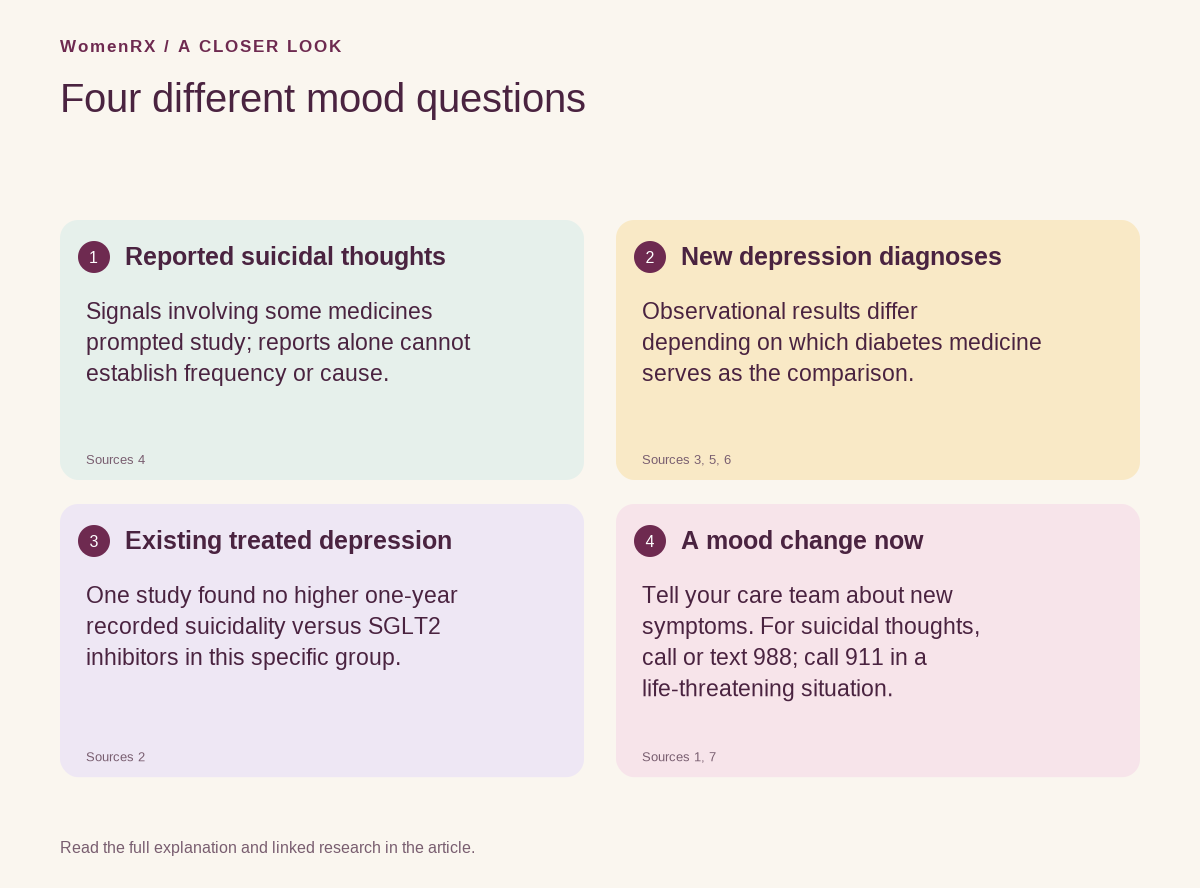
Reported suicidal thoughts: Signals involving some medicines prompted study; reports alone cannot establish frequency or cause.4
New depression diagnoses: Observational results differ depending on which diabetes medicine serves as the comparison.356
Existing treated depression: One study found no higher one-year recorded suicidality versus SGLT2 inhibitors in this specific group.2
A mood change now: Tell your care team about new symptoms. For suicidal thoughts, call or text 988; call 911 in a life-threatening situation.17
Read the figure as text
These findings answer different questions, so one result cannot stand in for another.- Reported suicidal thoughts: Signals involving some medicines prompted study; reports alone cannot establish frequency or cause.4
- New depression diagnoses: Observational results differ depending on which diabetes medicine serves as the comparison.356
- Existing treated depression: One study found no higher one-year recorded suicidality versus SGLT2 inhibitors in this specific group.2
- A mood change now: Tell your care team about new symptoms. For suicidal thoughts, call or text 988; call 911 in a life-threatening situation.17
More questions, answered
Does a depression diagnosis mean I can’t take a GLP-1 medicine?
The study of people with type 2 diabetes and recently treated depression did not find higher one-year recorded suicidality after starting a GLP-1 medicine than after starting an SGLT2 inhibitor. It cannot predict your individual response, so discuss your current symptoms and treatment with your prescriber. 2
Sources you can check
- Depression: MedlinePlusAccessed 2026-09-25Return to first citation
- Risk of Psychiatric Worsening With GLP-1 Receptor Agonist Use in Patients With Type 2 Diabetes and Treated Depression.Chang Y, Hsieh MH, Ju PC, Chang CC. · Diabetes, obesity & metabolism · 2026Return to first citation
- Association of glucagon-like peptide-1 receptor agonist use with anxiety disorders, depression, self-harm, and suicidality: a large cohort study.Anagnostakis F, Kokkorakis M, Anastasiou G, Nagarajan S, Mantzoros CS. · Diabetes research and clinical practice · 2026Return to first citation
- Association of Glucagon-Like Peptide-1 Receptor Agonists and Suicidality: A Systematic Review.Au HCT, Zheng YJ, Le GH, Wong S, Teopiz KM, Kwan ATH, Rosenblat JD, Mansur RB, Choi H, McIntyre RS. · Obesity reviews : an official journal of the International Association for the Study of Obesity · 2026Return to first citation
- GLP-1 Receptor Agonist Use and Risk of Suicide Death.Ueda P, Söderling J, Wintzell V, Svanström H, Pazzagli L, Eliasson B, Melbye M, Hviid A, Pasternak B. · JAMA internal medicine · 2024Return to first citation
- Glucagon-Like Peptide-1 Receptor Agonists and Risk of Mental Health Disorders in Type 2 Diabetes: Active Comparator, New User Cohort Study.Kim C, Kim S, Lee DY, Han E, Lee YH, You SC. · Diabetes, obesity & metabolism · 2026Return to first citation
- Depression in Women: 4 Things to Know - National Institute of Mental Health (NIMH)Accessed 2026-09-25Return to first citation
- Postpartum Depression: MedlinePlusAccessed 2026-09-25Return to first citation