GLP-1 Medicines and Bone Health After Menopause
Bone-density findings are mixed, and none yet proves that these medicines prevent or cause fractures after menopause.
For postmenopausal women, the evidence is not settled. A review of randomized trials in people with type 2 diabetes found better average bone-density measurements with GLP-1 receptor agonists, but no clear difference in fractures. A small semaglutide pilot in older adults found no significant bone changes over 20 weeks. Neither result establishes long-term effects specifically after menopause. 34
The short version: promising signals, no firm answer
There isn't enough evidence to say that GLP-1 medicines protect bone or cause osteoporosis after menopause. Studies have measured different things: bone mineral density (BMD), bone-turnover markers, and fractures. Those outcomes aren't interchangeable. A change in a scan or blood marker doesn't, by itself, show whether someone will break a bone. BMD estimates how much mineral is in bone; lower density can mean weaker bones, while fractures are the outcome that directly reflects a break. 12
A review of randomized trials in people with type 2 diabetes found no statistically clear increase in fractures with GLP-1 receptor agonists: the pooled relative risk was 0.80, with a confidence interval from 0.47 to 1.36. That range includes both a possible reduction and a possible increase, so it doesn't establish protection or rule out harm. The same review reported better average BMD measurements at several sites than in control groups. Those findings are encouraging, but they don't settle what happens to fracture risk over time. 3
Why the studies don't give one simple verdict
The studies don't all answer the same question. In the review of 25 studies among people with type 2 diabetes, average BMD and some bone-turnover measures improved, while fracture risk did not differ clearly. A post hoc analysis of a small 20-week semaglutide pilot in older adults with overweight or obesity and prediabetes or diabetes found no significant difference in whole-body BMD or two turnover markers compared with lifestyle counseling alone. Only half of that pilot's 20 participants were women, and its abstract provides no postmenopausal subgroup results. Its short duration and small size limit what it can tell us about fractures or longer-term change. 34
A separate retrospective study offers a different kind of signal. It compared matched groups of women over 50 who already had osteoporosis and found vertebral fractures in about 1.9% of those with GLP-1 receptor agonist exposure versus 4.3% of those without it during the study period. This is an association in health-record data, not a randomized test. It can't show that the medicine caused the difference, and it doesn't establish the effect for all postmenopausal women or for people without diagnosed osteoporosis. 5
Taken together, the evidence doesn't justify treating GLP-1 medicines as either bone-protective or bone-damaging. It also doesn't establish that results for the class apply equally to each medicine. The studies summarized here do not provide a clear, long-term answer specifically for postmenopausal women taking semaglutide or tirzepatide. 345
Separate the medicine question from the weight-loss question
A person's bone health during treatment may involve more than the medicine itself. Weight loss in older adults has been associated in prior observational studies and lifestyle interventions with lower BMD and higher fracture risk; that doesn't prove the same effect for every person losing weight on a GLP-1 medicine. It does give a reason to consider the pace and circumstances of weight loss separately from a drug's direct effect on bone. 4
If reduced appetite makes it harder to eat a varied diet, that's a practical issue to raise, rather than proof that the medicine has weakened your bones. Bone health also involves factors such as age and physical activity. Weight-bearing activity, along with getting enough calcium and vitamin D, is among the measures MedlinePlus identifies for helping lower fracture risk. 12
What to bring into the conversation
A useful discussion starts with your own risk, not a blanket verdict on the medication. You might ask:
- How does my bone history affect this decision? Mention any prior fracture or diagnosis of low bone density or osteoporosis. A bone-density scan can show whether density is low or in the osteoporosis range. 1
- Do I need a bone-density assessment? Ask whether a scan makes sense in light of your age and history, rather than assuming that everyone taking a GLP-1 medicine needs one. 1
- Is weight loss affecting how I eat or move? If it is harder to eat well or stay active, discuss practical ways to address that alongside your treatment plan. Physical activity, including weight-bearing activity, is relevant to fracture prevention. 2
- How should we follow my bone health over time? Ask what changes in your personal risk, symptoms, or scan results would prompt a closer look. A scan measures density; it can't alone answer whether a medicine changed your fracture risk. 12
The balanced takeaway is that current results are not a reason to assume your bones are being harmed, or protected. If bone health is a concern, consider your menopause-related history, existing fracture risk, and the effects of weight loss together, while recognizing that the direct evidence in postmenopausal women remains limited.
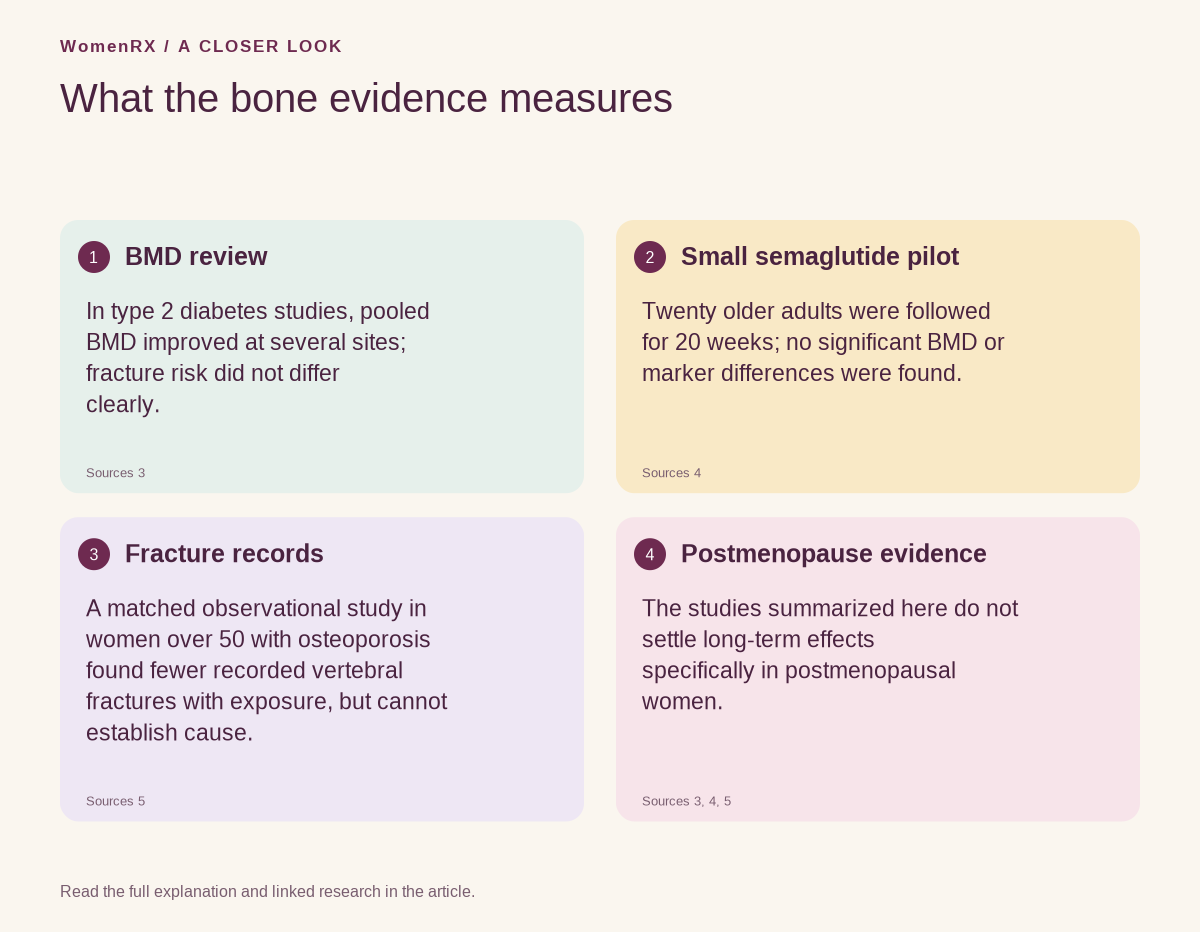
What the bone evidence measures
BMD review: In type 2 diabetes studies, pooled BMD improved at several sites; fracture risk did not differ clearly.3
Small semaglutide pilot: Twenty older adults were followed for 20 weeks; no significant BMD or marker differences were found.4
Fracture records: A matched observational study in women over 50 with osteoporosis found fewer recorded vertebral fractures with exposure, but cannot establish cause.5
Postmenopause evidence: The studies summarized here do not settle long-term effects specifically in postmenopausal women.345
Read the figure as text
These findings come from different populations and study designs, and they measure outcomes that should not be treated as interchangeable.- BMD review: In type 2 diabetes studies, pooled BMD improved at several sites; fracture risk did not differ clearly.3
- Small semaglutide pilot: Twenty older adults were followed for 20 weeks; no significant BMD or marker differences were found.4
- Fracture records: A matched observational study in women over 50 with osteoporosis found fewer recorded vertebral fractures with exposure, but cannot establish cause.5
- Postmenopause evidence: The studies summarized here do not settle long-term effects specifically in postmenopausal women.345
More questions, answered
Does a better bone-density result mean fewer fractures?
Not necessarily. BMD is a measure of bone mineral, while a fracture is an actual break. The GLP-1 trial review found better average BMD at several sites but no statistically clear difference in fractures, so the scan findings don't prove fracture prevention. 13
Does the evidence apply specifically to tirzepatide?
The findings summarized here concern GLP-1 receptor agonists as a group and don't establish a long-term, postmenopausal bone effect for tirzepatide specifically. Ask about evidence for the particular medicine you're taking or considering. 345
Sources you can check
- Bone Density | Bone Mineral Density | BMD | MedlinePlusAccessed 2026-09-25Return to first citation
- Fracture | MedlinePlusAccessed 2026-09-25Return to first citation
- Effect of GLP-1 receptor agonists on bone mineral density, bone metabolism markers, and fracture risk in type 2 diabetes: a systematic review and meta-analysis.Tan Y, Liu S, Tang Q. · Acta diabetologica · 2025Return to first citation
- Bone mineral density and turnover response to GLP-1 receptor agonists in older adults with overweight/obesity and prediabetes/type 2 diabetes: a 20-week pilot trial post hoc analysis.Dinkla L, Beavers KM, Robbins R, Akpalu D, Wherry SJ, Miller G, Beavers DP, Espinoza S, Trejo J, Stepanenko A, Cortes TM. · Frontiers in aging · 2025Return to first citation
- Investigating the Relationship Between Glucagon-Like Peptide-1 Receptor Agonist Use and Incidence of Vertebral Fractures in Female Patients Aged Over 50 Years With Osteoporosis: A Propensity-Matched Analysis.Stump K, Kelleher S, Aynaszyan S, Ricci S, Pazionis T. · Clinical spine surgery · 2026Return to first citation