Vaginal Dryness and GLP-1 Medicines: What’s Known
A direct link hasn’t been established; when dryness starts and what else is happening can point to more useful explanations.
Semaglutide prescribing information describes gastrointestinal effects and dehydration-related concerns, but doesn’t establish a vaginal-dryness mechanism. A retrospective diabetes cohort reported genitourinary symptoms with SGLT2 inhibitors, a different medicine class, but no specific GLP-1-associated vaginal-dryness outcome. That doesn’t rule out a link. Menopause and other hormone changes are recognized causes; fluid loss from vomiting or diarrhea doesn’t, by itself, explain vaginal dryness. 1 2 3 4
A change in vaginal comfort after starting a GLP-1 medicine can feel connected, especially if it began around the same time. But timing alone can’t show that the medicine caused it. Semaglutide prescribing information describes gastrointestinal effects, while a retrospective diabetes cohort did not report a specific GLP-1-associated vaginal-dryness outcome. 2 3 4
One retrospective study reported genital itching and urinary tract infections in people taking SGLT2 inhibitors, a different class of diabetes medicines. It didn’t report a specific finding linking a GLP-1 medicine to vaginal dryness. Genitourinary symptoms are a broad category, not proof of a particular cause. 4
When dehydration may be part of the picture
Some GLP-1 medicines can cause gastrointestinal effects such as nausea, vomiting, or diarrhea. Semaglutide prescribing information also describes dehydration related to gastrointestinal symptoms and reports of acute kidney injury in that context. These facts make fluid loss worth mentioning if you’ve had persistent vomiting or diarrhea. They don’t establish that dehydration causes vaginal dryness, or that a GLP-1 medicine directly affects vaginal tissues. 2 3
If dryness began during a stretch of gastrointestinal symptoms, share both timelines with your prescriber and mention any concerns about the medicine.
Other causes can fit better
Menopause can change hormone levels and reduce vaginal moisture. Dryness can also happen when you aren’t aroused during sex, or alongside conditions such as diabetes or Sjögren’s syndrome. Cancer treatments that affect hormone levels are another recognized cause. These possibilities can matter at different ages, so dryness isn’t automatically a sign of menopause. 1
The pattern may help frame the conversation: for example, dryness around a menopause transition raises a different question from dryness that appears with itching, unusual discharge, or recurring urinary symptoms. Those details don’t diagnose the cause, but they can help a clinician decide what to assess.
What to discuss and what may help
Make a short timeline: when the dryness started, when you began or changed a medicine, and whether you’ve also had gastrointestinal symptoms, menstrual or menopause-related changes, pain with sex, itching, discharge, or urinary symptoms. Mention other medicines and health conditions too. The goal is to assess the whole pattern, not to assume the GLP-1 medicine is responsible.
For symptom relief, water-based lubricant before sex and vaginal moisturizer are options described for dryness. Avoiding perfumed washes around the vagina may also help. If hormone changes appear to be the cause, ask whether an estrogen-containing treatment is suitable for you; treatment options differ, and hormonal treatment isn’t right for everyone. 1
Arrange an assessment if dryness lasts for weeks despite self-care or affects daily life. Unusual discharge or bleeding after sex, between periods, or after menopause also warrants discussion with a clinician. 1
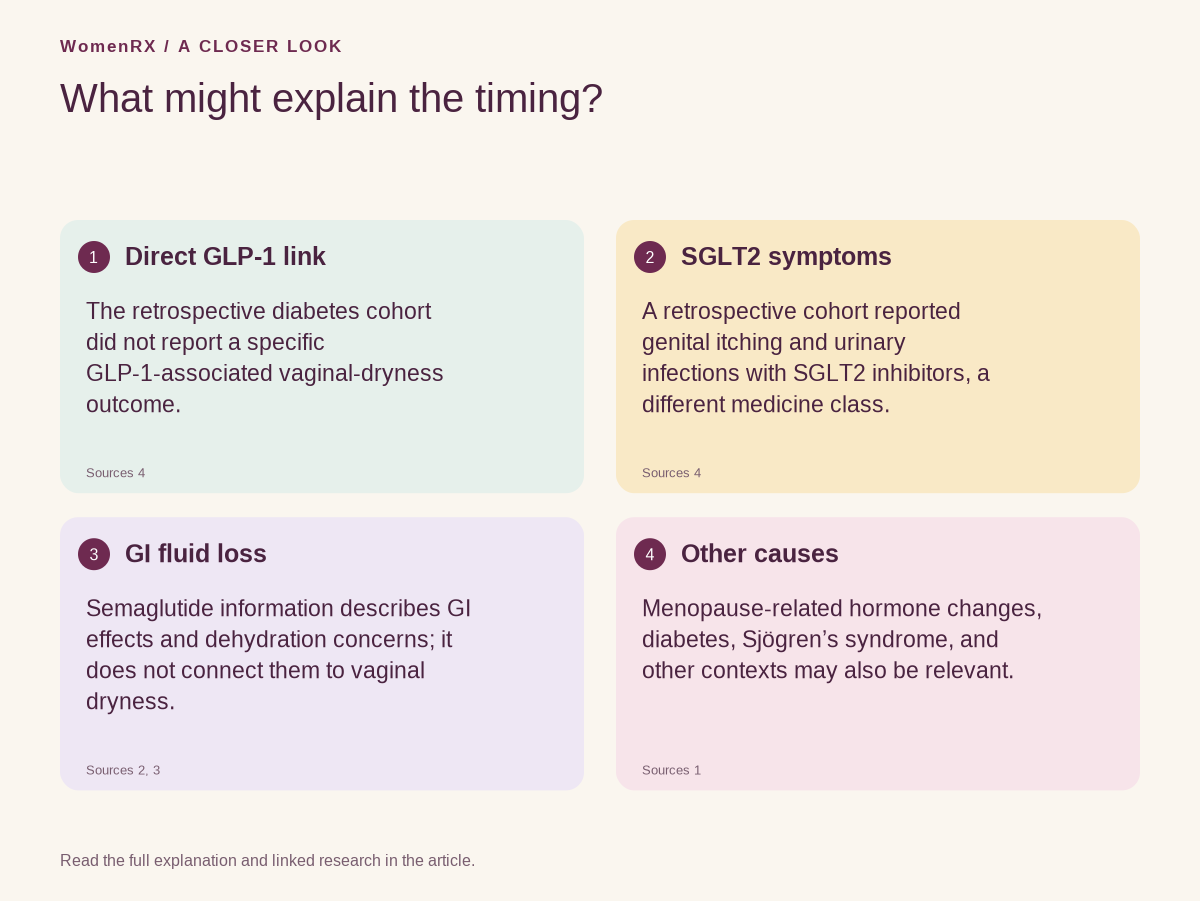
What might explain the timing?
Direct GLP-1 link: The retrospective diabetes cohort did not report a specific GLP-1-associated vaginal-dryness outcome.4
SGLT2 symptoms: A retrospective cohort reported genital itching and urinary infections with SGLT2 inhibitors, a different medicine class.4
GI fluid loss: Semaglutide information describes GI effects and dehydration concerns; it does not connect them to vaginal dryness.23
Other causes: Menopause-related hormone changes, diabetes, Sjögren’s syndrome, and other contexts may also be relevant.1
Read the figure as text
These distinctions separate a demonstrated finding from possible context and recognized alternative causes.- Direct GLP-1 link: The retrospective diabetes cohort did not report a specific GLP-1-associated vaginal-dryness outcome.4
- SGLT2 symptoms: A retrospective cohort reported genital itching and urinary infections with SGLT2 inhibitors, a different medicine class.4
- GI fluid loss: Semaglutide information describes GI effects and dehydration concerns; it does not connect them to vaginal dryness.23
- Other causes: Menopause-related hormone changes, diabetes, Sjögren’s syndrome, and other contexts may also be relevant.1
More questions, answered
Should I stop my GLP-1 medicine if dryness starts?
Dryness starting after a medicine isn’t enough to establish that the medicine caused it. Tell your prescriber when it began and raise any concerns about the medicine while discussing possible explanations.
Sources you can check
- Vaginal dryness - NHSAccessed 2026-09-25Return to first citation
- WEGOVY (SEMAGLUTIDE) INJECTION, SOLUTION WEGOVY (SEMAGLUTIDE) TABLET [NOVO NORDISK PHARMACEUTICAL INDUSTRIES, LP] | US prescribing information and patient instructionsAccessed 2026-09-25Return to first citation
- OZEMPIC (ORAL SEMAGLUTIDE) TABLET RYBELSUS (ORAL SEMAGLUTIDE) TABLET [NOVO NORDISK PHARMACEUTICAL INDUSTRIES, LP] | US prescribing information and patient instructionsAccessed 2026-09-25Return to first citation
- Real-World Evidence of the GLP-1RA/SGLT2-i Therapy versus Standard Care: A Retrospective Cohort Study.Mahmoud NM, Hussein A, Mussa BM, Abusnana S. · Clinical medicine insights. Endocrinology and diabetes · 2026Return to first citation