Libido Changes on GLP-1 Medicines: What Is Known and What to Check
A change in desire during treatment is worth taking seriously, but current research can’t tell us whether GLP-1 medicines directly cause it in women.
There isn’t enough systematic human research to establish whether semaglutide, tirzepatide, or other GLP-1 medicines reliably raise or lower women’s sexual desire. Reviews describe possible effects, but much of the concern rests on theory, case reports, and animal studies. If desire changed after treatment began, note the timing and other changes too, then discuss the pattern with your prescriber without assuming the medicine is the only explanation. 3 5
What the evidence can, and can’t, tell you
If your desire changed after starting a GLP-1 medicine, the timing is worth paying attention to. It doesn’t, by itself, prove the medicine caused the change. Current research doesn’t establish a reliable increase or decrease in sexual desire among women taking semaglutide, tirzepatide, or other GLP-1 medicines.
A 2026 narrative review focused on midlife women describes sexual effects as largely uncharacterized and says systematic clinical evidence is limited. Another review proposes that GLP-1 activity could affect reward pathways involved in desire, but presents this as a theoretical model, not a demonstrated treatment effect. The evidence described in these reviews does not establish how common libido changes are or who is more likely to experience them. 3 5
There is a relevant animal finding, but it can’t answer what happens to women taking these medicines. In a study of female rats and mice, certain GLP-1 medicines reduced some sexual behaviors; the effects differed by drug and species. Animal behavior isn’t a measure of human desire, and these results don’t establish a class effect in women. 4
Desire can shift through more than one pathway
Sexual desire is part of a broader picture of sexual health, which can be affected by medicines and health conditions as well as personal circumstances. A change that begins during treatment could have more than one contributor, and the timing can help frame the conversation without settling the cause. 1 3
One review suggests that possible medication-related influences could be offset or mixed with other changes, including mood and physical effects. It also discusses proposed brain-signaling mechanisms. These are hypotheses from a review, not proof that GLP-1 medicines suppress desire in women. 5
Weight and metabolic changes may also happen alongside changes in how you feel about your body or your health. It’s tempting to assume those changes will automatically raise desire, but that isn’t established either. The review focused on midlife women describes the overall effects of GLP-1 treatment on female sexual function as largely uncharacterized. 3
Look at the timeline, not just the prescription
A simple way to make sense of the change is to compare what was happening before treatment with what’s happening now. You might jot down when the change began, whether it varies over time, and what else changed around then. Include changes in other medicines, mood, relationship circumstances, or general health. These are context to consider, not proof of a particular cause.
Life stage matters as context, too. If you’re in the menopause transition or are postpartum, mention that; those details can help make the timeline clearer, but they don’t automatically explain a change in desire. The midlife-women review emphasizes that menopause-related and psychosocial factors can intersect with sexual health, while the wider effects of GLP-1 medicines remain uncertain. 3
If sex is painful, mention that specifically rather than describing only a drop in desire. You can also share whether mood has changed and whether you’re taking an antidepressant: SSRIs and SNRIs can have reduced sex drive among their possible side effects. Don’t assume one factor is responsible just because it fits the timing. 2
What to bring into a medication conversation
Tell your prescriber when the change started in relation to treatment, what else changed, and whether the concern is desire, arousal, pain, or more than one of these. If you take other medicines, bring their names or a current medication list. MedlinePlus identifies medicines and chronic health conditions as factors that can affect sexual health. 1
Ask whether any other recent health or medication changes could be contributing, and how to follow the change while continuing to address the reason you started treatment. The available research doesn’t support assuming that a libido change is a proven class effect, or that weight loss will improve desire. It does support treating your experience as worth discussing rather than dismissing it or assigning it a cause too soon. 3 5
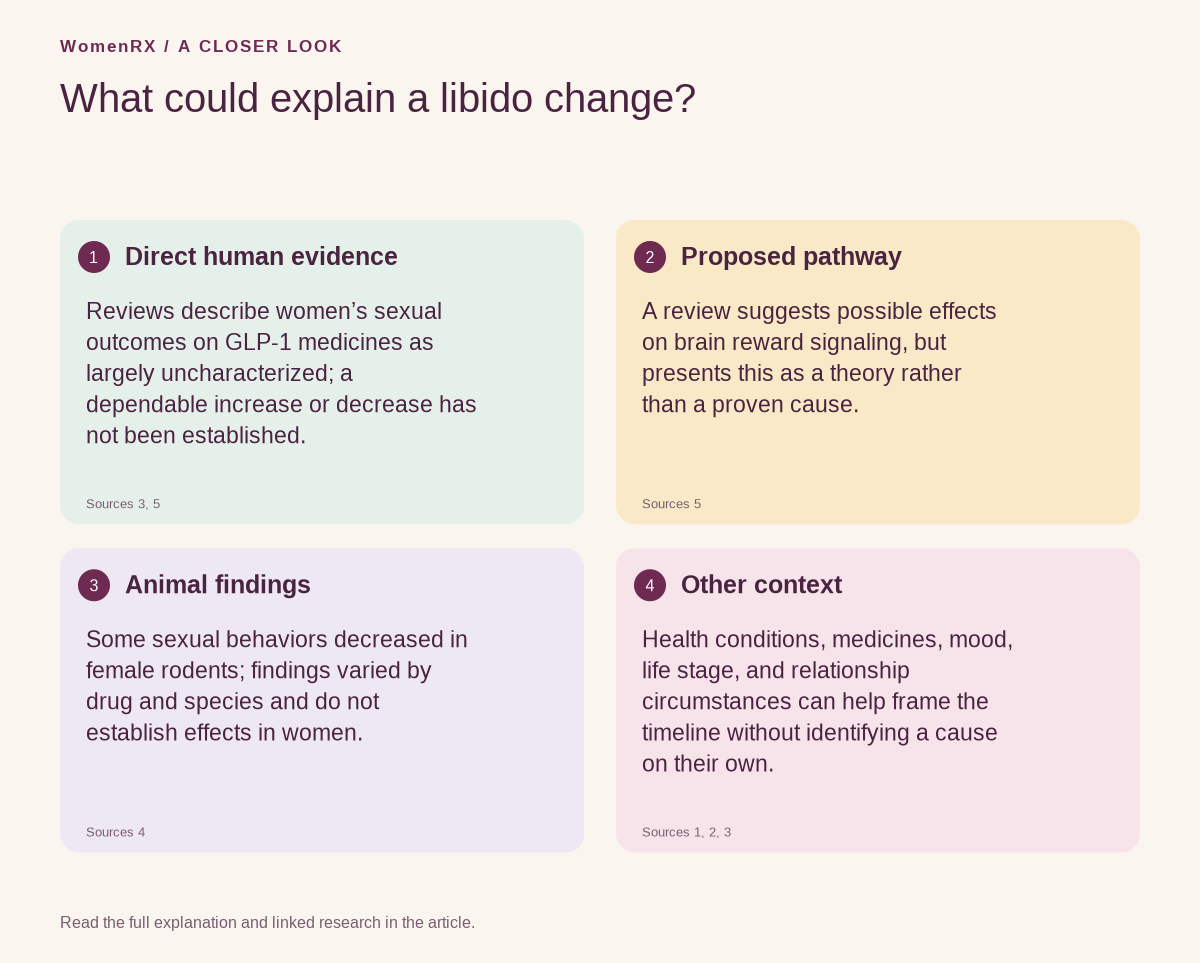
What could explain a libido change?
Direct human evidence: Reviews describe women’s sexual outcomes on GLP-1 medicines as largely uncharacterized; a dependable increase or decrease has not been established.35
Proposed pathway: A review suggests possible effects on brain reward signaling, but presents this as a theory rather than a proven cause.5
Animal findings: Some sexual behaviors decreased in female rodents; findings varied by drug and species and do not establish effects in women.4
Other context: Health conditions, medicines, mood, life stage, and relationship circumstances can help frame the timeline without identifying a cause on their own.123
Read the figure as text
Separate the limited direct medication evidence from possible pathways and other context worth mentioning.- Direct human evidence: Reviews describe women’s sexual outcomes on GLP-1 medicines as largely uncharacterized; a dependable increase or decrease has not been established.35
- Proposed pathway: A review suggests possible effects on brain reward signaling, but presents this as a theory rather than a proven cause.5
- Animal findings: Some sexual behaviors decreased in female rodents; findings varied by drug and species and do not establish effects in women.4
- Other context: Health conditions, medicines, mood, life stage, and relationship circumstances can help frame the timeline without identifying a cause on their own.123
More questions, answered
Does lower desire mean the medicine is causing it?
Not necessarily. A change that follows treatment is useful to report, but timing alone doesn’t establish cause. Reviews say women’s sexual outcomes have not been studied systematically enough to confirm a dependable medication effect. 3 5
Could menopause or another medicine be part of the picture?
They’re useful context to bring up, not automatic explanations. Sexual health can be affected by medicines and health conditions, and SSRIs and SNRIs can have reduced sex drive among their possible side effects. 1 2
Sources you can check
- Sexual Health | MedlinePlusAccessed 2026-09-25Return to first citation
- Other medicines for menopause symptoms - NHSAccessed 2026-09-25Return to first citation
- Weight loss interventions and sexual function in midlife women: the emerging role of glucagon-like peptide-1 receptor agonists.Castaneda R, Sepulveda D, Sepulveda D, Hurtado Andrade MD, Shufelt CL, Faubion SS. · Menopause (New York, N.Y.) · 2026Return to first citation
- Short- and long-acting GLP-1 receptor agonists decrease female sexual behaviors in experienced rodents.Shevchouk O, Edvardsson CE, Ericson M, Blid Sköldheden S, Zhang Q, Dreher Nabinger D, Snoeren EM, Westberg L, Jerlhag E. · Behavioural brain research · 2026Return to first citation
- Clinical review of how glucagon-like peptide-1 agonist obesity medications decrease sexual desire, and a biopsychosocial model for why we don't 'see' it.Gelfand ST, Tveit MC, Simon JA. · Obesity pillars · 2026Return to first citation