GLP-1 Patches: What the Evidence Can Actually Show
A patch needs more than a GLP-1 claim: check the active ingredient, how it crosses skin, and whether it has been tested in people.
A product advertised as a “GLP-1 patch” isn’t automatically equivalent to prescription semaglutide or another GLP-1 medicine. The US prescribing information for Wegovy describes injection and tablet forms, while transdermal GLP-1 research includes experimental delivery systems and animal studies. Check for the exact drug, evidence that the patch delivers it, and human results for that specific product. 1 2 4
Start with the ingredient, not the slogan
“GLP-1 patch” can describe very different things. The useful first question is whether the label names an actual GLP-1 receptor agonist, such as semaglutide, or uses language like “supports GLP-1” without naming a drug. Those aren’t interchangeable claims. A product name or a reference to the body’s GLP-1 system doesn’t establish what active ingredient is in the patch.
For comparison, the US prescribing information for Wegovy identifies semaglutide as the active ingredient and describes injection and tablet forms. That tells you what those specific prescription products are; it doesn’t make a product advertised as a patch equivalent to either one. 1
When a patch doesn’t clearly disclose its active ingredient, the amount it contains, and whether it is a prescription drug or a different kind of product, there isn’t enough information to compare it fairly with a prescribed medicine.
Ask how the medicine gets through skin
Semaglutide and related GLP-1 medicines are peptides, or chains of amino acids. Getting a peptide through the skin is a delivery challenge: the skin acts as a barrier, and research on transdermal liraglutide describes effective delivery as difficult. 3 4
That’s why “patch” needs a closer look. Some experimental approaches use dissolving microneedles or engineered microstructures to carry drug into or through the skin. They are not simply evidence that any adhesive sticker can deliver a peptide. A dissolving microneedle system carrying liraglutide, for example, was tested in diabetic mice, not in a human weight-loss trial. 2 5
For a specific product, look for evidence that its own formulation delivers the named drug through skin and produces measurable drug exposure. Research on a different peptide, a different patch design, or a laboratory prototype can show that a delivery approach is being explored. It does not establish that another product works.
Separate delivery research from weight-loss results
There are scientific reasons to study transdermal delivery, but early results need to be read in context. One engineered exendin-4 microstructure system improved glucose tolerance in guinea pigs; the same paper also described weight and metabolic findings in mice. These are animal results, not evidence of weight-loss outcomes in people using a marketed patch. 2
A semaglutide transdermal-delivery study reported weight changes in male mice. That offers a preclinical finding, not proof that a patch produces weight loss, or a particular degree of weight loss, in people. 4 In another example, dissolving microneedles carrying liraglutide were studied in diabetic mice. 5
So when an advertisement makes a human weight-loss claim, ask for a clinical study of that exact product. The key details are who took part, what the comparison was, how long the study lasted, and what outcomes it measured. Animal weight change, successful passage through skin, and human weight loss are separate steps in the evidence chain.
Check who was studied, including women
The semaglutide patch study described above used male mice. It can’t tell us whether a transdermal GLP-1 treatment works differently in women, or whether results vary across ages or life stages. 4 The animal studies described here also don’t establish effectiveness or safety in people.
That’s a meaningful gap when comparing products, but it isn’t proof that a patch will affect women differently. A human study should make its participant group and outcomes clear. If women are included, it’s useful to know whether results were reported for women rather than assuming a mixed group answers every sex-specific question.
A quick claim audit
Before treating a patch advertisement as comparable to prescription medication, check four things:
- Ingredient: Does it name the active drug, rather than only promising to “support” GLP-1?
- Delivery: Is there evidence that this particular formulation gets the drug through skin and into the body?
- Human outcomes: Has the exact product been tested in people for the result being advertised?
- Regulatory status: Does the seller clearly identify what kind of product it is and its US regulatory status? Don’t infer that status from words like “clinical,” “prescription strength,” or “GLP-1.”
A convincing claim should connect all four. A patch may be a research idea, a product with a different active ingredient, or a prescription medicine in a specific formulation. The name alone doesn’t tell you which.
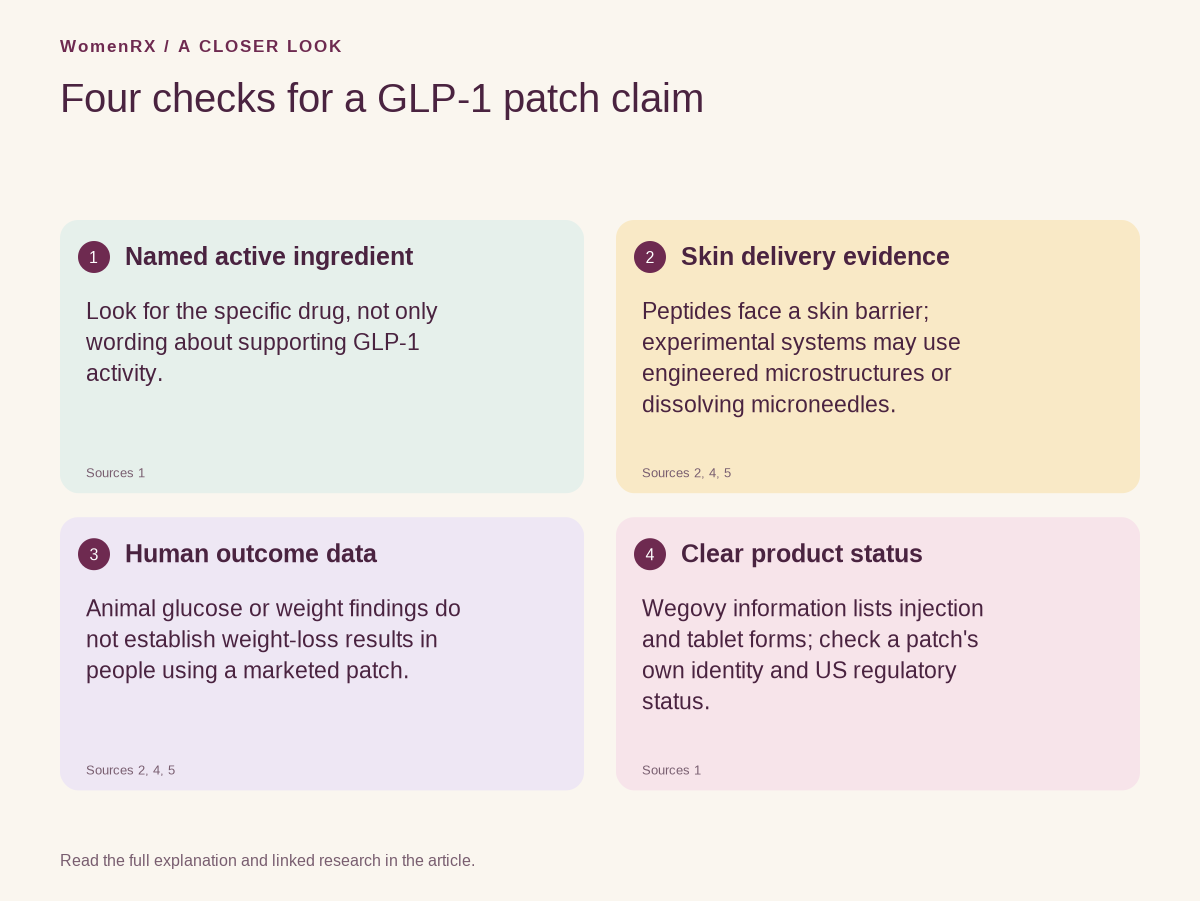
Four checks for a GLP-1 patch claim
Named active ingredient: Look for the specific drug, not only wording about supporting GLP-1 activity.1
Skin delivery evidence: Peptides face a skin barrier; experimental systems may use engineered microstructures or dissolving microneedles.245
Human outcome data: Animal glucose or weight findings do not establish weight-loss results in people using a marketed patch.245
Clear product status: Wegovy information lists injection and tablet forms; check a patch's own identity and US regulatory status.1
Read the figure as text
Compare the marketing claim with the evidence needed to identify the product, assess delivery, judge outcomes, and understand its US status.- Named active ingredient: Look for the specific drug, not only wording about supporting GLP-1 activity.1
- Skin delivery evidence: Peptides face a skin barrier; experimental systems may use engineered microstructures or dissolving microneedles.245
- Human outcome data: Animal glucose or weight findings do not establish weight-loss results in people using a marketed patch.245
- Clear product status: Wegovy information lists injection and tablet forms; check a patch's own identity and US regulatory status.1
More questions, answered
Does a microneedle patch count as the same kind of patch?
Not necessarily. Some experimental microneedle systems are designed to place drug into the skin, which is different from assuming that a simple adhesive patch delivers a peptide. Evidence still needs to match the exact drug, device, and product being advertised. 4 5
Do mouse results tell us whether a patch works for women?
No. A semaglutide transdermal-delivery study described weight findings in male mice. That can’t establish human effectiveness or answer whether outcomes vary among women or across life stages. 4
Sources you can check
- WEGOVY (SEMAGLUTIDE) INJECTION, SOLUTION WEGOVY (SEMAGLUTIDE) TABLET [NOVO NORDISK PHARMACEUTICAL INDUSTRIES, LP] | US prescribing information and patient instructionsAccessed 2026-09-25Return to first citation
- Engineering a long-acting, potent GLP-1 analog for microstructure-based transdermal delivery.Yang PY, Zou H, Chao E, Sherwood L, Nunez V, Keeney M, Ghartey-Tagoe E, Ding Z, Quirino H, Luo X, Welzel G, Chen G, Singh P, Woods AK, Schultz PG, Shen W. · Proceedings of the National Academy of Sciences of the United States of America · 2016Return to first citation
- Enhanced Transdermal Delivery of Liraglutide for Sustained Obesity Management.Chen N, Zeng Z, Chen H, Liu H, Zhang Z, Ke F, Ji X, Liu L, Zhang Z, Chen Y. · Langmuir : the ACS journal of surfaces and colloids · 2025Return to first citation
- Transdermal Semaglutide Administration in Mice: Reduces Body Weight by Suppressing Appetite and Enhancing Metabolic Rate.Li W, Cai R, Yin B, Zhou Y, Dong X, Li W, Wen J. · Biology · 2025Return to first citation
- Egg Microneedle for Transdermal Delivery of Active Liraglutide.You J, Juhng S, Song J, Park J, Jang M, Kang G, Yang H, Min HS, Shin J, Lee S, Ko HW, Jung H. · Advanced healthcare materials · 2023Return to first citation