Is There an Evidence-Based GLP-1 Patch for Weight Loss?
A patch’s GLP-1 claim is not proof that it delivers a GLP-1 medicine or causes weight loss in people.
This evidence doesn’t establish a transdermal GLP-1 patch as a proven weight-loss treatment. US product labeling describes semaglutide medicines as tablets or injections, while published transdermal and microneedle delivery examples include experiments in animals, not demonstrated weight-loss benefits in people. Check whether the product names a prescription medicine and delivery system, or is instead sold as a dietary supplement. 2 4 6 7
Start with what the patch actually contains
“GLP-1 patch” can describe very different things. A product might claim to contain a GLP-1 receptor agonist such as semaglutide, claim to support the body’s own GLP-1, or be a dietary supplement marketed for weight loss. Those are not interchangeable claims. A supplement marketed as supporting a hormone isn’t thereby a patch that delivers a prescription GLP-1 medicine.
Look for the exact active ingredient and the type of product on its label. US product labeling describes semaglutide medicines in tablet and injection forms; those labeled forms are not transdermal patches. 2 3 If the product is sold as a dietary supplement, it is regulated differently from a drug: supplements don’t require FDA premarket review or approval, and they aren’t permitted to contain pharmaceutical ingredients. 1
A patch has to pass more than one evidence test
A convincing claim needs to connect three things: the exact product, delivery of the stated active ingredient through the skin, and a meaningful clinical outcome in people. Evidence that a material can carry a drug, or that the drug changes weight in an animal, doesn’t establish that a particular store-bought patch delivers an effective amount or leads to weight loss in people.
There is a real scientific challenge here. Peptide medicines such as GLP-1 receptor agonists are difficult to deliver through the skin. Researchers have tested engineered systems, including dissolving microneedles and other transdermal approaches, to address that barrier. 5 6 But a microneedle device designed to place medicine into the skin is not necessarily the same thing as a simple adhesive patch, and a research device is not proof that a marketed product works.
For example, one study tested an engineered GLP-1-related peptide in rodents and guinea pigs, while another tested liraglutide delivery in a diabetic mouse model. 4 6 A semaglutide transdermal study reported results in male mice. 7 These findings can help researchers explore delivery methods; they don’t demonstrate weight-loss effectiveness in people.
Use this claim check before buying
- Name: Does the label identify a specific medicine, or does it use broad phrases such as “GLP-1 support”? A general claim doesn’t establish that the product contains a GLP-1 receptor agonist.
- Route: Does the evidence test this exact product as a skin-delivered system? Research on injections, tablets, a different patch, or a microneedle device doesn’t automatically apply.
- Delivery: Is there evidence the active ingredient gets through the skin and into the body? A list of ingredients or a claim about “absorption” isn’t the same as measured drug delivery.
- Outcome: Was the product tested in people for weight-loss outcomes? Animal weight changes and laboratory findings aren’t human treatment results.
- Population: Were women included, and were results reported for them? The semaglutide transdermal mouse study used male mice; animal findings cannot establish effectiveness or safety for women. 7
An unanswered item leaves that specific claim unverified: without a named ingredient, product identity is unclear; without route-specific evidence, delivery through the skin isn’t established; without human outcome results, weight-loss effectiveness for that product isn’t established. If results for women aren’t reported, that limits what can be concluded about effectiveness or safety for women, but doesn’t by itself negate evidence in other people. If its label identifies it as a dietary supplement, weigh that claim accordingly: supplement ingredients and combinations may have limited or variable evidence, and evidence for one ingredient doesn’t establish that the finished product works. 1
What about pregnancy?
Animal transdermal studies don’t establish safety during pregnancy. The semaglutide prescribing information says available data in pregnant women are insufficient to evaluate risks for the tablet products it covers; that information is not evidence about a patch. 3 A women-focused advertisement or a claim about “natural” ingredients doesn’t fill that evidence gap.
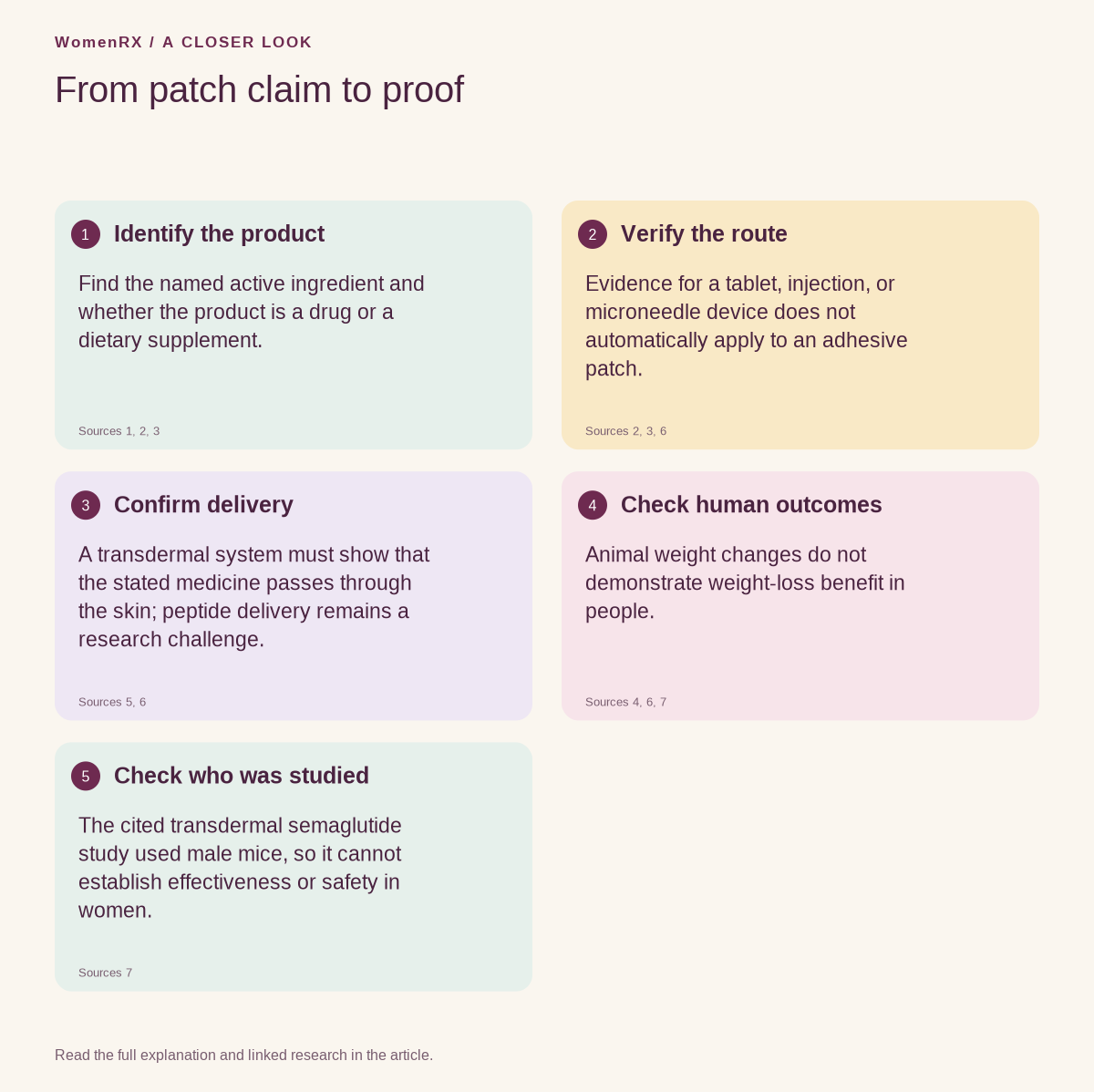
From patch claim to proof
Identify the product: Find the named active ingredient and whether the product is a drug or a dietary supplement.123
Verify the route: Evidence for a tablet, injection, or microneedle device does not automatically apply to an adhesive patch.236
Confirm delivery: A transdermal system must show that the stated medicine passes through the skin; peptide delivery remains a research challenge.56
Check human outcomes: Animal weight changes do not demonstrate weight-loss benefit in people.467
Check who was studied: The cited transdermal semaglutide study used male mice, so it cannot establish effectiveness or safety in women.7
Read the figure as text
Check each link in the chain before treating a GLP-1 patch advertisement as evidence of a working medicine.- Identify the product: Find the named active ingredient and whether the product is a drug or a dietary supplement.123
- Verify the route: Evidence for a tablet, injection, or microneedle device does not automatically apply to an adhesive patch.236
- Confirm delivery: A transdermal system must show that the stated medicine passes through the skin; peptide delivery remains a research challenge.56
- Check human outcomes: Animal weight changes do not demonstrate weight-loss benefit in people.467
- Check who was studied: The cited transdermal semaglutide study used male mice, so it cannot establish effectiveness or safety in women.7
More questions, answered
Do microneedle studies prove that a GLP-1 patch works?
No. Microneedles are a specific delivery technology, and the cited liraglutide example tested an engineered device in diabetic mice. That does not show that an ordinary adhesive patch, or a different product, delivers a medicine or causes weight loss in people. 6
Does a supplement that says it supports GLP-1 contain semaglutide?
That claim alone doesn’t establish that it contains semaglutide or another GLP-1 receptor agonist. Check the product’s stated identity and whether it is sold as a dietary supplement; supplements are not drugs and are not permitted to contain pharmaceutical ingredients. 1
Sources you can check
- Dietary Supplements for Weight Loss - Health Professional Fact SheetAccessed 2026-09-25Return to first citation
- WEGOVY (SEMAGLUTIDE) INJECTION, SOLUTION WEGOVY (SEMAGLUTIDE) TABLET [NOVO NORDISK PHARMACEUTICAL INDUSTRIES, LP] | US prescribing information and patient instructionsAccessed 2026-09-25Return to first citation
- OZEMPIC (ORAL SEMAGLUTIDE) TABLET RYBELSUS (ORAL SEMAGLUTIDE) TABLET [NOVO NORDISK PHARMACEUTICAL INDUSTRIES, LP] | US prescribing information and patient instructionsAccessed 2026-09-25Return to first citation
- Engineering a long-acting, potent GLP-1 analog for microstructure-based transdermal delivery.Yang PY, Zou H, Chao E, Sherwood L, Nunez V, Keeney M, Ghartey-Tagoe E, Ding Z, Quirino H, Luo X, Welzel G, Chen G, Singh P, Woods AK, Schultz PG, Shen W. · Proceedings of the National Academy of Sciences of the United States of America · 2016Return to first citation
- Enhanced Transdermal Delivery of Liraglutide for Sustained Obesity Management.Chen N, Zeng Z, Chen H, Liu H, Zhang Z, Ke F, Ji X, Liu L, Zhang Z, Chen Y. · Langmuir : the ACS journal of surfaces and colloids · 2025Return to first citation
- Egg Microneedle for Transdermal Delivery of Active Liraglutide.You J, Juhng S, Song J, Park J, Jang M, Kang G, Yang H, Min HS, Shin J, Lee S, Ko HW, Jung H. · Advanced healthcare materials · 2023Return to first citation
- Transdermal Semaglutide Administration in Mice: Reduces Body Weight by Suppressing Appetite and Enhancing Metabolic Rate.Li W, Cai R, Yin B, Zhou Y, Dong X, Li W, Wen J. · Biology · 2025Return to first citation