Weight-Loss Peptides: What Approved Medicines and Trials Show
Some incretin medicines have clinical-trial evidence for weight management, but a peptide label alone doesn’t establish a product’s approval, evidence, or expected results.
Liraglutide and semaglutide act on the GLP-1 receptor; tirzepatide acts on both GLP-1 and GIP receptors. A review describes these named medicines as approved for chronic weight management in eligible adults and reports weight loss in their trial programs. Retatrutide, by contrast, is described at the phase 3, top-line-results stage. The evidence for one named medicine doesn’t establish the benefits of another product. 4
Start with the exact medicine, not the word “peptide”
“Peptide” describes a type of molecule, not a level of evidence. Some prescription medicines used for weight management are peptide-based incretin drugs. Reviews also list other obesity medicines outside this named incretin group, including orlistat and phentermine/topiramate. A clinic or website calling a product a peptide doesn’t tell you whether it’s an approved medicine, whether it’s been tested in people, or whether it has evidence for weight loss. 34
The first useful question is: What’s the exact active ingredient and product name? Similar-sounding products may contain different ingredients, and the same ingredient can appear in products with different approved uses.
What the trial results say about named medicines
Liraglutide and semaglutide activate the GLP-1 receptor. Tirzepatide activates both the GLP-1 and GIP receptors. A review describes these medicines as approved for chronic weight management in eligible adults, alongside lifestyle intervention. 4
The review reports average weight loss of about 8% of body weight with liraglutide at 3.0 mg daily, an average of about 15% with semaglutide at up to 2.4 mg weekly, and a mean loss of up to 20.9% with the 15 mg tirzepatide treatment. These are results from separate trial programs, not a head-to-head comparison, and they aren’t a forecast of what any one person will lose. 4
A research-stage example is retatrutide. The review describes its phase 3 results as top-line and not yet peer reviewed. That’s a different evidence stage from the published trial evidence summarized for approved medicines; a promising result doesn’t by itself establish an approved treatment or guarantee a personal outcome. 4
There’s also a practical distinction between products containing the same active ingredient. Saxenda’s US prescribing information identifies liraglutide and describes how it reduces weight through decreased calorie intake, rather than increased 24-hour energy expenditure. Victoza’s prescribing information also identifies liraglutide, but the ingredient name alone doesn’t establish that two products have the same approved use or evidence for weight management. 12
Clinical evidence doesn’t mean a treatment is right for everyone or free of tradeoffs. In Saxenda trials, severe gastrointestinal reactions were reported more often among people receiving Saxenda than among those receiving placebo. A useful discussion of an established medicine includes relevant risks, not just a weight-loss headline. 1
Check a seller’s claim, one step at a time
A candidate being studied for weight loss isn’t automatically an approved treatment. Animal studies, early human studies, and later-stage trials answer different questions. Even when phase 3 results are announced, top-line findings aren’t the same as a peer-reviewed report. 4
When you see a claim about a research-stage or seller-promoted peptide, use this quick check:
- Name the compound. Ask for the exact active ingredient, not just a category such as “peptide blend.”
- Find human weight-loss trials. Look for studies in people that measured weight outcomes, rather than relying on a proposed mechanism or animal findings.
- Check the comparison. Was the compound compared with placebo or another treatment, and for how long?
- Look for published results. A trial announcement or early result isn’t the same as a full, peer-reviewed report.
- Verify the product and indication. Evidence for one medicine doesn’t establish the safety or effectiveness of a different product, formulation, or use.
These checks don’t prove a product is safe or unsafe. They help you distinguish evidence about a named medicine from a sales claim that borrows the reputation of a drug class.
What the averages don’t tell you
The reported weight-loss percentages are averages, not women-specific estimates. They don’t establish whether treatment effects differ between women and men. They also don’t answer questions about use during pregnancy or breastfeeding; those decisions require information for the exact medicine and product, not a broad claim about peptides. 4
One last distinction can prevent a common mix-up: a peptide-based medicine may have clinical evidence for a specific use, while another product marketed with the same broad label may not. Ask for the ingredient, the human trial evidence for that ingredient, and the product’s specific approved use. That’s a more useful starting point than the word “peptide.”
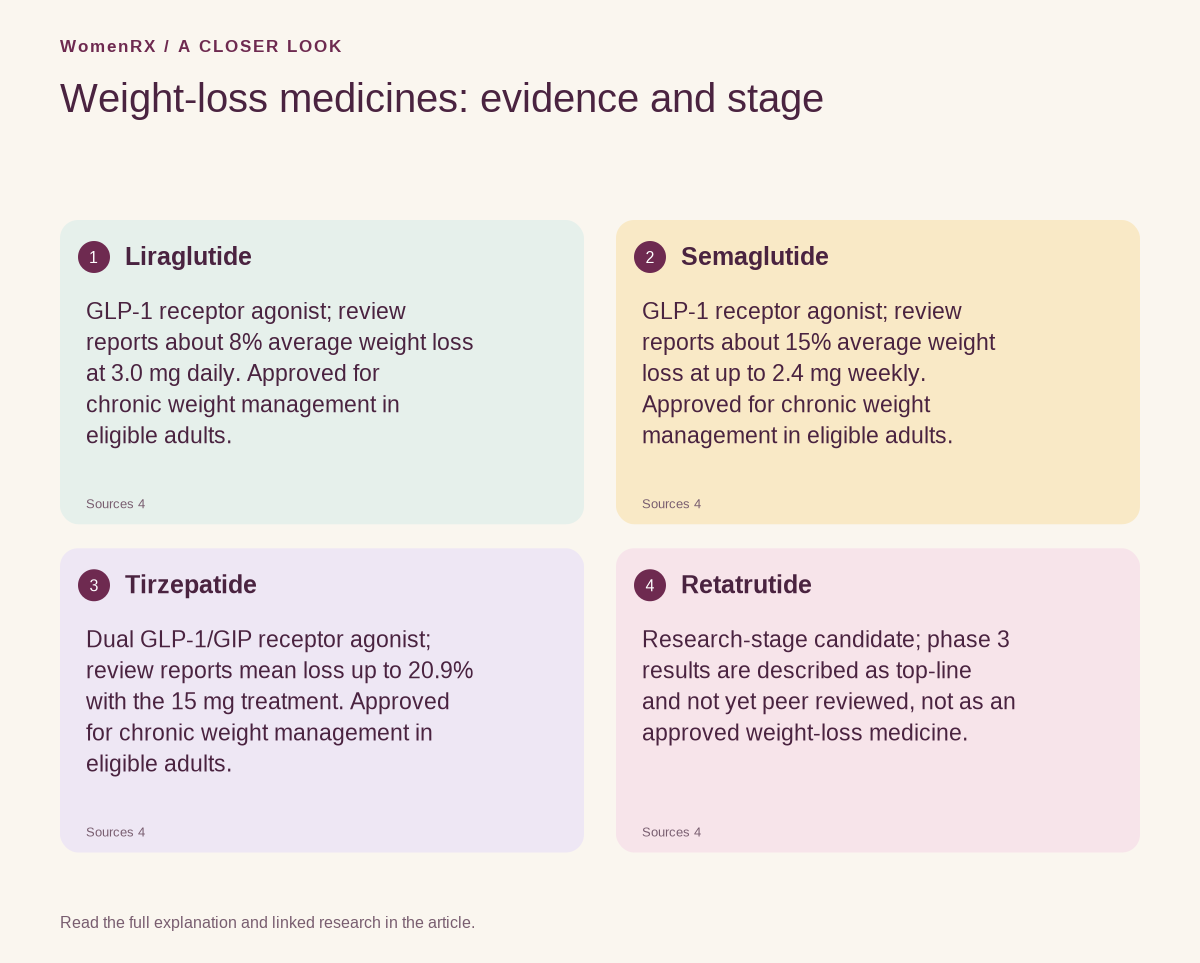
Weight-loss medicines: evidence and stage
Liraglutide: GLP-1 receptor agonist; review reports about 8% average weight loss at 3.0 mg daily. Approved for chronic weight management in eligible adults.4
Semaglutide: GLP-1 receptor agonist; review reports about 15% average weight loss at up to 2.4 mg weekly. Approved for chronic weight management in eligible adults.4
Tirzepatide: Dual GLP-1/GIP receptor agonist; review reports mean loss up to 20.9% with the 15 mg treatment. Approved for chronic weight management in eligible adults.4
Retatrutide: Research-stage candidate; phase 3 results are described as top-line and not yet peer reviewed, not as an approved weight-loss medicine.4
Read the figure as text
Compare the named medicine, reported evidence, and research stage. Trial averages from different programs are not head-to-head results or personal predictions.- Liraglutide: GLP-1 receptor agonist; review reports about 8% average weight loss at 3.0 mg daily. Approved for chronic weight management in eligible adults.4
- Semaglutide: GLP-1 receptor agonist; review reports about 15% average weight loss at up to 2.4 mg weekly. Approved for chronic weight management in eligible adults.4
- Tirzepatide: Dual GLP-1/GIP receptor agonist; review reports mean loss up to 20.9% with the 15 mg treatment. Approved for chronic weight management in eligible adults.4
- Retatrutide: Research-stage candidate; phase 3 results are described as top-line and not yet peer reviewed, not as an approved weight-loss medicine.4
More questions, answered
Are all weight-loss medicines incretin medicines?
No. Reviews list medicines such as orlistat and phentermine/topiramate alongside incretin medicines such as liraglutide and semaglutide. The drug class and evidence need to be checked for the exact medicine. 3
Does a promising trial result mean a peptide is approved?
No. Retatrutide is described as having phase 3 top-line results that were not yet peer reviewed. A trial result and an approved medicine are different things. 4
Sources you can check
- SAXENDA (LIRAGLUTIDE) INJECTION, SOLUTION [NOVO NORDISK PHARMACEUTICAL INDUSTRIES, LP] | US prescribing information and patient instructionsAccessed 2026-09-25Return to first citation
- VICTOZA (LIRAGLUTIDE) INJECTION [NOVO NORDISK] | US prescribing information and patient instructionsAccessed 2026-09-25Return to first citation
- Review article: Pharmacologic management of obesity - updates on approved medications, indications and risks.Lupianez-Merly C, Dilmaghani S, Vosoughi K, Camilleri M. · Alimentary pharmacology & therapeutics · 2024Return to first citation
- For Weight Loss: Why Do GLP-1 Agonists Work, and How Can We Make Them Work Better?Giang C, Meng J, Mohammad MA, Liu Z, Wu X, Zhu Y. · Biology · 2026Return to first citation