Weight-Loss Medicines and Pills: What to Compare
The right comparison starts with your health, goals, and life stage, not a universal “best pill.”
Prescription weight-management medicines are different from over-the-counter supplements: clinical guidelines recommend certain prescription options for eligible adults, while the safety and effectiveness of combining phentermine-topiramate with over-the-counter or herbal weight-loss products haven’t been established. The choice depends on conditions you have, possible harms, access, preferences, and pregnancy considerations, with follow-up to review how treatment is working. 2 5
Prescription weight-loss medicines aren’t interchangeable, and a supplement marketed for weight loss isn’t automatically a safer or equivalent alternative. A useful comparison asks what each option is supported for, how its risks fit your health and life stage, and how you’ll review the plan over time.
Start with who the recommendation applies to
An April 2026 American College of Physicians guideline suggests considering medication alongside lifestyle changes for nonpregnant adults with obesity, defined in that guideline as a BMI of 30 or higher. For adults with a BMI from 27 to under 30, it suggests medication when certain weight-related conditions are present, including type 2 diabetes, high cholesterol, high blood pressure, sleep apnea, or cardiovascular disease. These are guideline recommendations, not a decision based on BMI alone. 5
BMI is one screening measure, not a full picture of health: it doesn’t distinguish fat from muscle or bone. Weight history, other conditions, goals, and preferences can also matter when a treatment plan is considered. 3 5
The guideline groups medication options differently according to the evidence it reviewed. For adults with obesity, it gives conditional, moderate-certainty recommendations for semaglutide and tirzepatide, and lower-certainty recommendations for phentermine-topiramate, liraglutide, and naltrexone-bupropion. That’s a guide to a discussion, not proof that one option will work best for every person. The guideline asks clinicians and patients to weigh benefits, harms, cost, access, medical conditions, goals, preferences, and warnings together. 5
Compare the evidence, not the label
Ask what outcome matters in your case: weight change, a weight-related health condition, or maintaining weight loss. Also ask what evidence applies to people like you and over what period. A systematic review of 12 randomized trials involving 4,915 adults found that medication during a weight-maintenance phase was associated with less regain and further improvements in weight and some cardiometabolic measures compared with placebo. Gastrointestinal side effects were more common; the review said longer-term trials are still needed. These results describe a group of trials, not a prediction for one person or a comparison that identifies a universal winner. 4
Follow-up is part of the comparison, not an afterthought. Ask how you and your clinician will judge benefit, side effects, and whether the plan still fits your goals. The guideline explicitly includes discussion of switching when response is inadequate, while the maintenance review supports treating weight management as something that may need ongoing review rather than a one-time course. 5 4
Treat supplement combinations as a separate safety question
A product being sold over the counter or described as “natural” doesn’t establish that it works or that it is safe alongside a prescription medicine. The prescribing information for phentermine-topiramate says that its safety and effectiveness when combined with other weight-loss products, including over-the-counter drugs and herbal preparations, haven’t been established. Bring the exact product name and ingredients to the medication discussion rather than assuming the combination is harmless. 2
Medication-specific questions matter too. For example, phentermine-topiramate can interact with some medicines and substances: its prescribing information warns about combining it with monoamine oxidase inhibitors, alcohol or other central nervous system depressants, and certain other drugs. It also describes possible spotting with a particular combined oral contraceptive; the label says not to stop that contraceptive just because spotting occurs, but to tell the prescriber if it is troubling. These details apply to this medicine, not to every weight-loss treatment. 1
Put pregnancy and breastfeeding on the comparison list
The ACP guideline’s recommendations are for nonpregnant adults. It specifically flags monthly pregnancy tests with phentermine-topiramate as a safety consideration. If you’re planning pregnancy, could become pregnant, are pregnant, or are breastfeeding, raise that before choosing a medicine and ask for guidance specific to the exact product. For phentermine-topiramate, ask how pregnancy testing and contraception questions apply to you; the label also notes that spotting can occur with a particular oral contraceptive, without anticipating an increased pregnancy risk from that interaction. 5 1
The cited guideline doesn’t establish medication choices for pregnancy or breastfeeding. Don’t assume that one medicine’s guidance applies to another, or that an over-the-counter product is a suitable substitute. 5 2
Questions that make the comparison useful
- Am I in a group the guideline’s recommendation covers, and what other health factors change the choice?
- What benefit are we aiming to assess, and when will we review whether it’s helping?
- Which side effects, warnings, or interactions matter with my health conditions and current medicines?
- What should I know about cost, access, and ongoing treatment before deciding?
- How does pregnancy planning, pregnancy, or breastfeeding change the options for this specific product?
- Should I avoid combining it with any supplement or other weight-loss product?
Those questions help turn “Which pill is best?” into a more useful one: “Which option fits my health, priorities, and circumstances, and how will we know whether it remains a good fit?”
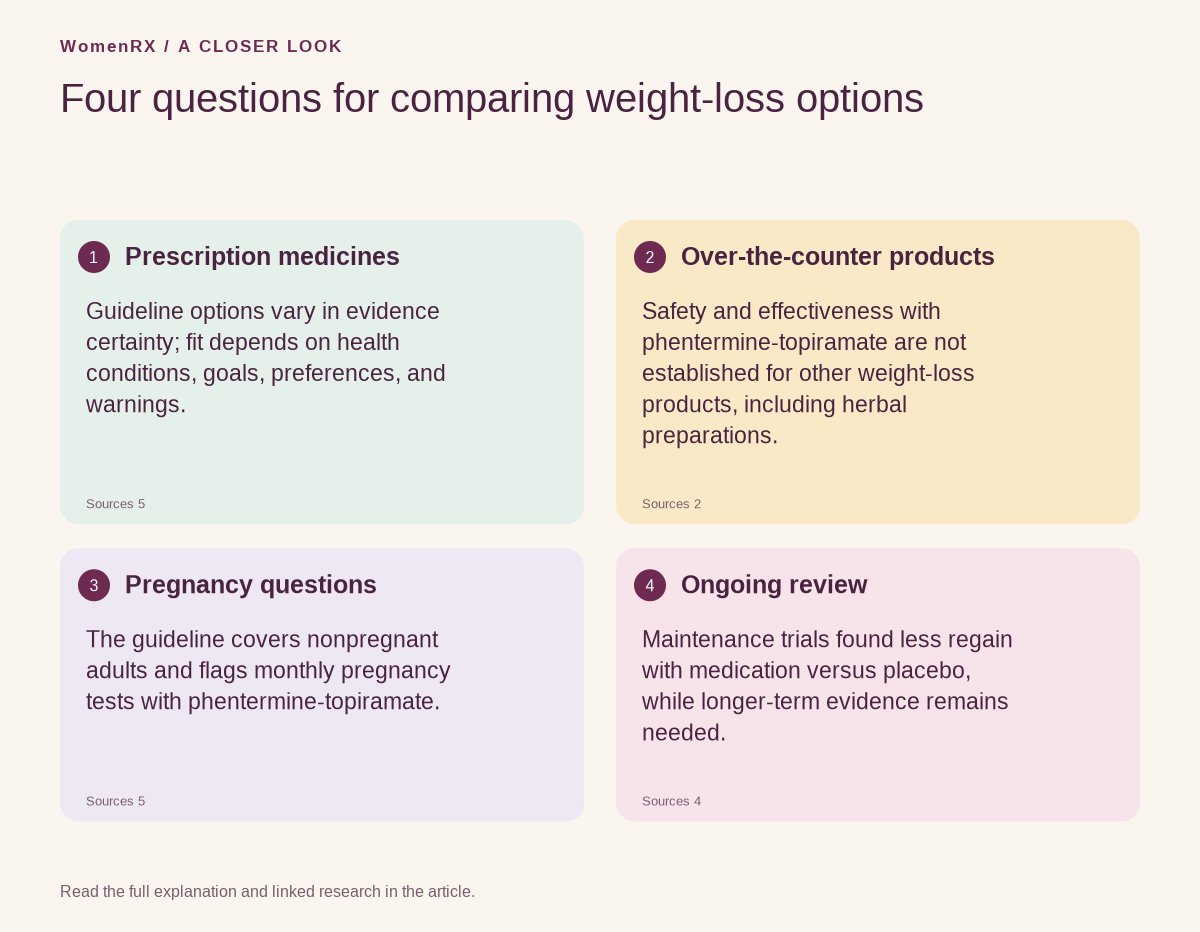
Four questions for comparing weight-loss options
Prescription medicines: Guideline options vary in evidence certainty; fit depends on health conditions, goals, preferences, and warnings.5
Over-the-counter products: Safety and effectiveness with phentermine-topiramate are not established for other weight-loss products, including herbal preparations.2
Pregnancy questions: The guideline covers nonpregnant adults and flags monthly pregnancy tests with phentermine-topiramate.5
Ongoing review: Maintenance trials found less regain with medication versus placebo, while longer-term evidence remains needed.4
Read the figure as text
Compare the evidence and safety questions that apply to each option, rather than treating all pills or products as equivalent.- Prescription medicines: Guideline options vary in evidence certainty; fit depends on health conditions, goals, preferences, and warnings.5
- Over-the-counter products: Safety and effectiveness with phentermine-topiramate are not established for other weight-loss products, including herbal preparations.2
- Pregnancy questions: The guideline covers nonpregnant adults and flags monthly pregnancy tests with phentermine-topiramate.5
- Ongoing review: Maintenance trials found less regain with medication versus placebo, while longer-term evidence remains needed.4
More questions, answered
Does a higher BMI automatically mean a weight-loss medicine is right for me?
No. The guideline uses BMI ranges to describe groups for whom medication may be considered, but it also calls for discussion of medical conditions, goals, preferences, benefits, harms, and warnings. BMI itself doesn’t distinguish fat from muscle or bone. 5 3
Can I add an over-the-counter weight-loss product to a prescription?
Don’t assume the combination is safe or effective. Phentermine-topiramate’s prescribing information says its safety and effectiveness with other weight-loss products, including over-the-counter drugs and herbal preparations, haven’t been established. Ask about the exact product and ingredients. 2
Sources you can check
- QSYMIA (PHENTERMINE AND TOPIRAMATE) CAPSULE, EXTENDED RELEASE [VIVUS LLC] | US prescribing information and patient instructionsAccessed 2026-09-25Return to first citation
- PHENTERMINE AND TOPIRAMATE CAPSULE, EXTENDED RELEASE [TEVA PHARMACEUTICALS, INC.] | US prescribing information and patient instructionsAccessed 2026-09-25Return to first citation
- Obesity: MedlinePlusAccessed 2026-09-25Return to first citation
- Efficacy and Safety of Anti-Obesity Medications for Weight Loss Maintenance in Adults With Overweight or Obesity: A Systematic Review and Meta-Analysis of Randomised Controlled Trials.Chen Z, Cheng R, Wang H, Hu F. · Diabetes, obesity & metabolism · 2026Return to first citation
- Pharmacologic Treatments With Lifestyle Modifications in Nonpregnant Adults With Overweight or Obesity in Outpatient Settings: A Living Clinical Guideline From the American College of Physicians (April 2026).Qaseem A, Cross JT, Harrod CS, Owens DK, Balk EM, Crandall CJ, Clinical Guidelines Committee of the American College of Physicians, Fitterman N, Gibson M, Lewis J, Mackey K, Miller... · Annals of internal medicine · 2026Return to first citation