Compounded and Approved GLP-1 Medicines: What Should You Know?
A compounded GLP-1 medicine may differ from an approved product in formulation, instructions, and oversight, so check the details before using it.
An FDA-approved GLP-1 medicine and a compounded preparation aren’t interchangeable just because they contain the same named drug. Compounded products may differ in route, formulation, or added ingredients, and they don’t undergo FDA approval. Ask who made and dispensed the exact product, how to use and store it, and what rules apply where you live. Discuss pregnancy planning, pregnancy, or breastfeeding with your prescriber.
The same drug name doesn’t guarantee the same product
An approved medicine is a specific product. A compounded preparation may have a different formulation, route, or added ingredients, so its directions and evidence may not match those of an approved product. In a search of online listings conducted in 2025, researchers found compounded semaglutide and tirzepatide products that differed from available FDA-approved products. That search describes what they found, not every product on the market. 1
Compounding can meet a particular need, but compounded medicines do not undergo FDA approval. A professional pharmacy network described limited clinical-outcome evidence for compounded semaglutide and tirzepatide, as well as legal and safety concerns. Whether a specific product may be offered can depend on applicable rules and circumstances, so ask about the exact preparation and where it is being supplied. 25
An added ingredient or a different route isn’t proof of an advantage. The 2025 search identified compounded products with added ingredients and oral formulations; whether the oral forms offered benefits over available oral tablets had not been determined. 1
What safety reports suggest, and what they can’t establish
A U.S. analysis of adverse-event reports found higher reporting odds for some events and product-quality concerns associated with compounded GLP-1 medicines, including nausea, abdominal pain, and preparation or prescribing errors. It found lower reporting odds for administration and dosing errors. These are reporting signals, not a measure of how often problems happen among all users, and they don’t prove that compounding caused an event. 3
Reviews also describe dosing-error risks and fraudulent products in the compounded semaglutide market. If you’re offered a vial, ask the pharmacist to explain the directions for that exact product and how to measure the prescribed amount. Don’t try to translate directions from another product or rely on an informal conversion. 2
Questions to take to your prescriber or pharmacist
Bring the prescription, package, or product information if you have it. You can ask:
- What exactly is in this preparation? Confirm the medicine, formulation, route, and any added ingredients. Ask how it differs from the approved product being discussed.
- Who makes and dispenses it? Get the name and contact details of the dispensing pharmacy or supplier. Ask your prescriber or pharmacist to help verify the source and whether the product may be supplied in your location. Professional guidance recommends reputable compounding pharmacies when a compounded product is used, but that does not make it FDA-approved. 5
- How do I use this specific product? Ask the pharmacist to review the written directions and the measuring device with you. If the label and verbal instructions don’t match, pause and get clarification before using it.
- How should it be stored, and what is its beyond-use date? Ask for both details for your preparation. In the online listings researchers examined, storage and beyond-use information was often absent, which makes it worth confirming directly rather than guessing. 1
- Who should I contact if I miss a dose or feel unwell? Get a plan for the exact medicine and formulation instead of borrowing instructions for a different product.
If you’re already using a compounded GLP-1 medicine, tell your prescriber and pharmacist what it is and how you take it. A U.S. primary-care records study found that compounded use was documented less often than estimates from some surveys. Sharing the details can help your care team keep your medication record and decisions coordinated. 4
Pregnancy planning, pregnancy, and breastfeeding
If you’re planning a pregnancy, are pregnant, or breastfeeding, talk with your prescriber about the exact medicine before starting or continuing it. Ask what applies to your circumstances and product; don’t assume advice for one medicine or formulation automatically applies to another.
Make the decision product by product
When an approved medicine is an option, professional guidance recommends making efforts to help patients obtain it. If a compounded preparation is being considered, ask why that specific product is appropriate, where it comes from, how you’ll use it safely, and how your care team will follow up. A lower price or an added ingredient doesn’t answer those questions. 5
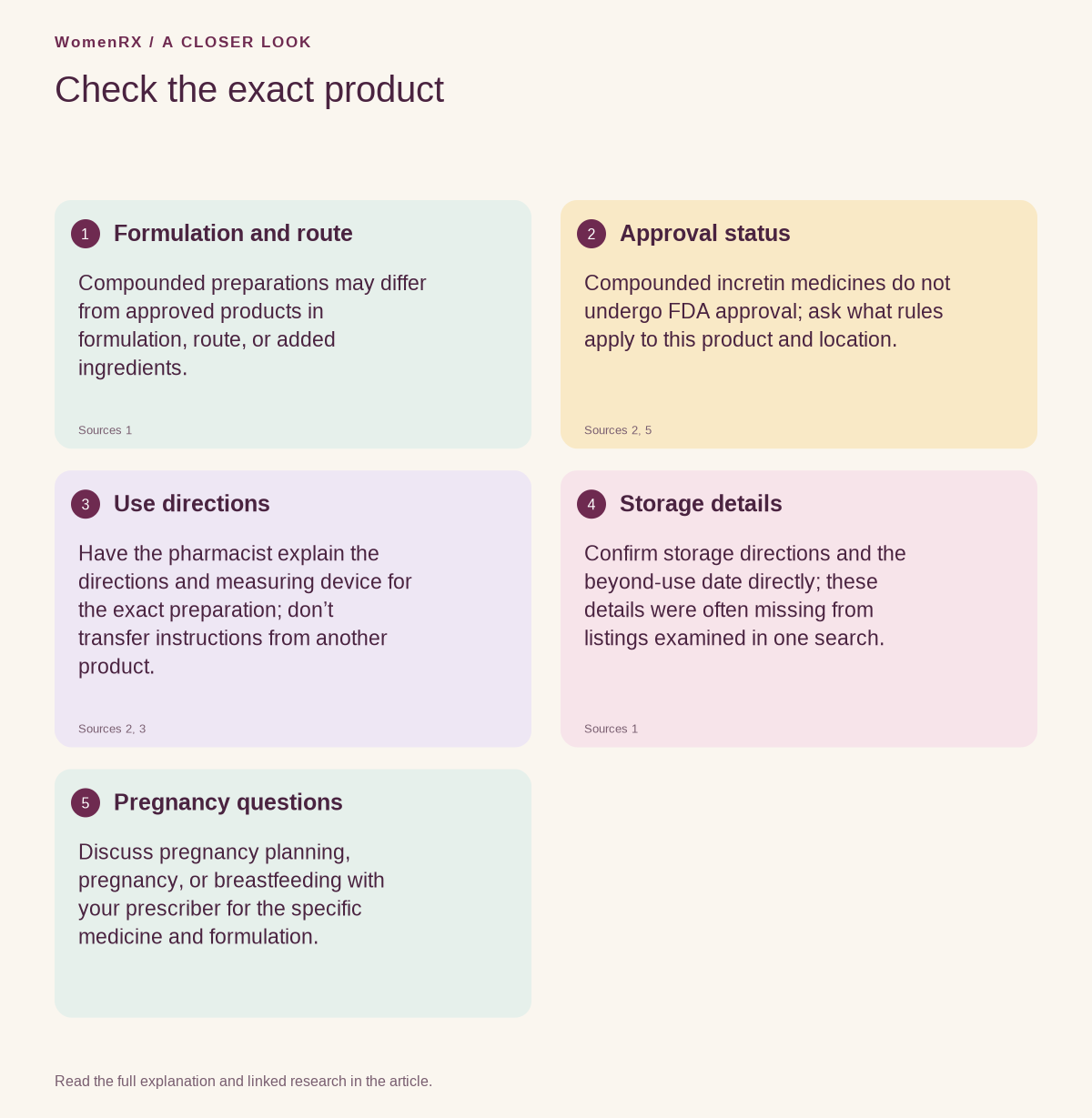
Check the exact product
Formulation and route: Compounded preparations may differ from approved products in formulation, route, or added ingredients.1
Approval status: Compounded incretin medicines do not undergo FDA approval; ask what rules apply to this product and location.25
Use directions: Have the pharmacist explain the directions and measuring device for the exact preparation; don’t transfer instructions from another product.23
Storage details: Confirm storage directions and the beyond-use date directly; these details were often missing from listings examined in one search.1
Pregnancy questions: Discuss pregnancy planning, pregnancy, or breastfeeding with your prescriber for the specific medicine and formulation.
Read the figure as text
These are the product and oversight differences to clarify with your prescriber or pharmacist before using a compounded preparation.- Formulation and route: Compounded preparations may differ from approved products in formulation, route, or added ingredients.1
- Approval status: Compounded incretin medicines do not undergo FDA approval; ask what rules apply to this product and location.25
- Use directions: Have the pharmacist explain the directions and measuring device for the exact preparation; don’t transfer instructions from another product.23
- Storage details: Confirm storage directions and the beyond-use date directly; these details were often missing from listings examined in one search.1
- Pregnancy questions: Discuss pregnancy planning, pregnancy, or breastfeeding with your prescriber for the specific medicine and formulation.
More questions, answered
Can I switch between an approved product and a compounded version?
Don’t assume they’re interchangeable based on the drug name. Compounded products may differ in route, formulation, or added ingredients, and their directions may differ too. Ask your prescriber and dispensing pharmacist to review both exact products and their instructions before making a change. 12
What if I think I measured a dose incorrectly?
Contact the dispensing pharmacist or prescriber promptly. Tell them the product name, what the label says, the amount you intended to take, and the amount you think you took so they can advise you about that specific product. 23
Sources you can check
- Compounded Semaglutide and Tirzepatide Products Use Unique Formulations but Efficacy and Safety Largely Unknown.Belcourt J, Sapowadia A, White CM. · The Annals of pharmacotherapy · 2026Return to first citation
- Navigating compounded semaglutide: what health care providers need to know.Liu G, Jarema M, Mo M, Stievater T. · The American journal of managed care · 2025Return to first citation
- Safety analysis of compounded GLP-1 receptor agonists: a pharmacovigilance study using the FDA adverse event reporting system.McCall KL, Mastro Dwyer KA, Casey RT, Samana TN, Sulicz EK, Tso SY, Yalanzhi ER, Piper BJ. · Expert opinion on drug safety · 2026Return to first citation
- Documentation of Compounded GLP-1 Receptor Agonists in a Large Primary Care Dataset.Hendrix N, Velásquez EE, Pham H, Bazemore A. · Pharmacoepidemiology and drug safety · 2025Return to first citation
- Compounded incretins in clinical practice: An opinion of the endocrine and metabolism practice and research network of the American College of Clinical Pharmacy.Courtney LA, Clements JN, Isaacs D, Pitlick JM, Reece SM, Whitley HP. · Diabetes & metabolic syndrome · 2025Return to first citation