Approved, compounded, or investigational: GLP-1 terms explained
The same ingredient name doesn’t mean the same product, evidence, or oversight.
An approved medicine is a specific product with an official label; a compounded preparation is made by a pharmacy and may differ in ingredients or form; an investigational medicine is still being studied. Those categories aren’t interchangeable. Check the exact product, formulation, evidence, and pregnancy or breastfeeding information rather than assuming one GLP-1 medicine’s findings apply to another. 1 3 5
Start with the product, not the label people use for it
“GLP-1” is often used casually for several different medicines. But a shared drug class, ingredient name, or marketing description doesn’t tell you whether a particular product is an approved medicine, a compounded preparation, or an investigational agent. Those labels point to different kinds of evidence and oversight.
For example, semaglutide is sold as branded medicines with different product-specific uses and instructions. The Wegovy prescribing information describes its own forms and directions, while a clinical review identifies Ozempic and Wegovy as FDA-approved semaglutide products for different uses. 1 4 Tirzepatide also appears in FDA-approved products, but that doesn’t make every preparation containing tirzepatide equivalent to those products. 2
What each category tells you
| Category | What it means | The question to ask |
|---|---|---|
| Approved medicine | A specific medicine with product-specific prescribing information. Form, use, and instructions belong to that product. 1 4 | “Is this the exact approved product, and what does its own label say?” |
| Compounded preparation | A pharmacy-made preparation that may use a different formulation, route, or added ingredient. It isn’t automatically the same as an approved product. 3 | “What exactly is in it, how is it made and stored, and what evidence supports this formulation?” |
| Investigational agent | A medicine still being evaluated in research. Trial findings can be promising without establishing that it is an approved treatment or interchangeable with existing medicines. 5 | “What phase and kind of human evidence exists, and what remains unanswered?” |
The table is a starting point, not a quality ranking. Compounding can fill a medical need, but the review of compounded semaglutide describes concerns about quality controls, dosing errors, and fraudulent products. 4 The key is to find out what the specific preparation is and what is known about it, rather than treating “compounded” as a synonym for either “fake” or “the same as the brand.”
Why a compounded version needs its own evidence
A familiar ingredient name doesn’t establish that a changed route, added ingredient, or new formulation works as well as the approved product. A 2026 editorial that searched for compounded semaglutide and tirzepatide products found preparations with different routes and combinations of added ingredients. It concluded that evidence for the safety and effectiveness of these distinct products was limited. 3
There are also product-quality questions, separate from whether an ingredient can have a medical effect. In a laboratory analysis of samples of compounded tirzepatide combined with certain forms of vitamin B12, researchers identified an impurity. They said its clinical effects were unknown. This finding raises a concern about the tested combinations; it does not show that every compounded product contains that impurity or that the impurity causes harm in people. 2
Useful questions include: What are all the active and added ingredients? Is the route or dosage form different from an approved product? What information is available about storage and beyond-use dating? Who is the dispensing pharmacy, and can the pharmacist explain the product and how to use it? These questions matter because preparations can differ, and reviews have raised concerns about dosing errors and variable product information. 3 4
Promising trial results aren’t the same as an approved treatment
Retatrutide is described in clinical research as an investigational agent. A network meta-analysis included randomized trials of retatrutide and other emerging agents, but it also noted that direct comparisons between the newer medicines were limited. Results from trials can help researchers understand possible benefits and harms; they don’t by themselves establish how an agent compares with an approved medicine in everyday care. 5
When you hear a dramatic result, check who was studied, what the comparator was, how long the study lasted, and whether the result came from a direct comparison or an indirect analysis. A ranking in a network meta-analysis is not the same as a head-to-head trial. The studies summarized in this analysis included people with overweight, obesity, and/or type 2 diabetes, so don’t assume the findings answer every person’s question or apply equally to women. 5
Make pregnancy and breastfeeding product-specific questions
Don’t infer reproductive safety for one medicine from another drug in the same broad class. Ask about the exact medicine and formulation, and look for information specific to pregnancy and breastfeeding. The Wegovy patient information, for example, says breastfeeding is not recommended with its tablets and that it is not known whether injected Wegovy passes into breast milk. That is product-specific information, not a finding about every GLP-1 medicine or every compounded version. 1
If a product is compounded or investigational, ask what reproductive-safety information exists for that exact formulation, and what is unknown. A familiar ingredient name or promising weight-loss result cannot fill in missing pregnancy or breastfeeding evidence.
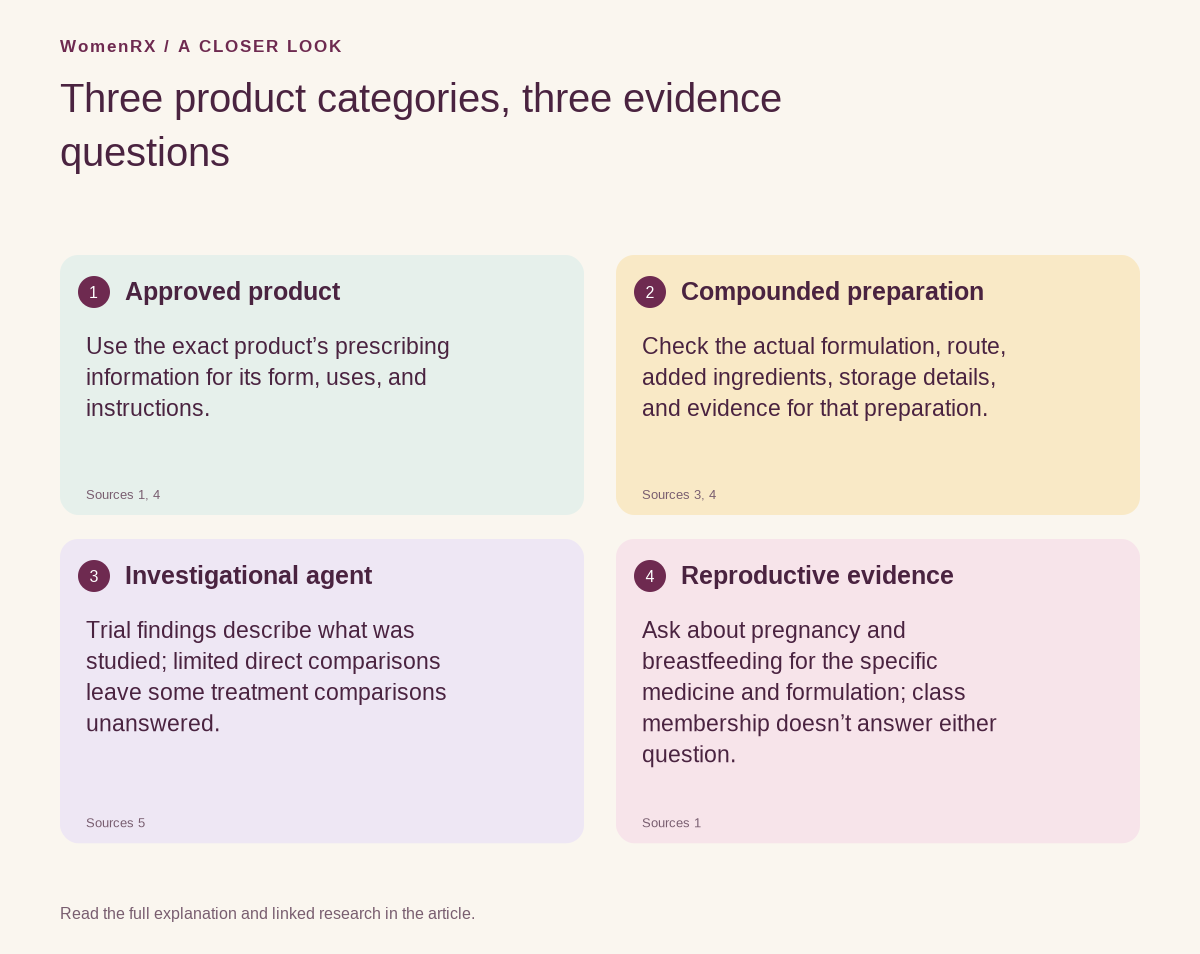
Three product categories, three evidence questions
Approved product: Use the exact product’s prescribing information for its form, uses, and instructions.14
Compounded preparation: Check the actual formulation, route, added ingredients, storage details, and evidence for that preparation.34
Investigational agent: Trial findings describe what was studied; limited direct comparisons leave some treatment comparisons unanswered.5
Reproductive evidence: Ask about pregnancy and breastfeeding for the specific medicine and formulation; class membership doesn’t answer either question.1
Read the figure as text
The ingredient name alone doesn’t show whether a product is approved, compounded, or still being studied.- Approved product: Use the exact product’s prescribing information for its form, uses, and instructions.14
- Compounded preparation: Check the actual formulation, route, added ingredients, storage details, and evidence for that preparation.34
- Investigational agent: Trial findings describe what was studied; limited direct comparisons leave some treatment comparisons unanswered.5
- Reproductive evidence: Ask about pregnancy and breastfeeding for the specific medicine and formulation; class membership doesn’t answer either question.1
More questions, answered
Does a compounded product become equivalent to an approved medicine if it has the same ingredient?
No. A different route, dosage form, or added ingredient can make it a distinct preparation, and evidence about the approved product doesn’t automatically establish the safety or effectiveness of that version. 3
Does a promising clinical trial mean an investigational medicine is ready for routine use?
Not by itself. Trial results are evidence about the people and comparisons studied; direct comparisons among emerging agents may still be limited. 5
Sources you can check
- WEGOVY (SEMAGLUTIDE) INJECTION, SOLUTION WEGOVY (SEMAGLUTIDE) TABLET [NOVO NORDISK PHARMACEUTICAL INDUSTRIES, LP] | US prescribing information and patient instructionsAccessed 2026-09-25Return to first citation
- A novel, widespread impurity in mass-compounded tirzepatide/B12 products: potential patient safety implications.Jordan B, Arbogast L, Clemens M, Huang L, Snyder M. · Expert opinion on drug safety · 2026Return to first citation
- Compounded Semaglutide and Tirzepatide Products Use Unique Formulations but Efficacy and Safety Largely Unknown.Belcourt J, Sapowadia A, White CM. · The Annals of pharmacotherapy · 2026Return to first citation
- Navigating compounded semaglutide: what health care providers need to know.Liu G, Jarema M, Mo M, Stievater T. · The American journal of managed care · 2025Return to first citation
- Comparative Efficacy and Safety of Glucagon Receptor Agonists on Metabolic Outcomes: A Network Meta-Analysis of Randomised Controlled Trials.Abulehia A, Ayesh H, Ayesh O, Jaber D, Asad T, Itbaisha A, Abugharbieh H, Gharbia R, Abu-Hilal LH, Leon BGC. · Endocrinology, diabetes & metabolism · 2026Return to first citation