Reading a COA for Compounded GLP-1 Medicines
A certificate of analysis can show what was tested in a sample, but it cannot answer every question about the medicine in your vial.
Check whether the certificate names the exact medicine and formulation, matches the batch on your vial, identifies the tests and methods used, and reports results with clear limits and a named laboratory. Then ask what the testing did not cover. A COA can document particular analytical results; by itself, it does not establish sterility, the full manufacturing picture, regulatory approval, clinical effectiveness, or whether a medicine is appropriate for you.
A certificate of analysis (COA) is most useful when you can connect its results to the exact product and batch you were offered. Treat it as a record of specific tests, not as an all-purpose quality or safety certificate. One published analysis of compounded tirzepatide combined with vitamin B12 reported finding an impurity in samples it tested; that finding raises a question about those tested combinations, but does not establish the contents or quality of every compounded product. 2
Start by matching the document to the vial
Look for the medicine name, formulation, strength or concentration, batch or lot number, and a test or report date. Compare those details with the vial and its label. If a field is missing, ask the seller or pharmacy whether the report applies to the exact batch you would receive. A report for a different batch, a different formulation, or an ingredient on its own may not answer the question you have about the finished product.
The wording matters, too. Semaglutide and tirzepatide are different medicines. If the product combines one of them with another ingredient, the report should make clear whether the combination itself was tested. In the published tirzepatide/B12 analysis, researchers assessed compounded combination samples for peptide-related impurities, and reported an impurity arising from a reaction between tirzepatide and certain B12 analogs. That is a reason to ask about combination-specific testing, not proof that every combination contains that impurity. 2
Read the test results, not just the word “pass”
For each test, look for the result, the test method, and the acceptance limit or specification used to judge that result. A simple “pass” is hard to interpret if the document does not show what was tested or what counted as passing. Ask which substances or properties the test covers and whether the result is for the finished preparation or only a starting ingredient.
Different tests answer different questions. Analytical testing can examine properties such as potency or purity, but a COA only tells you about the tests it actually reports. In a study of compounded buffered lidocaine, for example, researchers described separate methods for potency, purity, sterility, endotoxin, particulates, and container integrity. That study concerned lidocaine, not GLP-1 medicines, but it illustrates why one test result should not be read as a result for every quality dimension. 3
Check who tested it, and what the report leaves open
Look for the laboratory’s name and enough identifying information to ask who performed the testing. Ask whether that laboratory tested the sample independently, what sample it received, and whether the results apply to your batch. A laboratory name alone does not tell you what the laboratory tested or verify that the report matches the vial.
A COA also does not, by itself, demonstrate sterile preparation or broader manufacturing controls. Sterility and other quality checks are distinct from a potency or impurity result; a review of quality assurance for compounded sterile preparations discusses separate documentation and testing procedures for sterility and endotoxin. 4 The lidocaine research likewise reports several different tests rather than treating one analytical result as a complete quality assessment. 3
Nor does a COA establish that a medicine is regulator-approved, clinically effective, or suitable for you. Those are different questions from whether a particular sample met a particular test specification. The report also cannot tell you whether use is appropriate during pregnancy or for your medical circumstances. Pregnancy medicine decisions depend on the specific medicine and your situation; MedlinePlus advises checking with a healthcare provider before taking medicine during pregnancy. 1
Questions worth asking before relying on a COA
- Does this report match the exact product, formulation, and batch I would receive?
- What was tested: the finished product, a starting ingredient, or a different sample?
- Which tests were performed, and what do the reported results and limits mean?
- Who performed the testing, and can the laboratory and report be independently verified?
- What quality checks are not covered by this document, including sterility or other manufacturing controls?
If the answers are vague, the document leaves important questions unresolved. That does not prove the medicine failed a test; it means the COA alone does not answer what you need to know.
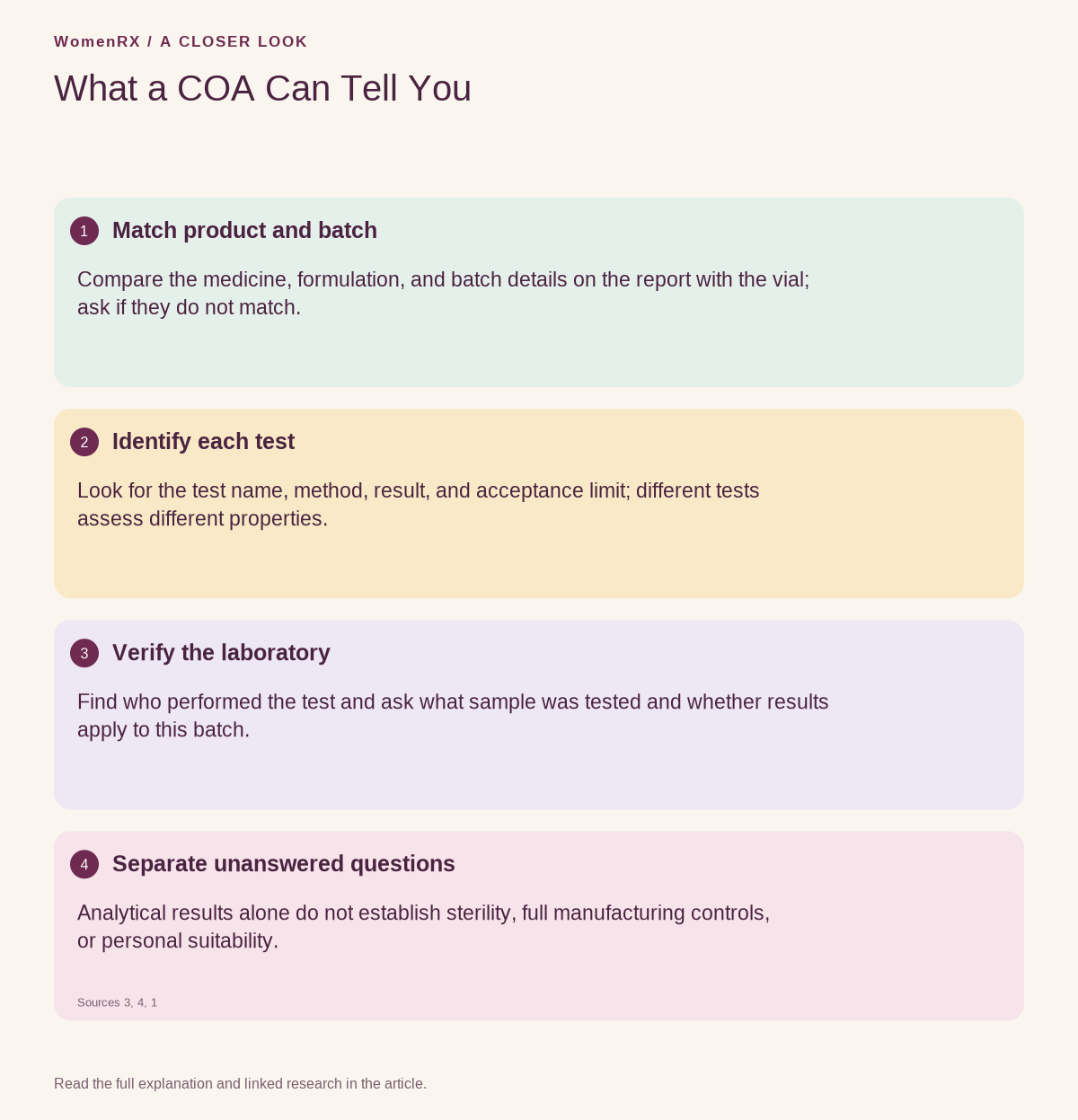
What a COA Can Tell You
Match product and batch: Compare the medicine, formulation, and batch details on the report with the vial; ask if they do not match.
Identify each test: Look for the test name, method, result, and acceptance limit; different tests assess different properties.
Verify the laboratory: Find who performed the test and ask what sample was tested and whether results apply to this batch.
Separate unanswered questions: Analytical results alone do not establish sterility, full manufacturing controls, or personal suitability.341
Read the figure as text
Use these checks to connect a report to the product and batch, then keep its test results separate from broader quality and personal-suitability questions.- Match product and batch: Compare the medicine, formulation, and batch details on the report with the vial; ask if they do not match.
- Identify each test: Look for the test name, method, result, and acceptance limit; different tests assess different properties.
- Verify the laboratory: Find who performed the test and ask what sample was tested and whether results apply to this batch.
- Separate unanswered questions: Analytical results alone do not establish sterility, full manufacturing controls, or personal suitability.341
More questions, answered
Does a COA prove that a compounded GLP-1 medicine is sterile?
Not unless it reports an appropriate sterility test for the relevant sample, and even then it documents that test rather than every aspect of preparation and quality. Sterility, endotoxin, potency, and other properties are distinct testing questions. 3 4
Can a COA tell me whether a GLP-1 medicine is safe during pregnancy?
No. A COA reports results for tests on a sample; it does not determine whether a medicine is appropriate during pregnancy or for an individual. Pregnancy medicine decisions should be made with a healthcare provider who knows the specific medicine and situation. 1
Sources you can check
- Pregnancy and Medicines | MedlinePlusAccessed 2026-09-25Return to first citation
- A novel, widespread impurity in mass-compounded tirzepatide/B12 products: potential patient safety implications.Jordan B, Arbogast L, Clemens M, Huang L, Snyder M. · Expert opinion on drug safety · 2026Return to first citation
- In-office compounding of buffered lidocaine and epinephrine - A stability and safety review.Desai SR, Vidimos AT, Elder EJ, Davidson G, Compounding Work Group. · Journal of the American Academy of Dermatology · 2026Return to first citation
- Quality Assurance and Quality Control, Part 2.Akers MJ. · International journal of pharmaceutical compounding · 2015Return to first citation