How to Check a Weight-Loss Peptide Before You Use It
Check the exact product and its intended use: a familiar ingredient name doesn’t tell you whether that formulation is approved for weight management.
Start with the exact active ingredient, brand or product, and formulation, then verify that the specific product is FDA-approved for weight management, not just that a similar ingredient is used in another medicine. Compounded products are not FDA-approved, and investigational or supplement products aren’t interchangeable with approved medicines. Ask what evidence supports the exact product and what follow-up your care plan includes. 4 5

“Peptide” isn’t an approval category
Peptides are a broad group of molecules, not a single kind of weight-loss treatment. Some prescription medicines work on hormone pathways involved in appetite and fullness. But seeing “peptide,” “GLP-1,” or a familiar drug name in an ad doesn’t establish that a product is FDA-approved for weight management, or that it is the same formulation used in studies.
The useful question is not just “Does it contain semaglutide or tirzepatide?” It’s “What is this exact product, and what use is it authorized for?”
Check the product, not just the ingredient
FDA approval applies to a specific drug product and its authorized uses. The brand, active ingredient, formulation, and intended use all matter. For example, semaglutide and tirzepatide appear in products with different brand names and indications: a review distinguishes Wegovy and Zepbound for weight management from Ozempic and Mounjaro for type 2 diabetes. Those names aren’t interchangeable just because an active ingredient is related or the same. 4 5
Liraglutide, semaglutide, and tirzepatide are among the medicines discussed in the literature for weight management, but they are distinct medicines, and tirzepatide acts on two hormone receptors rather than one. Don’t treat “GLP-1” as a label that makes every product or formulation equivalent. 2 5
A practical product check:
- Exact identity: What is the active ingredient and product or brand name on the prescription and pharmacy label?
- Formulation: Is it an approved brand-name product, a compounded preparation, a pill, or an injection? Don’t assume one form has the same authorization or evidence as another.
- Intended use: Is this exact product approved for weight management, or for another condition? A medicine may be prescribed for a use other than its labeled indication, but that is different from having approval for that use. 4 5
- Evidence: Are claims based on trials of this exact product and formulation, or on a different drug, a small early-stage study, or promotional material?
- Care plan: Who evaluates whether it’s appropriate for you, and what follow-up will address your response, side effects, and treatment plan?
Approved, compounded, and investigational aren’t synonyms
FDA-approved medicines have been reviewed for the uses described in their labeling. A compounded medicine is different: it isn’t FDA-approved, and FDA does not review compounded medicines for safety, effectiveness, or quality before they’re marketed. A valid prescription and a licensed provider’s involvement don’t turn a compounded product into an FDA-approved one.
An investigational product is still being studied; encouraging results from a clinical trial don’t establish that it is approved or available as an authorized treatment. For instance, a randomized phase II trial of the oral investigational product VCT220 reported weight changes over 16 weeks in adults in China. That is evidence about that study product and trial, not proof that any online product described as an oral GLP-1 or peptide has the same results. 6
Weight-loss supplements are another category. They are not prescription drugs, and they do not undergo the same FDA premarket approval process as drugs. NIH’s Office of Dietary Supplements says little is known about whether many weight-loss supplements work, and some ingredients may cause harm or interact with medicines. 3
If a seller won’t identify the exact active ingredient, formulation, pharmacy, or prescriber, you don’t have enough information to assess what is being offered. Treat “research use,” “peptide blend,” or a claim that a product is “the same as” a brand-name medicine as a reason to verify details, not as evidence of equivalence.
What the weight-loss evidence can tell you
Clinical trials can show whether a particular medicine reduced weight on average in the people studied, compared with a control group, over a stated period. They don’t guarantee an individual result, and results from one medicine or formulation shouldn’t be transferred automatically to another. A review reports different average outcomes across trials of liraglutide, semaglutide, and tirzepatide, which is one reason a single headline percentage can’t stand in for a product-specific comparison. 5
For women, ask whether the trial results and adverse effects were reported separately by sex. The overall weight-loss figures summarized in the review aren’t, by themselves, a women-only estimate. A study that includes women can still leave unanswered whether outcomes or side effects differ by sex if it reports only combined results. 5
Include pregnancy plans in the product check
Weight-loss treatment needs a different conversation if you’re pregnant, breastfeeding, or planning to try to conceive. A review on GLP-1 medicines and fertility says these medicines should be avoided during pregnancy and describes limited human evidence; it also discusses stopping treatment before conception. Don’t rely on a general online timeline: ask the prescriber to review the exact medicine and your pregnancy plans before starting or continuing it. 4 5
The goal isn’t to sort treatments by hype. It’s to know exactly what product is being considered, what it is approved to do, what evidence applies to that product, and who will oversee the decision.
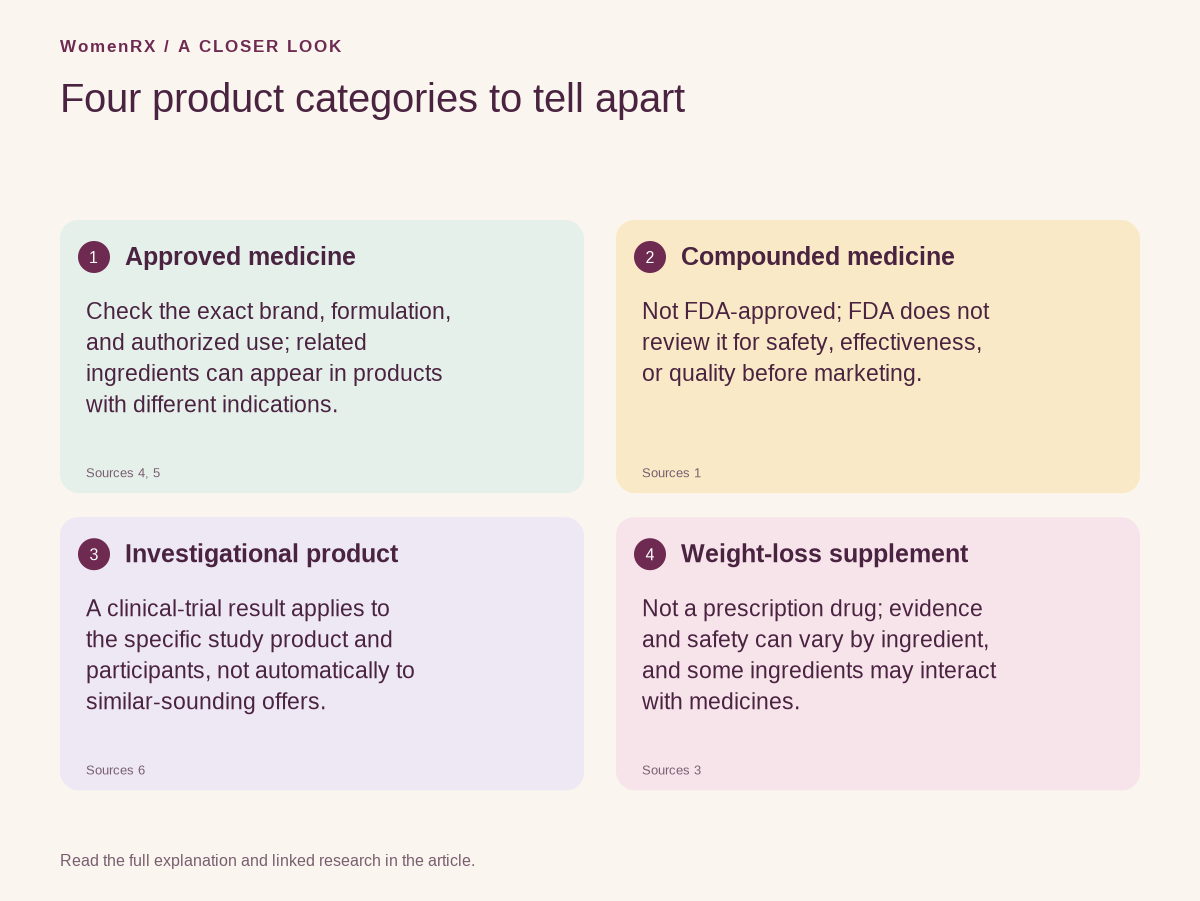
Four product categories to tell apart
Approved medicine: Check the exact brand, formulation, and authorized use; related ingredients can appear in products with different indications.45
Compounded medicine: Not FDA-approved; FDA does not review it for safety, effectiveness, or quality before marketing.
Investigational product: A clinical-trial result applies to the specific study product and participants, not automatically to similar-sounding offers.6
Weight-loss supplement: Not a prescription drug; evidence and safety can vary by ingredient, and some ingredients may interact with medicines.3
Read the figure as text
The label and evidence depend on the exact product. These categories are not interchangeable.- Approved medicine: Check the exact brand, formulation, and authorized use; related ingredients can appear in products with different indications.45
- Compounded medicine: Not FDA-approved; FDA does not review it for safety, effectiveness, or quality before marketing.
- Investigational product: A clinical-trial result applies to the specific study product and participants, not automatically to similar-sounding offers.6
- Weight-loss supplement: Not a prescription drug; evidence and safety can vary by ingredient, and some ingredients may interact with medicines.3
More questions, answered
Does a prescription mean a compounded product is FDA-approved?
No. A prescription and clinical evaluation don’t change a compounded medicine’s status: compounded medicines are not FDA-approved, and FDA does not review them for safety, effectiveness, or quality before marketing.
Are weight-loss supplements the same as prescription medicines?
No. Supplements aren’t prescription drugs and don’t undergo the same FDA premarket approval process as drugs. Evidence and safety vary by ingredient, and some supplement ingredients may interact with medicines. 3
Sources you can check
- SAXENDA (LIRAGLUTIDE) INJECTION, SOLUTION [NOVO NORDISK PHARMACEUTICAL INDUSTRIES, LP] | US prescribing information and patient instructionsAccessed 2026-09-25Return to first citation
- Dietary Supplements for Weight Loss - Health Professional Fact SheetAccessed 2026-09-25Return to first citation
- GLP-1 Receptor Agonists and Fertility: What Is Known So Far?Becker AS, Castilhos JP, Shugair SAS, Colombo T, Hentschke M-. · JBRA assisted reproduction · 2026Return to first citation
- Medical therapy to treat obesity and optimize fertility in women of reproductive age: a narrative review.Duah J, Seifer DB. · Reproductive biology and endocrinology : RB&E · 2025Return to first citation
- Oral nonpeptide GLP-1 receptor agonist VCT220 for obesity treatment: a randomized, double-blind, phase II trial.Ji L, Gao L, Li B, Liu M, Zhang X, Meng C. · Signal transduction and targeted therapy · 2026Return to first citation