Weight-Loss Supplements With Semaglutide: What Can You Check?
A supplement’s ingredients, your other medicines, and any stomach symptoms matter more than the product’s weight-loss claim.
There isn’t one interaction rule for weight-loss supplements and semaglutide. Fiber may add gas or bloating to semaglutide-related stomach symptoms, but a harmful fiber-semaglutide interaction hasn’t been established. Semaglutide also has medication-specific concerns, including low blood sugar risk when used with insulin or a sulfonylurea. Check every ingredient in a stack separately; the information about fiber cannot clear the rest of the product. 1 2 3
Start with ingredients, not the product name
A “weight-loss stack” can contain several active ingredients, and the product name alone won’t tell you what to check. Write down each active ingredient and the amount per serving from the label. Include powders, capsules, teas, gummies, and anything described as a blend. If an amount or ingredient isn’t clear, bring the package or a clear photo of the label to a pharmacist.
Ask about each ingredient separately. The useful question is not simply, “Can I take this with a GLP-1?” It’s: “Is there a known interaction with this ingredient and my specific medicine, or is the concern overlapping side effects or an evidence gap?” Fiber offers an example of overlapping gut effects. It doesn’t tell you whether a stimulant, botanical extract, or another ingredient in the same product is safe to combine with semaglutide. Nor should semaglutide-specific information be assumed to apply to every GLP-1 medicine.
Separate three different kinds of concern
A documented medication issue: Semaglutide product information says it can affect how some medicines work. The concern deserves a closer check when you take oral medicines, but that warning does not establish a specific interaction with every supplement. Oral semaglutide tablets also have particular administration instructions: their patient guide says to take other oral medicines after 30 minutes. Ask your pharmacist how a supplement fits those instructions rather than guessing about timing. 2
If you use insulin or a sulfonylurea for diabetes, mention that specifically. Semaglutide labeling says the risk of low blood sugar can be higher when it is used with these medicines. That is a prescription-medication combination to review, whether or not you’re considering a supplement. 1 2
Overlapping side effects: Semaglutide can cause nausea, vomiting, diarrhea, or constipation. Fiber can also cause gas or bloating, particularly when intake increases quickly. Those effects could make it harder to tell whether a symptom is from the medicine, the supplement, or both. That overlap is not the same as a proven drug interaction. 1 2 3
An uncertain combination: A 2026 review describes possible ways fiber and GLP-1 medicines could affect gut processes, but characterizes these ideas as hypotheses rather than established combination-treatment strategies; it also calls for well-designed trials. That’s a reason to be measured about claims that a particular fiber supplement will improve weight loss or prevent side effects. It is not evidence that fiber supplements are always unsafe. 3
These distinctions help with fiber. They cannot settle the question for other ingredients in a weight-loss product without checking those ingredients in their own right.
Give the pharmacist the details that change the answer
Bring the supplement label and the name and formulation of your GLP-1 medicine. Include the amount you plan to take, how often you’d use it, and any prescription medicines, over-the-counter medicines, vitamins, or other supplements. Mention whether you take a tablet or an injection, since the product’s administration instructions can differ. 2
Also describe any nausea, vomiting, diarrhea, constipation, or trouble keeping fluids down. With semaglutide, ongoing vomiting or diarrhea can lead to dehydration and kidney problems; severe or persistent stomach symptoms deserve attention rather than being covered up with another product. Persistent or severe abdominal pain, with or without nausea or vomiting, is a labeled warning sign that needs prompt medical attention. 1 2
A concise question to ask is: “Can you check each active ingredient on this label against my specific GLP-1, its formulation, my other medicines, and the symptoms I’m having?” If the label has a proprietary blend or unclear amounts, ask whether the ingredients can be identified well enough to review.
Make pregnancy plans part of the medication check
If you’re pregnant, breastfeeding, trying to conceive, or receiving fertility treatment, include that in the same conversation. Include the names of fertility medicines in the review so the pharmacist can consider them alongside the supplement and your GLP-1. For oral semaglutide tablets, the US patient guide says to stop treatment two months before a planned pregnancy and says breastfeeding is not recommended during treatment. Those instructions are product-specific, so don’t assume they apply to every GLP-1 medicine or formulation. 2
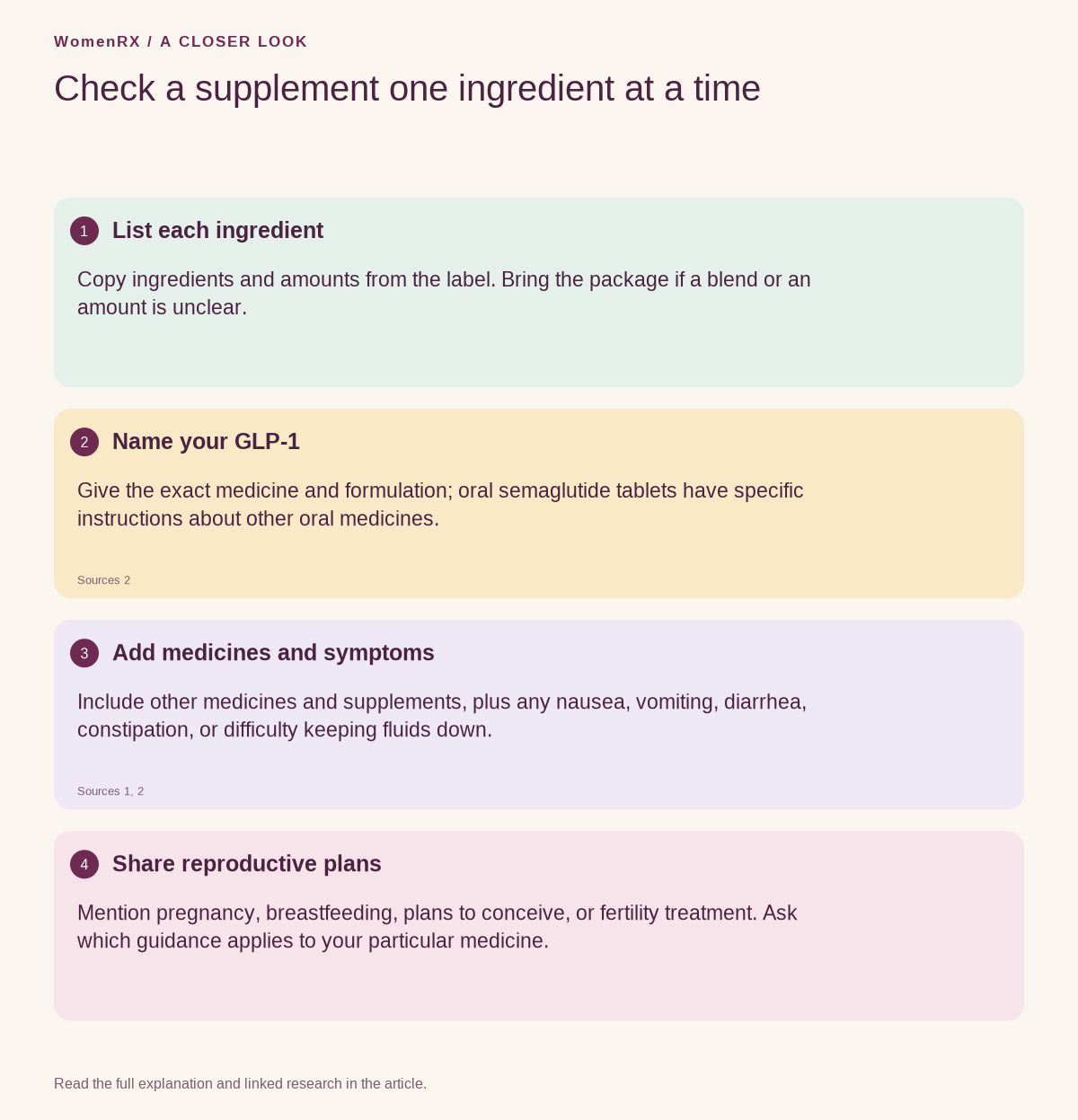
Check a supplement one ingredient at a time
List each ingredient: Copy ingredients and amounts from the label. Bring the package if a blend or an amount is unclear.
Name your GLP-1: Give the exact medicine and formulation; oral semaglutide tablets have specific instructions about other oral medicines.2
Add medicines and symptoms: Include other medicines and supplements, plus any nausea, vomiting, diarrhea, constipation, or difficulty keeping fluids down.12
Share reproductive plans: Mention pregnancy, breastfeeding, plans to conceive, or fertility treatment. Ask which guidance applies to your particular medicine.
Read the figure as text
Use this checklist to make a pharmacist review specific. It does not clear a supplement or substitute for checking its individual ingredients.- List each ingredient: Copy ingredients and amounts from the label. Bring the package if a blend or an amount is unclear.
- Name your GLP-1: Give the exact medicine and formulation; oral semaglutide tablets have specific instructions about other oral medicines.2
- Add medicines and symptoms: Include other medicines and supplements, plus any nausea, vomiting, diarrhea, constipation, or difficulty keeping fluids down.12
- Share reproductive plans: Mention pregnancy, breastfeeding, plans to conceive, or fertility treatment. Ask which guidance applies to your particular medicine.
More questions, answered
Is a fiber supplement automatically a problem with a GLP-1?
No. The research describes possible gut effects, not a proven harmful interaction or an established benefit from combining fiber supplements with a GLP-1 medicine. Fiber can also cause gas or bloating, so include it in an ingredient-by-ingredient review, especially if you already have gastrointestinal symptoms. 3
Sources you can check
- WEGOVY (SEMAGLUTIDE) INJECTION, SOLUTION WEGOVY (SEMAGLUTIDE) TABLET [NOVO NORDISK PHARMACEUTICAL INDUSTRIES, LP] | US prescribing information and patient instructionsAccessed 2026-09-25Return to first citation
- OZEMPIC (ORAL SEMAGLUTIDE) TABLET RYBELSUS (ORAL SEMAGLUTIDE) TABLET [NOVO NORDISK PHARMACEUTICAL INDUSTRIES, LP] | US prescribing information and patient instructionsAccessed 2026-09-25Return to first citation
- Dietary Fiber and Glucagon-Like Peptide-1 Receptor Agonists in Obesity Management: Converging Mechanisms, Interactions, and Strategies for Durable Weight Control.Wang Y, Liu J, Verbeke K, Retamal NG, Akkerman R, de Vos P. · Advances in nutrition (Bethesda, Md.) · 2026Return to first citation