Which Supplements Belong With a GLP-1 Medicine?
A supplement earns its place when you can name the need it addresses and check it against your exact medicine.
Start with the supplements you already take, not a prebuilt stack. For each one, identify the ingredient, the reason you use it, and the question you need answered about your medicine. The semaglutide tablet guide asks patients to disclose vitamins and herbal supplements, but it doesn’t identify an interaction with every supplement. Oral semaglutide also has specific timing instructions. 1
Start with a reason, not a stack
Taking a GLP-1 medicine doesn’t, by itself, tell you whether you need a multivitamin, fiber powder, or another supplement. The semaglutide tablet guide asks you to disclose vitamins and herbal supplements; it doesn’t recommend a standard supplement routine. Start with what you’re trying to address, such as a documented deficiency or a specific symptom, and review the product against the medicine you actually take. 1
That distinction matters because a request to disclose supplements is not a finding that they all interact. The semaglutide tablet guide says the medicine may affect how some medicines work and asks patients to share a list of medicines, vitamins, and herbal supplements. It does not identify an interaction for each supplement ingredient. 1
Use this worksheet for each product
Write down one row for every vitamin, mineral, herb, powder, gummy, or combination product you use, including items marketed for weight loss or digestion.
| What to record | What to write down |
|---|---|
| Product details | Full product name, each active ingredient, amount per serving, and how often you take it. A photo of the label can help. |
| Your reason | The specific purpose: for example, a deficiency identified on testing, a symptom you’re trying to address, or another clinician-recommended reason. |
| Evidence for that purpose | Is the product intended to address your specific need, or is the claim mainly about weight loss, appetite, or “metabolism”? Don’t treat a general marketing claim as proof it will help you. |
| Possible overlap | Check combination products for repeated ingredients, and include prescription medicines and over-the-counter products on the same list. |
| Questions to resolve | Ask whether the ingredient is appropriate for you, whether it affects the timing of your medicine, and whether there’s a clear reason to continue it. |
If you have a known deficiency, make that the starting point for the discussion. If heavy menstrual bleeding or menopause-related concerns are relevant, note them on the worksheet to discuss alongside the supplement and any test results. If you don’t, don’t assume that nausea, constipation, a change in appetite, or weight loss proves you need a particular nutrient. Nausea and constipation are among the effects described for semaglutide tablets, so a new symptom isn’t automatically evidence of a deficiency. 1
Dietary fiber may be useful, but its combination with GLP-1 medicines remains unproven
Dietary fiber is worth considering separately from a typical “weight-loss stack.” A 2026 review describes possible ways dietary fiber could support bowel regularity and overlap with gut pathways affected by GLP-1 medicines. But the authors characterize proposed interactions as hypothesis-generating, not established treatment strategies, and call for well-designed trials combining GLP-1 medicines with well-characterized fibers. The review does not establish that fiber supplements prevent side effects or improve weight loss when added to a GLP-1 medicine. 2
The practical distinction is between a reasonable nutrition goal and a proven benefit from combining fiber with a GLP-1 medicine. The review notes that fiber’s effects vary by type and amount, and that increasing intake too quickly can bring gas or bloating. If you’re already dealing with stomach symptoms, that tolerability question matters more than a claim that fiber will boost your medicine. 2
Check timing for oral semaglutide
Oral semaglutide has specific instructions that don’t apply automatically to injectable GLP-1 medicines. Its medication guide says to take the tablet on an empty stomach with water, then wait 30 minutes before eating, drinking, or taking other oral medicines. The guide also asks patients to disclose vitamins and herbal supplements, but doesn’t spell out how every supplement fits into that timing rule. Bring your exact product label to a pharmacist or prescriber rather than assuming the tablet instructions apply to injections. 1
That is the concrete supplement-review issue established here: what you take by mouth, when you take it, and whether it fits your tablet routine. The semaglutide tablet guide doesn’t provide an ingredient-by-ingredient supplement interaction list, so it can’t clear an herbal blend or establish that one interacts. If you also take insulin or a sulfonylurea, include it on the same medication list: the semaglutide tablet guide identifies those medicines as relevant to low-blood-sugar risk. That is a medicine interaction to review, not evidence of a supplement interaction. 1
Review pregnancy and breastfeeding guidance for your medicine
Pregnancy plans can change the medication discussion. The semaglutide tablet guide says to stop Rybelsus or Ozempic tablets two months before a planned pregnancy and to discuss blood-sugar management. It says breastfeeding isn’t recommended during treatment with those tablets. These are product-specific statements, not blanket instructions for every GLP-1 medicine, so check the guidance for the exact drug you take. 1
A useful stopping question
For each product, ask: “What specific need is this for, what evidence supports using it for that need, and has someone checked its ingredients and timing against my exact medicine?” If there’s no clear answer, pause before adding it or buying another product. Bring the worksheet and labels to your pharmacist or prescriber, and update the list when your medicines or supplements change.
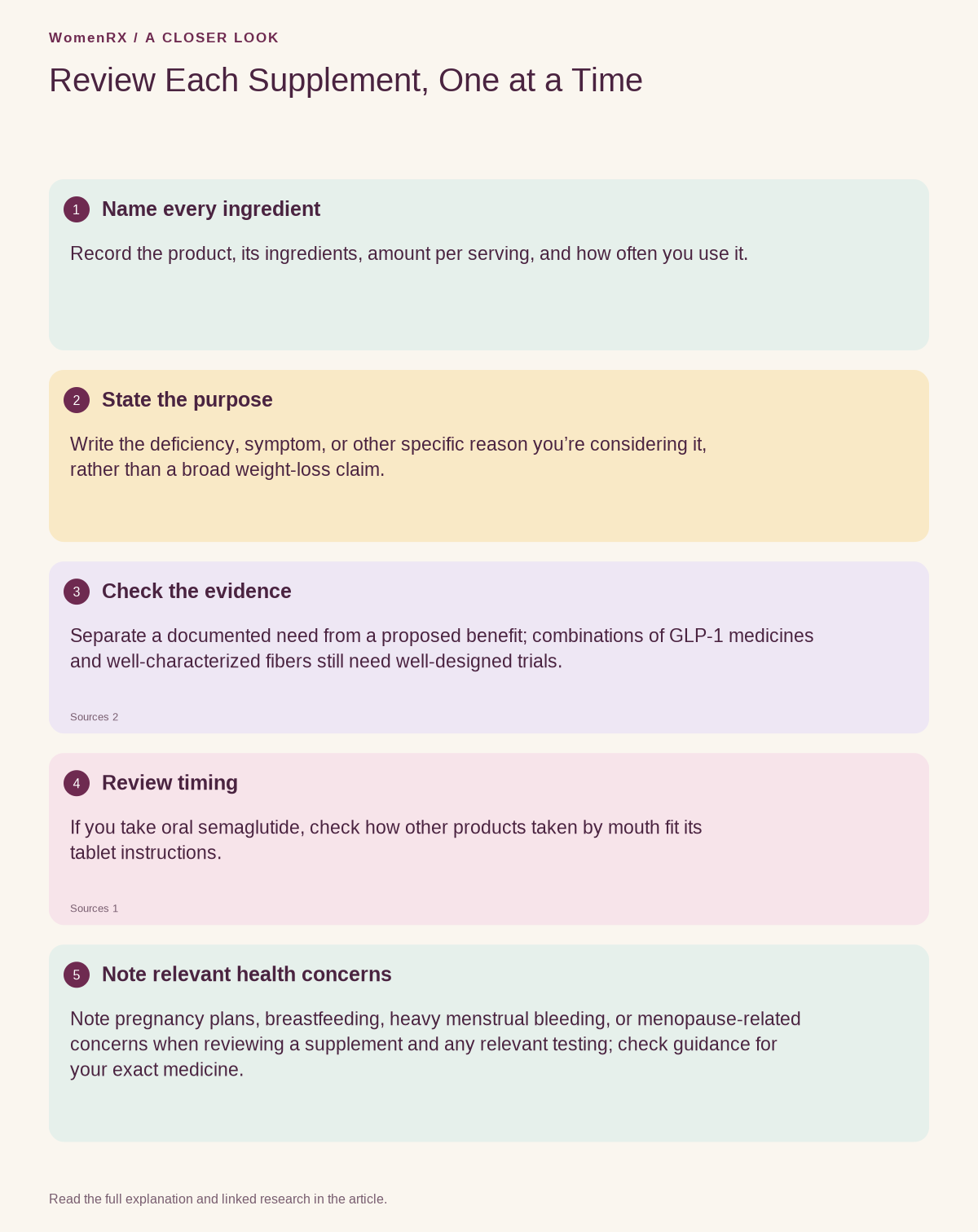
Review Each Supplement, One at a Time
Name every ingredient: Record the product, its ingredients, amount per serving, and how often you use it.
State the purpose: Write the deficiency, symptom, or other specific reason you’re considering it, rather than a broad weight-loss claim.
Check the evidence: Separate a documented need from a proposed benefit; combinations of GLP-1 medicines and well-characterized fibers still need well-designed trials.2
Review timing: If you take oral semaglutide, check how other products taken by mouth fit its tablet instructions.1
Note relevant health concerns: Note pregnancy plans, breastfeeding, heavy menstrual bleeding, or menopause-related concerns when reviewing a supplement and any relevant testing; check guidance for your exact medicine.
Read the figure as text
Use these prompts to make a supplement review specific to your needs and your exact GLP-1 medicine.- Name every ingredient: Record the product, its ingredients, amount per serving, and how often you use it.
- State the purpose: Write the deficiency, symptom, or other specific reason you’re considering it, rather than a broad weight-loss claim.
- Check the evidence: Separate a documented need from a proposed benefit; combinations of GLP-1 medicines and well-characterized fibers still need well-designed trials.2
- Review timing: If you take oral semaglutide, check how other products taken by mouth fit its tablet instructions.1
- Note relevant health concerns: Note pregnancy plans, breastfeeding, heavy menstrual bleeding, or menopause-related concerns when reviewing a supplement and any relevant testing; check guidance for your exact medicine.
More questions, answered
Do all supplements interact with GLP-1 medicines?
The semaglutide tablet guide asks patients to disclose vitamins and herbal supplements, but that is not the same as identifying an interaction with every product. Its specific tablet timing instructions make the details of anything else you take by mouth worth checking. 1
Should I take fiber while using a GLP-1 medicine?
Dietary fiber may be a reasonable nutrition consideration, but a 2026 review treats proposed benefits from combining dietary fiber with GLP-1 medicines as unproven and calls for trials using well-characterized fibers. This does not establish a benefit from fiber supplements as add-ons. The review also notes that increasing fiber intake too quickly can cause gas or bloating, which may matter if you already have stomach symptoms. 2
Sources you can check
- OZEMPIC (ORAL SEMAGLUTIDE) TABLET RYBELSUS (ORAL SEMAGLUTIDE) TABLET [NOVO NORDISK PHARMACEUTICAL INDUSTRIES, LP] | US prescribing information and patient instructionsAccessed 2026-09-25Return to first citation
- Dietary Fiber and Glucagon-Like Peptide-1 Receptor Agonists in Obesity Management: Converging Mechanisms, Interactions, and Strategies for Durable Weight Control.Wang Y, Liu J, Verbeke K, Retamal NG, Akkerman R, de Vos P. · Advances in nutrition (Bethesda, Md.) · 2026Return to first citation