Should Side Effects Make You Stop a GLP-1 Medicine?
The right next step depends on the symptom: serious allergy signs need immediate help, while milder stomach symptoms may leave room for a treatment review.
Don’t use one stop rule for every side effect. If you have signs of a serious allergic reaction, the instructions for Ozempic and Zepbound say to stop using the medicine and get medical help right away. Severe abdominal pain that won’t go away also has a specific stop-and-call instruction. Persistent vomiting or diarrhea calls for contacting your prescriber right away because dehydration can harm your kidneys. 48
First, separate a warning sign from an unpleasant side effect
Nausea, diarrhea and vomiting can happen with medicines such as semaglutide and tirzepatide. What matters for your next move is whether symptoms are mild and manageable, are continuing and costing you fluids, or match a warning sign that needs immediate action. For example, a brief spell of nausea while you can still drink is a different situation from vomiting that won’t let up. 48
Get medical help right away for signs of a serious allergic reaction, such as swelling of your face, lips, tongue or throat; trouble breathing or swallowing; a severe rash or itching; fainting or dizziness; or a very rapid heartbeat. The patient instructions for both Ozempic (semaglutide) and Zepbound (tirzepatide) say to stop using that medicine and get medical help right away if these signs occur. Don’t wait for a routine appointment. 48
Sudden, sharp abdominal pain also needs immediate medical assessment. So do abdominal pain with blood in your vomit or stool, or an abdomen that is hard and tender to touch. These are general abdominal-pain warning signs, not a way to tell at home whether your medicine is the cause. 1
When the medicine’s instructions say to stop and call
For severe abdominal pain that won’t go away, with or without vomiting, Ozempic and Zepbound instructions say to stop using the medicine and call your healthcare provider right away. The pain may spread toward your back. This is a warning sign for pancreatitis, but pain alone can’t establish the diagnosis. If the pain is sudden and sharp, seek immediate medical assessment rather than waiting for a returned call. 481
Zepbound’s instructions also say to tell your healthcare provider right away about possible gallbladder symptoms, including upper abdominal pain, fever, yellowing of the skin or eyes, or clay-colored stools. Those symptoms deserve assessment rather than an attempt to treat them as ordinary nausea. 4
Don’t wait out persistent fluid loss
If nausea, vomiting or diarrhea doesn’t go away, the Ozempic and Zepbound patient instructions say to tell your healthcare provider right away. Fluid loss can lead to dehydration and kidney problems; Zepbound’s prescribing information calls for kidney-function monitoring when side effects could cause significant fluid loss, particularly when treatment is started or the dose is increased. If you’re struggling to keep fluids down, say so when you call. 48
Confusion alongside possible dehydration needs medical help right away. While you’re able to drink, small sips may be easier than trying to take in a lot at once when you feel sick. That’s a way to replace fluid, not a reason to delay help for symptoms that persist or worsen. 23
If symptoms are tolerable, review the tradeoff
For a milder symptom without the warning signs above, a planned discussion may be more useful than deciding on your own to stop or push through. Tell your prescriber what the symptom is doing to your day: for example, whether nausea makes meals difficult, whether constipation is persistent, and whether the problem began after a change in treatment. Ask what options make sense for your specific medicine and what symptom would change the plan. 48
Stopping can have a longer-term tradeoff. A systematic review of studies in adults with overweight or obesity found weight regain after GLP-1-based treatment was discontinued compared with continued treatment. That finding doesn’t mean you should stay on a medicine through a serious side effect. It does mean a nonurgent decision to stop is worth pairing with a plan for what comes next. The review did not report a women-specific result. 7
When you contact your care team, have the medicine name, your most recent dose and when you took it, when symptoms started, whether they’re improving or worsening, and whether you can drink and urinate as usual. Mention other diabetes medicines, especially insulin or a sulfonylurea, because the Ozempic instructions flag these when discussing low blood sugar. Those details help the team respond to the situation you’re actually in. 8
Pregnancy plans and breastfeeding need a separate conversation
If you’re pregnant, planning pregnancy or breastfeeding, raise that specifically rather than treating it as just another side effect. Instructions differ by medicine, and the reason you take it matters. For example, Ozempic’s instructions say to stop it at least two months before a planned pregnancy and to discuss how to manage blood sugar during pregnancy; that timing should not be assumed to apply to every medicine in this group. 8
Research on exposure around conception and early pregnancy has not shown a consistent increase in several measured adverse outcomes, but evidence on continued use throughout pregnancy is limited. Breastfeeding evidence is limited too: in one small study, semaglutide was not detected in milk samples from eight women, which cannot settle every question about infant outcomes or every formulation. Tell the clinician managing your treatment if pregnancy is possible or you’re breastfeeding so the advice fits the particular medicine and your care needs. 568
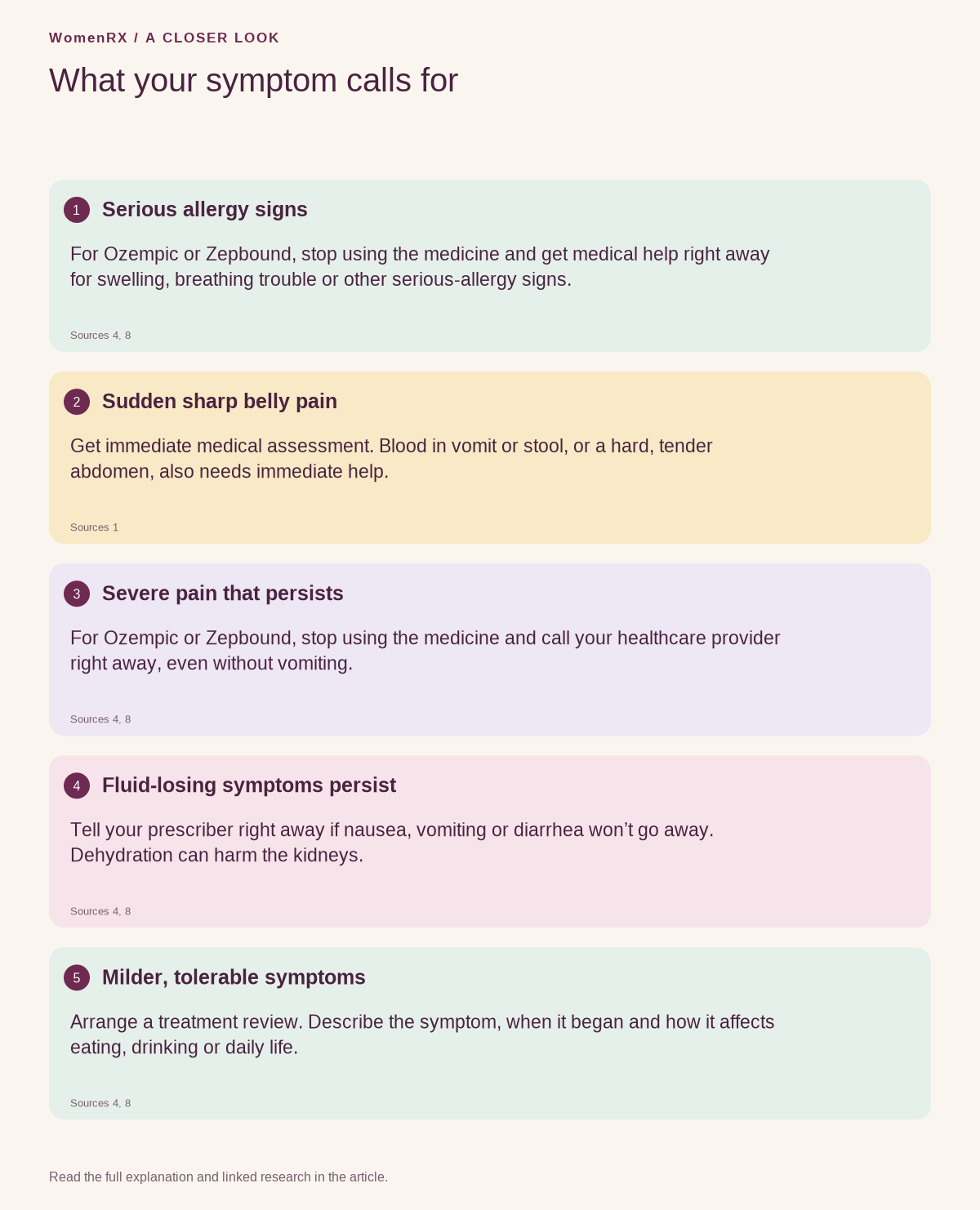
What your symptom calls for
Serious allergy signs: For Ozempic or Zepbound, stop using the medicine and get medical help right away for swelling, breathing trouble or other serious-allergy signs.48
Sudden sharp belly pain: Get immediate medical assessment. Blood in vomit or stool, or a hard, tender abdomen, also needs immediate help.1
Severe pain that persists: For Ozempic or Zepbound, stop using the medicine and call your healthcare provider right away, even without vomiting.48
Fluid-losing symptoms persist: Tell your prescriber right away if nausea, vomiting or diarrhea won’t go away. Dehydration can harm the kidneys.48
Milder, tolerable symptoms: Arrange a treatment review. Describe the symptom, when it began and how it affects eating, drinking or daily life.48
Read the figure as text
Start with the most serious symptom you have. These routes distinguish immediate assessment from product-specific instructions to contact your prescriber.- Serious allergy signs: For Ozempic or Zepbound, stop using the medicine and get medical help right away for swelling, breathing trouble or other serious-allergy signs.48
- Sudden sharp belly pain: Get immediate medical assessment. Blood in vomit or stool, or a hard, tender abdomen, also needs immediate help.1
- Severe pain that persists: For Ozempic or Zepbound, stop using the medicine and call your healthcare provider right away, even without vomiting.48
- Fluid-losing symptoms persist: Tell your prescriber right away if nausea, vomiting or diarrhea won’t go away. Dehydration can harm the kidneys.48
- Milder, tolerable symptoms: Arrange a treatment review. Describe the symptom, when it began and how it affects eating, drinking or daily life.48
Sources you can check
- Abdominal Pain | MedlinePlusAccessed 2026-09-25Return to first citation
- Dehydration: MedlinePlusAccessed 2026-09-25Return to first citation
- Dehydration - NHSAccessed 2026-09-25Return to first citation
- ZEPBOUND (TIRZEPATIDE) INJECTION, SOLUTION ZEPBOUND (TIRZEPATIDE) INJECTION, SOLUTION ZEPBOUND KWIKPEN (TIRZEPATIDE) INJECTION, SOLUTION [ELI LILLY AND COMPANY] | US prescribing information and patient instructionsAccessed 2026-09-25Return to first citation
- Safety of GLP-1 and Dual GLP-1/GIP Receptor Agonists in Preconception, Pregnancy, and Lactation: A Systematic Review of Maternal, Fetal, and Neonatal Outcomes.Ozbek L, Shah E, Al-Shiab R, Inal A, Guldan M, Afsar B, Covic A, Kanbay M. · Diabetes, obesity & metabolism · 2026Return to first citation
- Subcutaneous Semaglutide during Breastfeeding: Infant Safety Regarding Drug Transfer into Human Milk.Diab H, Fuquay T, Datta P, Bickel U, Thompson J, Krutsch K. · Nutrients · 2024Return to first citation
- Weight regain following discontinuation of glucagon-like peptide-1 receptor agonists in adults who are overweight or obese: a systematic review and meta-analysis.Qi H, Gao Q, Chen H, Du X, Pan B. · PeerJ · 2026Return to first citation
- OZEMPIC (SEMAGLUTIDE) INJECTION, SOLUTION [A-S MEDICATION SOLUTIONS] | US prescribing information and patient instructionsAccessed 2026-09-25Return to first citation