Psyllium for Constipation on GLP-1 Treatment
Psyllium may help constipation generally, but trials have not established it as a treatment for constipation related to GLP-1 medicines; severe or persistent abdominal pain calls for assessment before adding bulk.
Psyllium is a reasonable option to consider for mild constipation: trials in adults with constipation found improvement, but did not test it specifically for constipation caused by GLP-1 medicines. Increase fiber gradually, since a quick increase can cause gas, bloating, or cramps. Get medical advice for severe or persistent abdominal pain, especially if it comes with nausea or vomiting. 3 4 6
What psyllium can, and can’t, tell you
Psyllium is a form of fiber, and fiber can help with constipation. In a randomized trial of 72 people with chronic constipation, the psyllium group had more complete spontaneous bowel movements after four weeks; 75% met the study’s response definition. That supports psyllium as an option for constipation generally. It does not show that psyllium treats constipation caused by semaglutide, tirzepatide, or another GLP-1 medicine. 3 6
A separate eight-week trial in 79 people with functional constipation, most of them women, also found improvement in the psyllium group. These studies weren’t designed around GLP-1 treatment, so their results can’t answer how well psyllium works for someone whose symptoms began on one of these medicines. 5
Start with the pattern and the gentlest changes
Constipation can have more than one cause. A medicine may contribute, but a new bowel pattern shouldn’t automatically be blamed on the GLP-1. If symptoms started after beginning or changing a medicine, ask the prescriber or another health care provider to review it. Don’t stop a prescribed medicine on your own. 1 2
If symptoms are mild and you’re otherwise feeling well, general self-care can include gradually adding fiber from foods or a supplement, drinking enough fluids, and moving more. Increase fiber slowly: adding a lot at once can bring gas, bloating, or cramps. Psyllium is not a product-specific solution, and the studies above don’t establish a particular dose for people taking GLP-1 medicines. 1 2 3
When adding bulk may be the wrong first step
Don’t try to manage severe symptoms by adding fiber alone. The Wegovy prescribing information describes severe gastrointestinal reactions and flags persistent or severe abdominal pain, which may radiate to the back and may occur with nausea or vomiting. Get prompt medical assessment for severe or persistent abdominal pain, especially if you also have nausea or vomiting, rather than trying a fiber change first. 4
A sudden change in bowel habits merits medical review. If a medicine seems to be contributing, ask about options rather than stopping it without guidance. A clinician can also help decide whether short-term laxative use is appropriate. 1 2
Pregnancy, postpartum, and the rest of your context
Constipation is common during pregnancy and after giving birth. If either applies to you, mention it when asking about treatment; general constipation guidance says simple diet and lifestyle measures can be tried during pregnancy, but it does not establish psyllium-specific advice for pregnancy or postpartum. 2
If you’re seeking advice about constipation, mention relevant menstrual or pelvic symptoms too. Your medication, symptoms, and life stage all matter, so don’t assume a bowel change is caused by the GLP-1 alone.
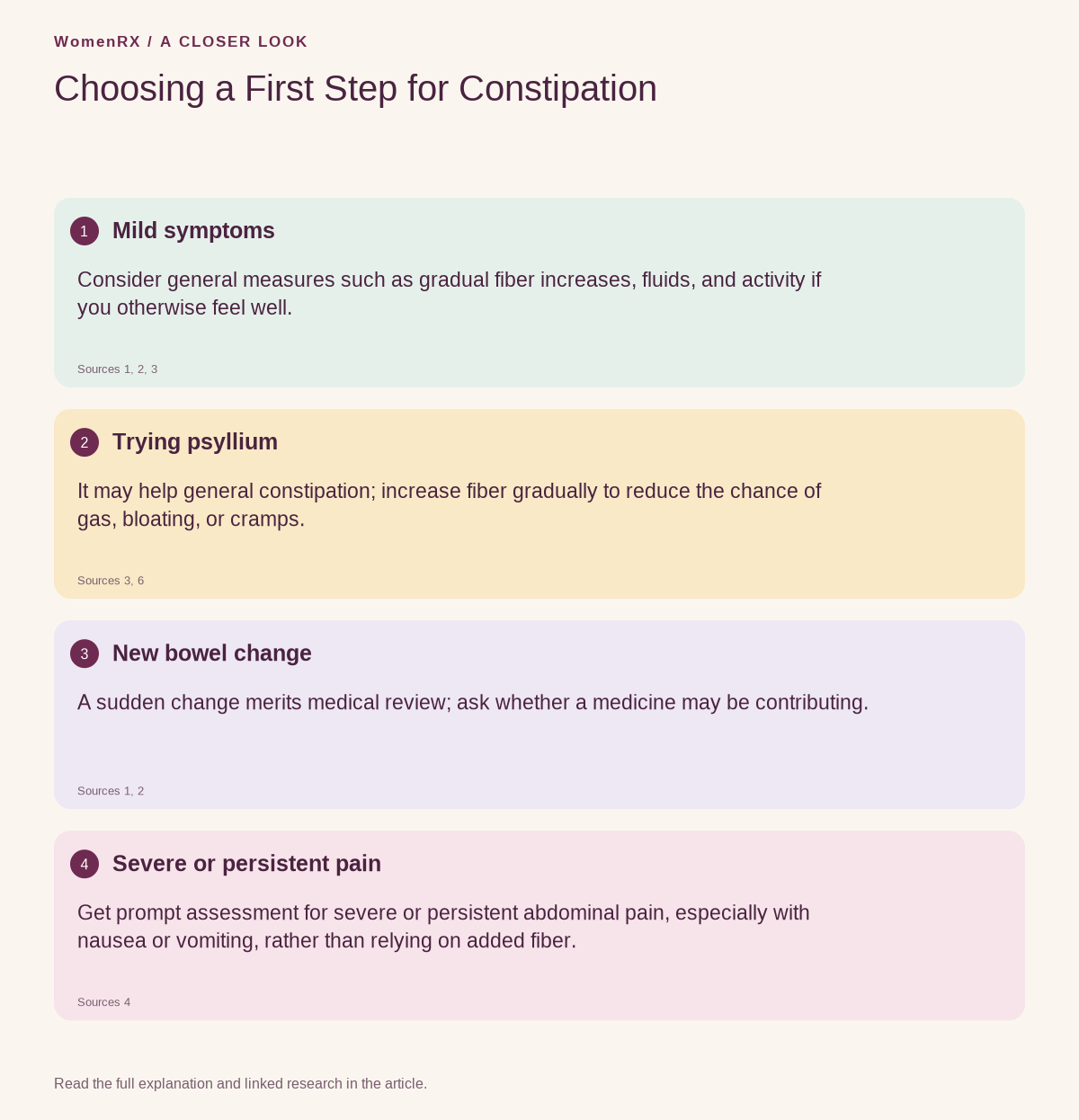
Choosing a First Step for Constipation
Mild symptoms: Consider general measures such as gradual fiber increases, fluids, and activity if you otherwise feel well.123
Trying psyllium: It may help general constipation; increase fiber gradually to reduce the chance of gas, bloating, or cramps.36
New bowel change: A sudden change merits medical review; ask whether a medicine may be contributing.12
Severe or persistent pain: Get prompt assessment for severe or persistent abdominal pain, especially with nausea or vomiting, rather than relying on added fiber.4
Read the figure as text
Use symptom severity and the pattern of bowel changes to distinguish mild constipation, where gradual self-care may be reasonable, from symptoms that need medical assessment.- Mild symptoms: Consider general measures such as gradual fiber increases, fluids, and activity if you otherwise feel well.123
- Trying psyllium: It may help general constipation; increase fiber gradually to reduce the chance of gas, bloating, or cramps.36
- New bowel change: A sudden change merits medical review; ask whether a medicine may be contributing.12
- Severe or persistent pain: Get prompt assessment for severe or persistent abdominal pain, especially with nausea or vomiting, rather than relying on added fiber.4
More questions, answered
Is psyllium proven to treat constipation from semaglutide or tirzepatide?
Trials of psyllium for general constipation did not study constipation specifically caused by GLP-1 medicines. They support psyllium as a possible general option, not as an established treatment for GLP-1-related constipation. 5 6
Can constipation happen during pregnancy or after birth?
Yes. Constipation is common during pregnancy and after giving birth. General guidance supports simple diet and lifestyle measures during pregnancy, but doesn’t provide psyllium-specific pregnancy advice. 2
Sources you can check
- Constipation | MedlinePlusAccessed 2026-09-25Return to first citation
- Constipation - NHSAccessed 2026-09-25Return to first citation
- Dietary Fiber: MedlinePlusAccessed 2026-09-25Return to first citation
- WEGOVY (SEMAGLUTIDE) INJECTION, SOLUTION WEGOVY (SEMAGLUTIDE) TABLET [NOVO NORDISK PHARMACEUTICAL INDUSTRIES, LP] | US prescribing information and patient instructionsAccessed 2026-09-25Return to first citation
- Agave tequilana Fructans Versus Psyllium plantago for Functional Constipation : Randomized Double-blind Clinical Trial.Coss-Adame E, García-Cedillo MF, Bustillo-Armendáriz G, Huerta-de la Torre MF, Delgado-Bautista MK, Arenas-Martinez J, Cassis-Nosthas L. · Journal of clinical gastroenterology · 2024Return to first citation
- Randomised clinical trial: mixed soluble/insoluble fibre vs. psyllium for chronic constipation.Erdogan A, Rao SS, Thiruvaiyaru D, Lee YY, Coss Adame E, Valestin J, O'Banion M. · Alimentary pharmacology & therapeutics · 2016Return to first citation