What Helps With Constipation During GLP-1 Treatment?
For mild constipation, gradual changes to food, fluids, and bathroom habits may help; severe pain needs a different response.
If constipation is mild, add fiber-rich foods gradually, drink water and other fluids regularly, and give yourself unhurried time to use the bathroom. Don’t assume the GLP-1 medicine is the only cause. Contact your prescriber if the change persists or worsens. Seek prompt assessment for severe or persistent abdominal pain. Get immediate help for sudden, sharp abdominal pain, or for abdominal pain when you can’t move your bowels, especially if you’re vomiting. 12347
First, notice what’s different for you
Constipation isn’t just a question of how many days have passed. Stool may be hard or dry, painful to pass, or difficult to empty fully. Fewer than three bowel movements in a week is one common sign, but you don’t need to go every day to be regular. A change from your usual pattern matters. 23
GLP-1 medicines can contribute. A review of randomized trials found constipation was more likely with the GLP-1 medicines studied than with placebo. That finding doesn’t tell you what’s causing your particular symptoms. Eating less, drinking less, a change in routine, limited movement, or another medicine may also be part of the picture. The reported results don’t tell us whether constipation risk differs for women. 356
The useful question is whether this is mild constipation you can approach gradually, or whether the symptoms call for assessment instead of more fiber.
For mild symptoms, build up rather than pile on
Make room for fiber-containing foods. Fruit, vegetables, and whole grains are familiar options. Oats or fruit might fit into a smaller meal if your appetite has changed. Start with a manageable addition, then see how you feel before adding more. Fiber helps prevent constipation, but a sudden increase can bring gas, bloating, and cramps. 13
Keep fluids in the picture. Not drinking enough is a common contributor to constipation. Water and other liquids are part of general constipation self-care, alongside fiber-rich foods. If you’ve been given a fluid limit for another condition, don’t change it just to follow general constipation advice. 23
Give the bathroom routine a chance to work. Try to use a regular time and place, leave yourself enough time, and avoid repeatedly ignoring the urge to go. Moving less than usual can also contribute to constipation, so consider whether your activity has changed. 3
These are reasonable first steps, not a reason to force large meals or rapidly increase fiber when you’re already uncomfortable. A review raises the possibility that smaller meals during GLP-1 treatment reduce fiber intake, but it does not establish that a particular food or fiber supplement treats constipation in people taking these medicines. 5
When more fiber isn’t the next move
If your bowel habits remain changed, symptoms are getting worse, or the first adjustments aren’t helping, contact your prescriber. Mention when the constipation started and whether your eating, drinking, activity, other medicines, or GLP-1 treatment changed around that time. General constipation guidance advises asking whether a medicine could be contributing and using a laxative only if your care provider says to. 23
Pain changes the decision. Severe or persistent abdominal pain needs prompt medical assessment, particularly if it reaches toward your back, with or without nausea or vomiting. Liraglutide prescribing information identifies that pattern as a possible sign of pancreatitis; it isn’t something to treat by adding fiber. Get immediate medical help for sudden, sharp abdominal pain, or if you have abdominal pain and can’t move your bowels, especially if you’re also vomiting. 47
Pregnancy and postpartum need their own context
Constipation is common during pregnancy and after giving birth. If either applies to you, a new bowel change may have more than one contributor, so don’t automatically put it down to the GLP-1 medicine. Simple food and routine changes can be tried during pregnancy, but discuss persistent symptoms and any medicine or laxative you’re considering with your pregnancy or postpartum care team. If you have an existing bowel or pelvic-floor condition, bring that history into the conversation too, rather than assuming the same approach fits every kind of constipation. 23
For mild symptoms, you may notice a difference after a few days, though general constipation guidance says improvement can sometimes take a few weeks. That isn’t a reason to wait through worsening symptoms or the warning signs above. 347
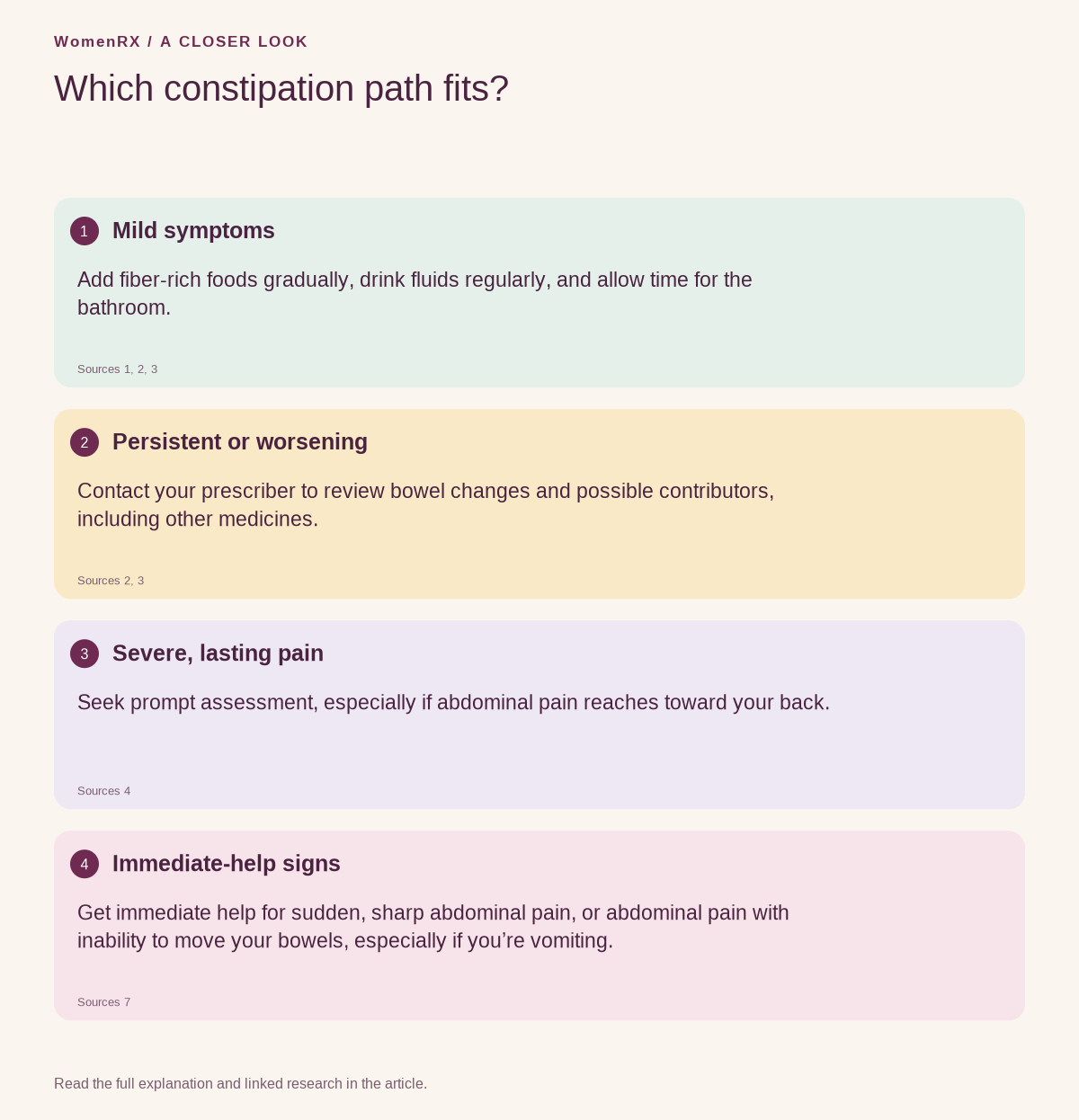
Which constipation path fits?
Mild symptoms: Add fiber-rich foods gradually, drink fluids regularly, and allow time for the bathroom.123
Persistent or worsening: Contact your prescriber to review bowel changes and possible contributors, including other medicines.23
Severe, lasting pain: Seek prompt assessment, especially if abdominal pain reaches toward your back.4
Immediate-help signs: Get immediate help for sudden, sharp abdominal pain, or abdominal pain with inability to move your bowels, especially if you’re vomiting.7
Read the figure as text
Start with how you feel now, then choose self-care or assessment rather than adding fiber regardless of symptoms.- Mild symptoms: Add fiber-rich foods gradually, drink fluids regularly, and allow time for the bathroom.123
- Persistent or worsening: Contact your prescriber to review bowel changes and possible contributors, including other medicines.23
- Severe, lasting pain: Seek prompt assessment, especially if abdominal pain reaches toward your back.4
- Immediate-help signs: Get immediate help for sudden, sharp abdominal pain, or abdominal pain with inability to move your bowels, especially if you’re vomiting.7
More questions, answered
Do I need a fiber supplement while taking a GLP-1 medicine?
Not necessarily. Food-based fiber is a reasonable place to start for mild symptoms, added gradually to limit gas, bloating, and cramps. A review discusses possible roles for fiber supplements during GLP-1 treatment, but does not establish that everyone needs one or that a particular supplement treats GLP-1-related constipation. 15
Sources you can check
- Dietary Fiber: MedlinePlusAccessed 2026-09-25Return to first citation
- Constipation | MedlinePlusAccessed 2026-09-25Return to first citation
- Constipation - NHSAccessed 2026-09-25Return to first citation
- SAXENDA (LIRAGLUTIDE) INJECTION, SOLUTION [NOVO NORDISK PHARMACEUTICAL INDUSTRIES, LP] | US prescribing information and patient instructionsAccessed 2026-09-25Return to first citation
- Psyllium and Glucomannan as Viscous Fiber Modulators of the Gut-Microbiome-Incretin Axis: Molecular Links to Metabolic Inflammation, Barrier Function, and GLP-1 Receptor Agonist Therapy.Yoon Y, Hwang J, Yang CM, Moon M, Lee JJ, Lam KHS, Castro JC, Suryadi T, Suhaimi A, Lee J. · International journal of molecular sciences · 2026Return to first citation
- Exploring the rates of Gastrointestinal adverse effects among five GLP-1 receptor agonists: A systematic review and Meta-Analysis of randomized controlled trials.Joy B, Ramsamooj A, Ibrahim S, Wen J, Hsu N, Frezza E. · Endocrine · 2026Return to first citation
- Abdominal Pain | MedlinePlusAccessed 2026-09-25Return to first citation