How to Support Muscle While Taking a GLP-1
Some weight lost on a GLP-1 medicine is lean mass, so pair weight-loss care with a realistic plan for strength, nutrition, and follow-up.
You can support muscle during GLP-1-associated weight loss by discussing resistance exercise, adequate food and protein, side effects that limit eating, and useful follow-up measures with your prescriber. Lean-mass loss can accompany weight loss, but lean mass is not the same as muscle. Exercise may help, though evidence that a particular program prevents muscle loss during GLP-1 treatment is still developing. 6 8 4
Weight loss can include lean mass
GLP-1 medicines reduce appetite and food intake, and weight loss can include a reduction in lean mass as well as fat. 8 In a 2026 meta-analysis of 20 randomized trials involving 15,782 adults with overweight or obesity, lean mass accounted for an estimated 35.2% of weight lost with semaglutide and 25.4% with tirzepatide. These are pooled estimates across trials, not predictions of what will happen to you. The analysis found broadly comparable proportions with medication and lifestyle weight loss overall. 6
One useful distinction: lean mass is not a direct measure of skeletal muscle. It also includes other tissues, organs, bone, and body water. A change on a body-composition reading therefore doesn’t tell the whole story about strength or physical function. 8
Make resistance exercise a practical part of the plan
Resistance exercise gives your muscles a reason to keep working as your weight changes. A review of lifestyle care alongside incretin medicines describes it as a sensible part of treatment, but also notes that strong, direct evidence testing exercise programs specifically alongside semaglutide or tirzepatide remains limited. So think of strength training as a supportive strategy, not a guarantee against lean-mass loss. 4
In one 12-week quasi-experimental study, adults who had recently started a GLP-1 medicine and received virtual support that included personalized, strength-focused activity coaching had a larger increase in muscle mass as a percentage of body weight than a usual-care group. The study used home bioelectrical-impedance scales and wasn’t a randomized trial, so that percentage change does not prove that participants preserved or gained a particular amount of muscle. 5
Ask your prescriber what kind of resistance exercise fits your health, experience, and current symptoms. If you’re new to it, have pain or mobility limits, or are feeling unusually weak, ask whether a physical therapist or qualified exercise professional can help you find a manageable starting point. The aim is an approach you can maintain, not to push through symptoms or match someone else’s routine.
Keep eating workable when appetite is lower
Appetite suppression can make it harder to eat enough or choose a varied diet. A review of lifestyle care during incretin treatment highlights protein, fluids, fiber, micronutrients, and overall food quality as considerations, while acknowledging that direct evidence on combining specific nutrition strategies with these medicines is limited. 4
Rather than trying to meet a generic target, tell your prescriber what a typical day of eating looks like and whether nausea or other symptoms are getting in the way. Ask whether a registered dietitian could help you plan meals that fit your appetite, preferences, health needs, and budget. General nutrition guidance favors a varied eating pattern that provides energy and nutrients, rather than a rigid list of allowed foods. 1
Let symptoms shape the plan
Nausea, vomiting, or other gastrointestinal effects can make exercise and eating harder. If symptoms are limiting meals, fluids, or your ability to stay active, let your prescriber know rather than trying to compensate with a more demanding workout. The Wegovy prescribing information reports gastrointestinal reactions, including severe reactions; that product-specific information doesn’t establish the same rates for every GLP-1 medicine. 3
For someone taking Wegovy, persistent or severe abdominal pain, sometimes spreading to the back and with or without nausea or vomiting, is a symptom the prescribing information says to watch for as a possible sign of pancreatitis. Contact medical care promptly if this occurs. 3
Follow function, not only the scale
BMI doesn’t distinguish fat, muscle, and bone mass. 2 Even body-composition estimates have limits: the methods used in studies differ, and lean mass includes more than muscle. It may be more useful to discuss several pieces of the picture, such as how your strength, daily activities, eating, and treatment symptoms are changing, alongside any measurements your clinician considers appropriate. 8
A GLP-1 and lifestyle review recommends monitoring nutritional adequacy and physical function as well as weight, but direct evidence for the best monitoring approach during treatment remains limited. 4
At follow-up, useful questions include: Is my current activity plan appropriate for me? Are side effects affecting how much I can eat or drink? Would nutrition or exercise support help? Which changes in strength or everyday function should prompt a check-in? These questions keep the focus on how you’re doing, not just how quickly the number on the scale changes.
What the evidence says about women
A meta-analysis of trials involving people with several conditions, including obesity and diabetes, found that its pooled lean-mass results were not modified by sex. That’s reassuring against assuming a different effect solely because someone is a woman, but it doesn’t answer whether results differ across menstrual, perimenopausal, or postmenopausal stages. Those distinctions weren’t established in the findings summarized here. 7
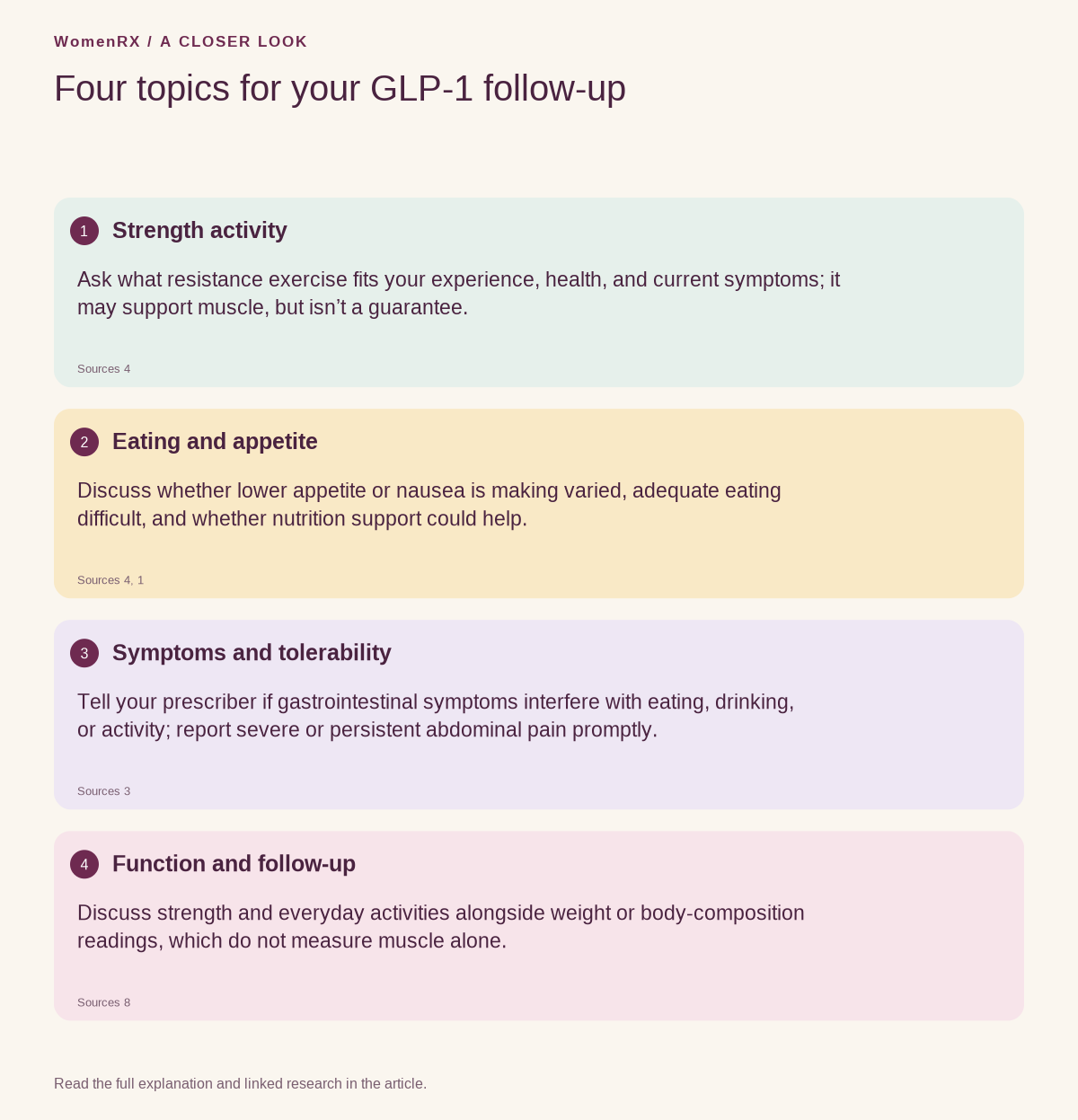
Four topics for your GLP-1 follow-up
Strength activity: Ask what resistance exercise fits your experience, health, and current symptoms; it may support muscle, but isn’t a guarantee.4
Eating and appetite: Discuss whether lower appetite or nausea is making varied, adequate eating difficult, and whether nutrition support could help.41
Symptoms and tolerability: Tell your prescriber if gastrointestinal symptoms interfere with eating, drinking, or activity; report severe or persistent abdominal pain promptly.3
Function and follow-up: Discuss strength and everyday activities alongside weight or body-composition readings, which do not measure muscle alone.8
Read the figure as text
Use these prompts to connect exercise, food intake, symptoms, and functional changes without treating a scale reading as a complete measure of muscle health.- Strength activity: Ask what resistance exercise fits your experience, health, and current symptoms; it may support muscle, but isn’t a guarantee.4
- Eating and appetite: Discuss whether lower appetite or nausea is making varied, adequate eating difficult, and whether nutrition support could help.41
- Symptoms and tolerability: Tell your prescriber if gastrointestinal symptoms interfere with eating, drinking, or activity; report severe or persistent abdominal pain promptly.3
- Function and follow-up: Discuss strength and everyday activities alongside weight or body-composition readings, which do not measure muscle alone.8
Sources you can check
- Nutrition: MedlinePlusAccessed 2026-09-25Return to first citation
- Obesity: MedlinePlusAccessed 2026-09-25Return to first citation
- WEGOVY (SEMAGLUTIDE) INJECTION, SOLUTION WEGOVY (SEMAGLUTIDE) TABLET [NOVO NORDISK PHARMACEUTICAL INDUSTRIES, LP] | US prescribing information and patient instructionsAccessed 2026-09-25Return to first citation
- Lifestyle Medicine as Co-Therapy During Incretin-Based Anti-Obesity Pharmacotherapy: Integrating Physical Activity, Nutrition, and Behavioral Strategies for Long-Term Success.Mallardo M, Messina A, Monda V, La Marra M, Monda A, Allocca S, Casillo M, Di Maio G, Perrone P, Daniele A, Monda M, Messina G, Moscatelli F, Polito R. · Nutrients · 2026Return to first citation
- Quality Plus Quantity: Evaluation of a Virtual GLP-1 Programme With Physical Activity Support to Promote Healthy Body Composition Change During GLP-1 Weight Loss.Stanton LA, Naqvi JB, Devaraj SM, McGuill A, Norwood T, Linke S. · Diabetes, obesity & metabolism · 2026Return to first citation
- Lean Mass Changes With Incretin Therapy Versus Lifestyle Intervention: A Systematic Review and Meta-Analysis of Randomised Controlled Trials.Eisa N, Barood O. · Diabetes, obesity & metabolism · 2026Return to first citation
- The Effects of Glucagon-Like Peptide-1 Receptor Agonists and Sodium-Glucose Co-Transporter-2 Inhibitors on Lean Body Mass in Humans: A Systematic Review and Meta-Analysis of Randomised Controlled Trials.Jobanputra R, Sargeant JA, Plekhanova T, James E, Almaqhawi A, Webb DR, Davies MJ, Yates T. · Diabetes/metabolism research and reviews · 2026Return to first citation
- Effect of GLP-1 receptor agonists at doses for obesity management on muscle health: systematic review and meta-analysis of randomized controlled trials (RCTs).Laverde LP, Muñoz-Velandia OM, Alfonso D, Gómez Medina AM. · International journal of obesity (2005) · 2026Return to first citation