How to Choose Protein Powder While Taking a GLP-1
A powder may help when your appetite is low, but the right choice starts with what you’re able to eat, not a brand ranking.
Protein powder is an option, not a requirement, while taking a GLP-1 medicine. If smaller meals make it hard to eat enough, compare the protein per serving with your usual food intake, then check ingredients, tolerability, independent testing claims, and cost. Protein needs vary. The small shake study did not measure muscle preservation, and the professional advisory says protein alone is likely insufficient without strength training. 147
First, ask what the powder would add
A GLP-1 medicine can make you less hungry, so a meal that used to feel ordinary may now feel like too much. That can make it harder to get enough protein and other nutrients from food. Protein helps your body build and maintain muscle, skin, and bone, but it’s only one part of a nourishing diet. 123
Before shopping, think through a typical day. Are you still eating protein-containing foods you enjoy, such as eggs, yogurt, beans, fish, or meat? Or are you regularly leaving meals unfinished and finding it difficult to eat much later? In the second situation, a drink may be a convenient way to add protein. It won’t replace the range of nutrients and energy you get from food. 12
There is some GLP-1-specific research, but it doesn’t identify a best powder. In a small, seven-day study, 20 adults taking a GLP-1 medicine drank a particular plant-based, high-protein nutrition shake and increased their reported protein intake. The study had no comparison group, and gastrointestinal symptoms did not significantly change across the week. It shows that this shake was usable for those participants, not that every powder will suit you. It did not measure muscle preservation. 4
Read the label against your actual needs
Start with protein per serving, not the largest number on the front of the tub. Check what counts as one serving and whether you’d realistically finish it. Then consider what you already eat. A scoop adds little practical value if it displaces a meal you could otherwise enjoy.
Next, check the ingredient list for anything you avoid or are allergic to. Look at added ingredients too, rather than assuming that more ingredients mean better nutrition. The wider question is whether the product helps you get enough to eat overall, including energy and nutrients beyond protein. 2
If independent testing matters to you, look for a clearly identified third-party certification and what it covers. Don’t treat a vague “tested” claim as a reason to overlook ingredients or tolerability. Compare cost per serving you’ll actually use, not just container price. A product that seems economical but sits untouched in your cupboard isn’t a useful choice.
Finally, consider how it feels to drink or eat. If you’re already dealing with bloating, nausea, or constipation, taste, texture, volume, and your response matter more than a product’s promise. One small shake study can’t predict your experience with a different formulation. If symptoms repeatedly make eating difficult, that’s a reason to discuss both the symptoms and your overall intake with your prescribing clinician or a registered dietitian, rather than keep buying powders to work around the problem. 46
Age and activity change the conversation, not the label
There isn’t one protein number for every woman taking a GLP-1. Needs vary with age, health, and activity. A professional society advisory discusses possible protein targets during weight reduction but stresses that requirements are individual, including uncertainty about how best to calculate them for people with obesity. Its proposed ranges aren’t a target to copy from someone else’s routine. 17
Menopause alone doesn’t tell you which powder or protein amount is right for you. At older ages, the question can become more pressing because some older adults need more protein even while needing fewer calories overall. 18
If you’re pregnant or breastfeeding, don’t borrow a proposed weight-loss protein target as your goal. Ask your care team or a registered dietitian to look at your overall food intake before relying on a powder to fill a gap. Protein needs are individual, and a powder can’t answer the broader question of whether you’re getting enough energy and nutrients. 127
Protein matters for muscle, but more powder isn’t a muscle-preservation plan. The joint advisory says increased protein alone is likely insufficient without strength training during weight reduction. The seven-day shake study did not measure muscle preservation. If you’re concerned about strength or are consistently struggling to eat enough, a dietitian can look at your whole diet and help determine whether a supplement fills a real gap. 567
A protein powder label check
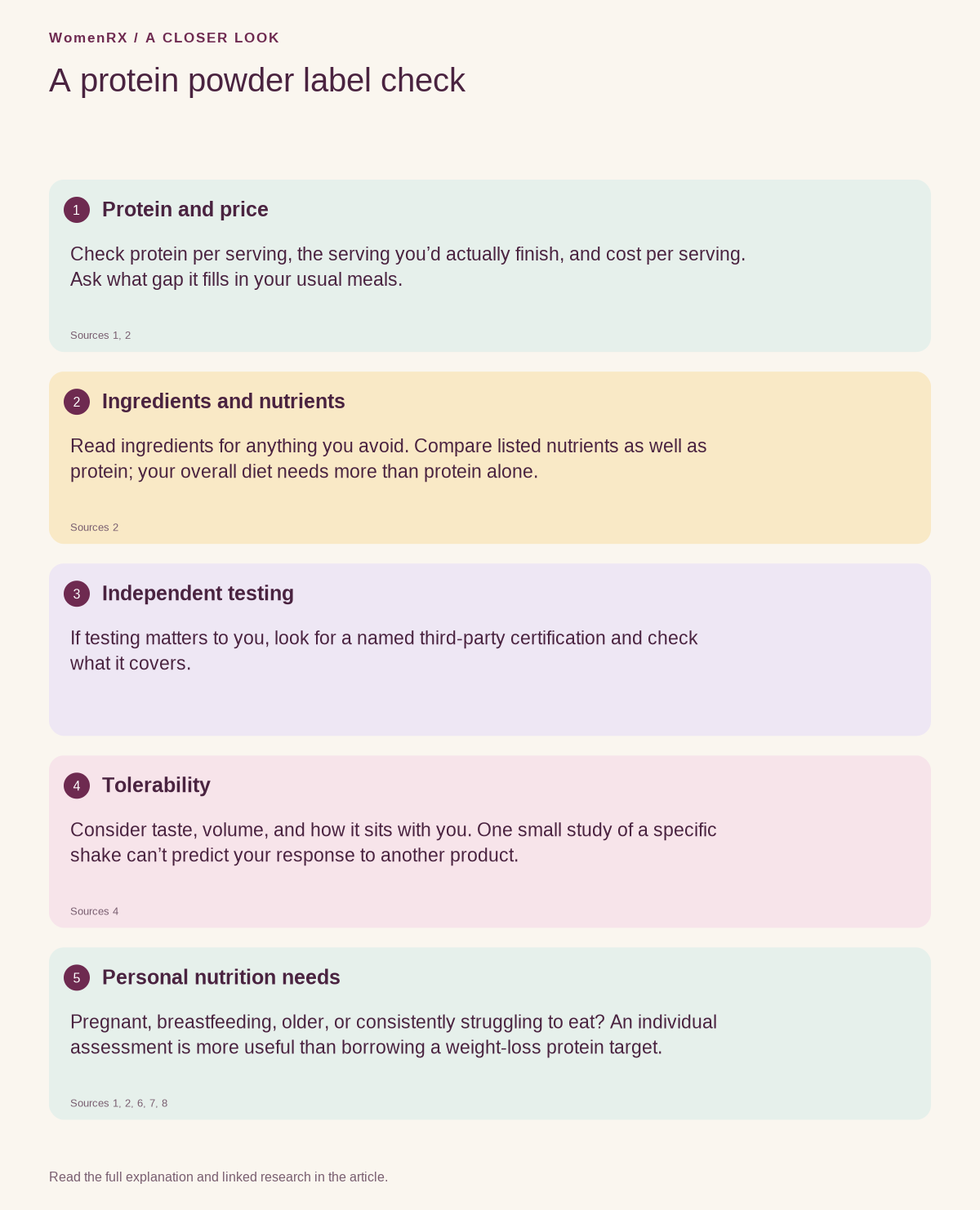
Protein and price: Check protein per serving, the serving you’d actually finish, and cost per serving. Ask what gap it fills in your usual meals.12
Ingredients and nutrients: Read ingredients for anything you avoid. Compare listed nutrients as well as protein; your overall diet needs more than protein alone.2
Independent testing: If testing matters to you, look for a named third-party certification and check what it covers.
Tolerability: Consider taste, volume, and how it sits with you. One small study of a specific shake can’t predict your response to another product.4
Personal nutrition needs: Pregnant, breastfeeding, older, or consistently struggling to eat? An individual assessment is more useful than borrowing a weight-loss protein target.12678
Read the figure as text
Use these prompts to compare a powder with the food you can comfortably eat. They aren’t a score or a substitute for individualized nutrition advice.- Protein and price: Check protein per serving, the serving you’d actually finish, and cost per serving. Ask what gap it fills in your usual meals.12
- Ingredients and nutrients: Read ingredients for anything you avoid. Compare listed nutrients as well as protein; your overall diet needs more than protein alone.2
- Independent testing: If testing matters to you, look for a named third-party certification and check what it covers.
- Tolerability: Consider taste, volume, and how it sits with you. One small study of a specific shake can’t predict your response to another product.4
- Personal nutrition needs: Pregnant, breastfeeding, older, or consistently struggling to eat? An individual assessment is more useful than borrowing a weight-loss protein target.12678
More questions, answered
How should I compare a powder with a ready-to-drink shake?
Put their labels side by side. Compare protein per serving, other listed nutrients, ingredients you need to avoid, and cost per serving. Then consider which one you’re more likely to use comfortably. Neither format is automatically the better choice.
Sources you can check
- Dietary Proteins: MedlinePlusAccessed 2026-09-25Return to first citation
- Nutrition: MedlinePlusAccessed 2026-09-25Return to first citation
- WEGOVY (SEMAGLUTIDE) INJECTION, SOLUTION WEGOVY (SEMAGLUTIDE) TABLET [NOVO NORDISK PHARMACEUTICAL INDUSTRIES, LP] | US prescribing information and patient instructionsAccessed 2026-09-25Return to first citation
- Plant-Based Nutrition Alleviates Gastrointestinal Symptoms and Enhances Protein Intake during GLP-1 Therapy.Withrow NA, Hsueh EE, Wolever T, Jenkins AL, Campbell J, Zurbau A, McMahon R, Valentine CJ. · Current developments in nutrition · 2026Return to first citation
- Dietary Intake as an Undermeasured Potential Mediator: The Ethical Case for Complete and Transparent Dietary Reporting in GLP-1 Receptor Agonist Trials.Strosahl JN, Ziegler TR, Singh RH. · Nutrients · 2026Return to first citation
- Do Patients Receiving GLP-1 Receptor Agonists for Weight Loss Require Structured Dietetic Care? Lessons from Metabolic and Bariatric Surgery (MBS) Pathways.Balasubaramaniam V, Scobie M, O'Kane M, Graham Y, Robertson AG, Mahawar K. · Nutrients · 2026Return to first citation
- Nutritional priorities to support GLP-1 therapy for obesity: four-society joint advisory2025Return to first citation
- Nutrition for Older Adults: MedlinePlusAccessed 2026-09-25Return to first citation