Taking a GLP-1 With an Antidepressant: What Matters?
The useful interaction check starts with your exact medicines, especially if your antidepressant is taken by mouth.
Taking an antidepressant doesn’t automatically rule out GLP-1 treatment. The key questions are which products you take, whether your antidepressant is oral, and what changes after either medicine starts. Semaglutide delays stomach emptying and may affect absorption of oral medicines, but a documented effect on levothyroxine doesn’t establish one for antidepressants. Don’t stop an antidepressant on your own. 1 2 3

Start with names, not drug classes
A question about “GLP-1s and antidepressants” is too broad to settle a medication decision. An SSRI and trazodone, for example, are both described as antidepressants, but side effects depend on the particular medicine. Tell the prescriber or pharmacist the name of your antidepressant and whether you take it by mouth, along with the name and form of your GLP-1 medicine. That gives them an actual pair to check. 1
This distinction matters when reading research about mood. Studies of GLP-1 prescriptions, antidepressant dispensing, and adverse-event reports do not test whether a particular antidepressant changes the effect of a particular GLP-1 medicine, or vice versa. They can’t answer a drug-pair interaction question for you. 4 5 6 7
Separate a possible absorption effect from a proven interaction
Semaglutide delays stomach emptying, so it has the potential to affect how other medicines taken by mouth are absorbed. This is a reason to review an oral antidepressant, not a finding that its dose or timing needs to change. 2 3
Here’s the difference between a possibility and a measured result: in an interaction study described in the oral semaglutide prescribing information, levothyroxine exposure increased by 33% when given with semaglutide tablets. Levothyroxine is not an antidepressant. That finding cannot tell you what happens to sertraline, trazodone, or another antidepressant, and it should not be used to change how you take one. 3
The form of the GLP-1 product matters, too. The Wegovy information says semaglutide may influence absorption of oral medicines; the measured levothyroxine result comes specifically from information for semaglutide tablets. Ask whether there is a concern documented for your products rather than applying that result to every GLP-1 medicine. 2 3
Sort out symptoms before changing either medicine
Semaglutide products can cause gastrointestinal problems, sometimes severe. Antidepressant side effects vary by medicine. If you develop nausea or vomiting after a medication change, the timing is useful context, but it doesn’t identify the cause by itself. Tell the prescriber which medicine changed and whether vomiting is making it difficult to take or keep down your oral antidepressant. Ask what to do about doses you cannot take; don’t guess at a replacement dose. 1 2 3
One symptom deserves a different response from a routine side-effect discussion: persistent or severe abdominal pain while taking semaglutide, sometimes spreading to the back and with or without nausea or vomiting, needs prompt medical assessment because it can be a sign of pancreatitis. 2
Watch mood without assuming the combination caused a change
Mood changes matter, particularly if you’re already being treated for depression. But the research does not show a single, clear drug-interaction pattern. A 2026 analysis of international adverse-event reports found signals for reports of depressed mood and suicidal thoughts with some GLP-1 medicines; a 2024 analysis of US adverse-event reports found no disproportionate-reporting signal for suicidal or self-injurious behavior. Reporting patterns cannot establish that a medicine caused an event or that an antidepressant-GLP-1 pair caused it. 4 6
Prescription studies measured something different again. One Australian study associated GLP-1 dispensing with more antidepressant dispensing, while another found an inverse association between starting a GLP-1 medicine and subsequently starting an antidepressant. Neither outcome measures how well an existing antidepressant is working. 5 7
If your mood worsens or you have suicidal thoughts, seek help promptly and tell the clinician managing your mental health treatment about the change and when it began. You don’t need to decide first whether the GLP-1 medicine caused it. 1 4
Make medication changes one decision at a time
If you’re considering stopping an antidepressant because of nausea, a mood change, or concern about an interaction, speak with its prescriber first. Stopping can cause withdrawal symptoms, and a planned reduction may need to be gradual. The most useful question is specific: “For these two products, is there a known interaction, a symptom we should monitor, or a reason to change either medicine?” 1
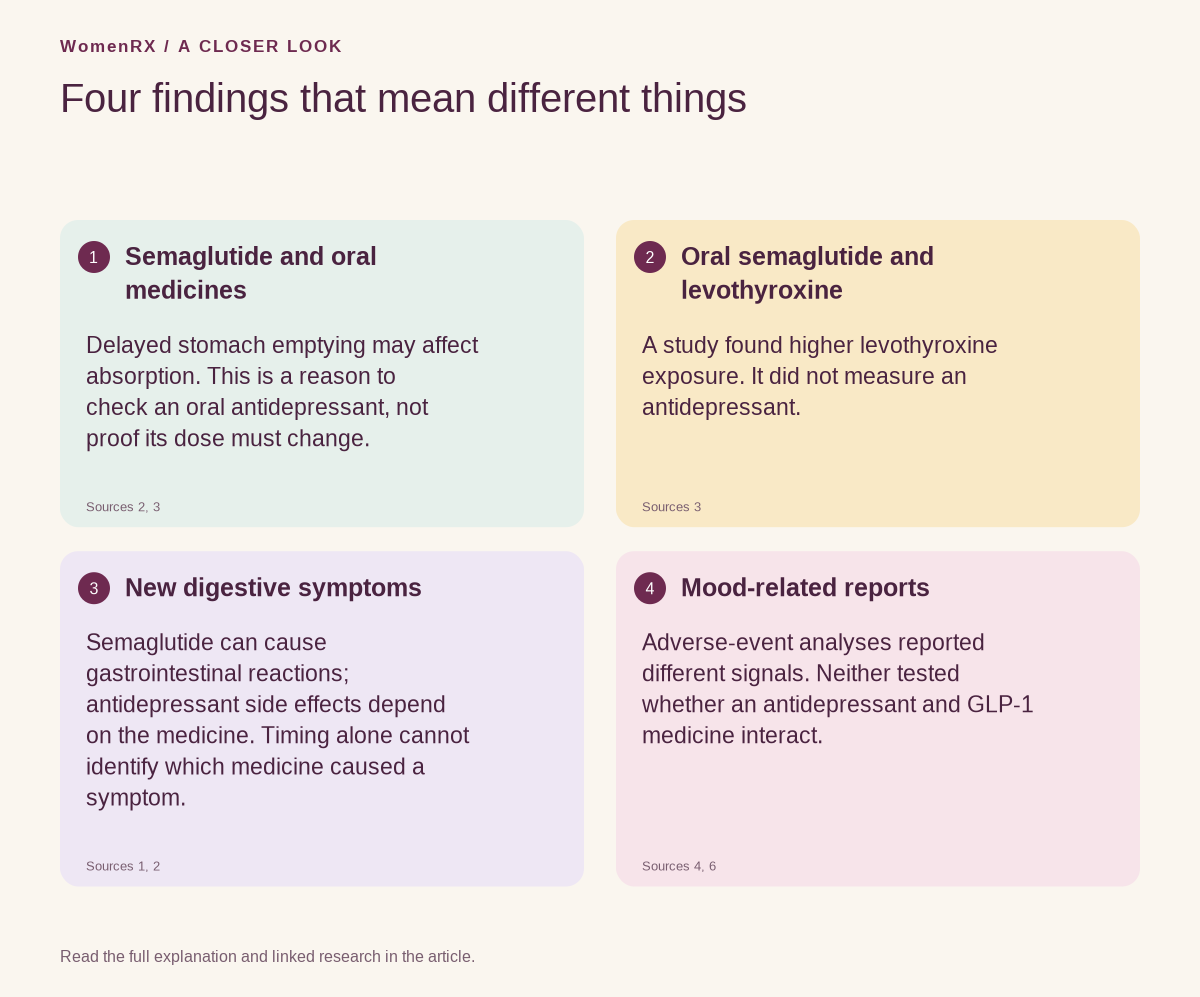
Four findings that mean different things
Semaglutide and oral medicines: Delayed stomach emptying may affect absorption. This is a reason to check an oral antidepressant, not proof its dose must change.23
Oral semaglutide and levothyroxine: A study found higher levothyroxine exposure. It did not measure an antidepressant.3
New digestive symptoms: Semaglutide can cause gastrointestinal reactions; antidepressant side effects depend on the medicine. Timing alone cannot identify which medicine caused a symptom.12
Mood-related reports: Adverse-event analyses reported different signals. Neither tested whether an antidepressant and GLP-1 medicine interact.46
Read the figure as text
These distinctions help separate a possible interaction from a measured result, a side effect, or a mood-reporting pattern.- Semaglutide and oral medicines: Delayed stomach emptying may affect absorption. This is a reason to check an oral antidepressant, not proof its dose must change.23
- Oral semaglutide and levothyroxine: A study found higher levothyroxine exposure. It did not measure an antidepressant.3
- New digestive symptoms: Semaglutide can cause gastrointestinal reactions; antidepressant side effects depend on the medicine. Timing alone cannot identify which medicine caused a symptom.12
- Mood-related reports: Adverse-event analyses reported different signals. Neither tested whether an antidepressant and GLP-1 medicine interact.46
Sources you can check
- Antidepressants - NHSAccessed 2026-09-25Return to first citation
- WEGOVY (SEMAGLUTIDE) INJECTION, SOLUTION WEGOVY (SEMAGLUTIDE) TABLET [NOVO NORDISK PHARMACEUTICAL INDUSTRIES, LP] | US prescribing information and patient instructionsAccessed 2026-09-25Return to first citation
- OZEMPIC (ORAL SEMAGLUTIDE) TABLET RYBELSUS (ORAL SEMAGLUTIDE) TABLET [NOVO NORDISK PHARMACEUTICAL INDUSTRIES, LP] | US prescribing information and patient instructionsAccessed 2026-09-25Return to first citation
- Depressed mood and suicidal thoughts reporting with GLP-1 receptor agonists in type 2 diabetes: A WHO VigiBase study.Aboukaoud M, Hoch B, Weiser M, Amiaz R. · Journal of affective disorders · 2026Return to first citation
- Cross-sectional, case-control and longitudinal associations between exposure to glucagon-like peptide-1 receptor agonists and the dispensing of antidepressants.Almeida OP, Fong Z, Hill Almeida LM, Sanfilippo FM, Page A, Etherton-Beer C. · Diabetes, obesity & metabolism · 2024Return to first citation
- Exploration of the potential association between GLP-1 receptor agonists and suicidal or self-injurious behaviors: a pharmacovigilance study based on the FDA Adverse Event Reporting System database.Zhou J, Zheng Y, Xu B, Long S, Zhu LE, Liu Y, Li C, Zhang Y, Liu M, Wu X. · BMC medicine · 2024Return to first citation
- Prescription Sequence Symmetry Analysis of Glucagon-Like Peptide-1 Receptor Agonists and Neuropsychiatric Conditions.Alfonso Arvez MJ, Wade S, Goordeen D, Ilomäki J, Cross AJ, Langiu M, Tan GSQ. · Clinical pharmacology and therapeutics · 2026Return to first citation