How to Assess a Peptide Treatment’s Safety
The safer question isn’t which peptide is best for women, but whether a specific treatment makes sense for you.
There’s no useful single “safest peptide” ranking for women. Start with the exact substance, product, route, and reason it’s being offered. Then compare the human evidence and reported harms for that use, check the product’s authorization and source, and ask how your circumstances affect the decision. Evidence for one peptide-based medicine doesn’t establish the safety of another. 12

Start with a name, not a category
“Peptide” describes a broad group, not one treatment with one safety profile. GLP-1-based medicines alone differ in their design and how they’re taken. Studies of these medicines address particular conditions and outcomes, not the safety of anything marketed as a peptide. 12
Ask for the exact substance and product name, its formulation and route, and the condition or outcome it’s meant to address. If the explanation stops at “a peptide protocol,” you don’t yet have enough detail to judge whether a study applies to what you’re being offered.
Check whether the evidence matches the offer
A useful study comparison starts with three questions: Was the same treatment studied? Was it used for the same purpose? Were the participants reasonably similar to you? A result for a related molecule or a different condition may help explain an idea, but it cannot establish the proposed treatment’s benefit or safety.
For example, reviews describe GLP-1 medicines’ effects on blood sugar and weight, along with heart and kidney outcomes in selected populations. Those findings cannot be transferred to an unrelated peptide or a different proposed use. 156
Even a head-to-head result has boundaries. A review summarizes a 40-week trial of 1,201 people with type 2 diabetes who were taking metformin. Semaglutide produced greater improvements in blood sugar and weight than dulaglutide, with similar safety profiles in that trial. That helps compare those treatments in that setting. It doesn’t identify the safest peptide for women generally. 1
Find out what “safe” meant in the studies
Ask which harms were recorded, how long participants were followed, and whether the evidence comes from human trials or mainly from an explanation of how the treatment might work. “Similar safety profiles” in one trial is not a promise that two treatments carry the same risks for every person or over a longer period. 1
The proposed purpose matters here too. A review of GLP-1 medicines and skin health discusses possible benefits and skin-related adverse effects, but notes that dermatology-specific randomized trials remain limited. A plausible skin benefit is not the same as a demonstrated treatment benefit. 3
Check the actual product being offered
Ask what authorization applies to the exact product and proposed use, rather than assuming that a familiar substance name settles the question. Also ask who makes and supplies the product, and how its identity and formulation can be verified. These questions don’t prove quality on their own. They help reveal whether you can confidently connect the product being offered to the evidence you’ve reviewed.
The route matters as well. If the study examined one formulation or way of taking a medicine, ask whether that evidence fits the formulation you would receive. GLP-1-based treatments, for example, have been developed in both injected and oral forms. 1
Bring your circumstances into the decision
Ask how your health history, other treatments, and reason for considering the peptide change the balance of likely benefit and harm. If you’re pregnant, breastfeeding, trying to conceive, receiving fertility treatment, or making contraception decisions, ask specifically what is known about that circumstance for this treatment. Menopause may also be relevant to a particular treatment question, but it isn’t a reason to assume every peptide has a distinct menopause safety profile.
Women aren’t one uniform study population. A review discussing myostatin inhibitors, for example, says clinical evidence about differences in outcomes by sex remains limited. That gap cannot be filled by calling a treatment “safe for women.” 4
You don’t need a universal ranking to make progress. You need an identifiable product, evidence that fits its intended use, a clear account of what harms were studied, and answers about where the product comes from. Any missing piece is a specific question to resolve before deciding.
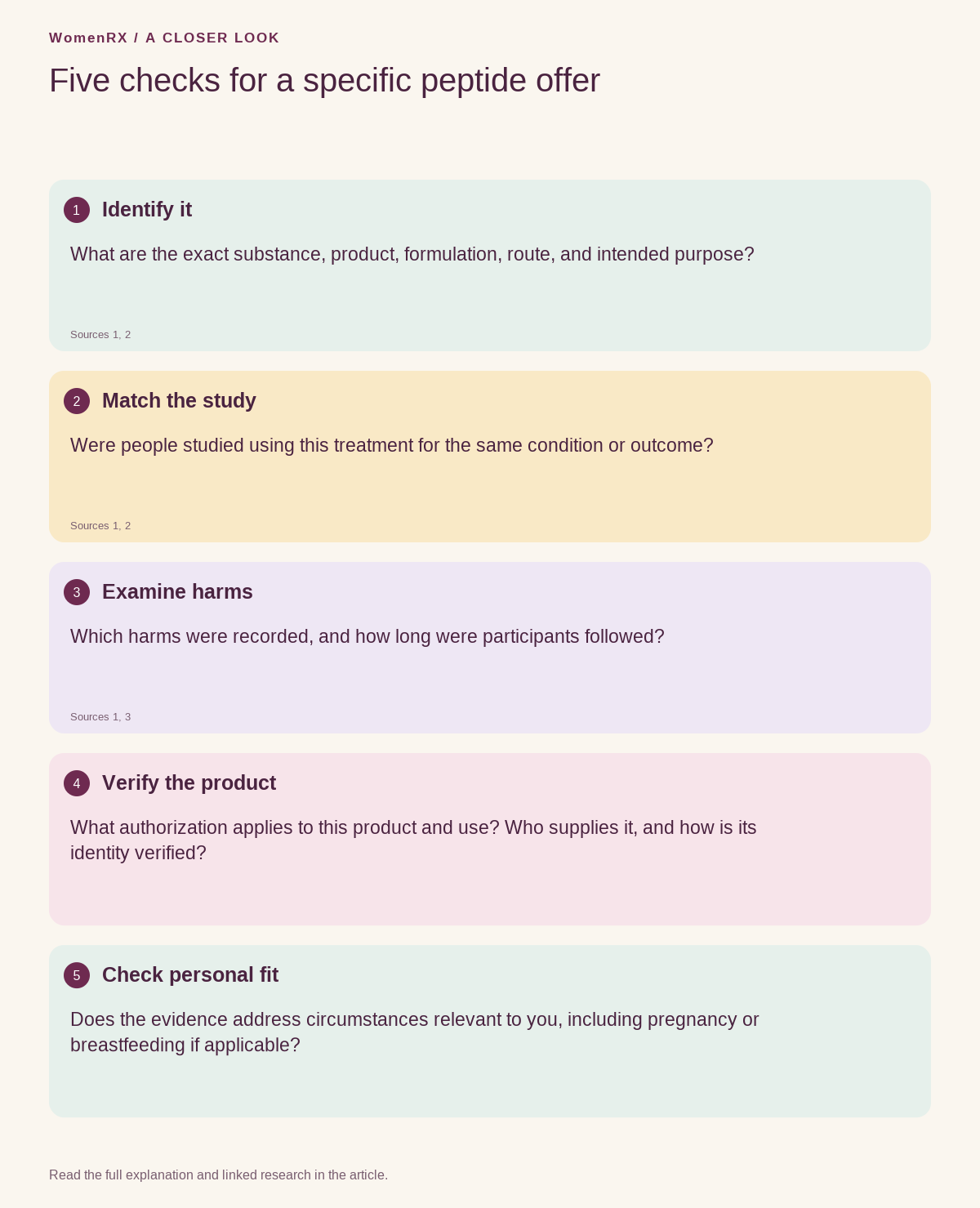
Five checks for a specific peptide offer
Identify it: What are the exact substance, product, formulation, route, and intended purpose?12
Match the study: Were people studied using this treatment for the same condition or outcome?12
Examine harms: Which harms were recorded, and how long were participants followed?13
Verify the product: What authorization applies to this product and use? Who supplies it, and how is its identity verified?
Check personal fit: Does the evidence address circumstances relevant to you, including pregnancy or breastfeeding if applicable?
Read the figure as text
Use these questions to compare the treatment being offered with the evidence for its intended use.- Identify it: What are the exact substance, product, formulation, route, and intended purpose?12
- Match the study: Were people studied using this treatment for the same condition or outcome?12
- Examine harms: Which harms were recorded, and how long were participants followed?13
- Verify the product: What authorization applies to this product and use? Who supplies it, and how is its identity verified?
- Check personal fit: Does the evidence address circumstances relevant to you, including pregnancy or breastfeeding if applicable?
More questions, answered
Does evidence for one peptide apply to another?
Not automatically. Even within GLP-1-based treatments, medicines differ in design and route, and findings are tied to the treatments and uses studied. 12
Sources you can check
- GLP-1-based therapeutics for cardiorenal protection in metabolic diseases.Apperloo EM, Heerspink HJL, van Raalte DH, Muskiet MHA. · Nephrology, dialysis, transplantation : official publication of the European Dialysis and Transplant Association - European Renal Association · 2026Return to first citation
- Dual and Triple Incretin-Based Co-agonists: Novel Therapeutics for Obesity and Diabetes.Gutgesell RM, Nogueiras R, Tschöp MH, Müller TD. · Diabetes therapy : research, treatment and education of diabetes and related disorders · 2024Return to first citation
- Glucagon-Like Peptide-1 (GLP-1) Receptor Agonists and Cutaneous Biology: Implications for Skin Disease and Longevity.Vyas K, Gopinath S, Dacso M, Green JB, Wyles S. · Dermatologic surgery : official publication for American Society for Dermatologic Surgery [et al.] · 2026Return to first citation
- Emerging Role of Myostatin Inhibitors in the Management of Glucagon-Like Peptide-1-Associated Sarcopenia and Metabolic Disorders.Baik J, Lee YS. · Journal of bone metabolism · 2025Return to first citation
- Preventing chronic kidney disease and maintaining kidney health: conclusions from a Kidney Disease: Improving Global Outcomes (KDIGO) Controversies Conference.Ortiz A, Arreola Guerra JM, Chan JCN, Jha V, Kramer H, Nicholas SB, Pavkov ME, Wanner C, Wong LP, Cheung M, King JM, Grams ME, Jadoul M, Tuttle KR, Conference Participants. · Kidney international · 2025Return to first citation
- GLP-1 Receptor Agonists and Cardiovascular Disease: What Do Clinicians Need to Know?Hayat J, Shah NP, Agarwala A, Khan MS, Butler J. · Current atherosclerosis reports · 2024Return to first citation