Peptide Treatment Costs: What to Count Before You Compare
A product’s listed price may leave out care costs, and a lower price alone can’t tell you whether a product is appropriate or trustworthy.
There’s no single price for “peptide treatment”: costs depend on the specific medicine, reason for treatment, and care arrangement. Compare the product with any consultation, testing, administration, follow-up, and repeat-purchase costs you’d actually be charged. As one dated example, Wegovy injection was listed at $349 per box of four pens at standard pricing in September 2026, but that is a product price, not a total care package. 1
Start with the exact product and purpose
“Peptide treatment” can mean very different things. A branded prescription medicine, a compounded medicine, and a product marketed as a wellness peptide aren’t interchangeable categories. Before comparing prices, write down the exact product name, form, and reason it’s being offered. A quote for one product can’t establish what another should cost or whether it’s a suitable alternative.
For prescription treatment, ask whether the quote is for the medicine alone or includes care around it. Make the comparison using the same product and treatment plan wherever possible. If the product, form, or stated use changes, you’re no longer comparing like with like.
A dated price example, not a typical rate
NovoCare’s listed self-pay prices for Wegovy provide a specific example of how much the offer details matter. On September 25, 2026, the listed standard price for Wegovy injection was $349 per box for the 0.25 mg, 0.5 mg, 1 mg, 1.7 mg, and 2.4 mg strengths; each box contains four pens. Wegovy HD 7.2 mg was listed at $399 per box. These are product prices, not quotes for an individualized insurance benefit or a complete telehealth-care package. 1
The same page described a limited offer for eligible new patients: $199 per box for the first two fills, at the 0.25 mg and 0.5 mg strengths, through December 31, 2026. The offer has conditions, and the listed prices may change. Treat an introductory price as a short-term offer, not the ongoing cost. The page also listed separate prices for Wegovy tablets, which are different products from the injections, so those prices shouldn’t be used as a direct comparison. 1
This example is for one branded medicine, not a price guide for peptides generally. It does show why it helps to ask whether a price is promotional, how long it applies, what quantity it buys, and what happens after the offer ends.
Build your own total-cost worksheet
Ask the clinic, pharmacy, or seller to show each charge separately. Mark a category “not applicable” if it truly doesn’t apply, rather than assuming it’s included.
| Cost category | What to ask |
|---|---|
| Product | What exact product and form is this price for? What quantity does it cover? Is it an introductory price, and what is the price after it ends? |
| Consultation | Is an initial visit charged separately? Are later visits included or billed separately? |
| Testing | Are any tests being proposed? Which ones, why, and are their costs included? |
| Administration | Is there a separate charge for giving the treatment, supplies, or training, if relevant? |
| Follow-up | What follow-up is included, and what could trigger another charge? |
| Repeat costs | What would you expect to pay when you need the next supply, including recurring care charges? |
| Coverage | Is the estimate for your exact product and reason for treatment? What will your plan cover, and what remains your responsibility? |
This isn’t a list of fees every patient will have. It’s a way to uncover what a particular quote includes and leaves out. Ask for the estimate in writing, including the quantity, dates or duration covered if stated, eligibility conditions, and any charges that could recur.
Insurance deserves its own check. In a 2025 U.S. observational survey of 518 employed adults starting tirzepatide for overweight or obesity without type 2 diabetes, 57.7% reported concern about treatment cost and 90% reported concern about insurance coverage. Those figures describe that particular survey group, not all women, all patients, or all peptide treatments. They do underline why it’s worth checking coverage for the specific medicine and reason for use rather than relying on a general statement that “insurance may cover it.” 5
Your reason for seeking care matters to the comparison. For example, if you had gestational diabetes during pregnancy and are now weighing a weight-management offer against care for blood sugar, don’t use one quote to estimate the other. Gestational diabetes usually goes away after birth, but it raises the risk of developing type 2 diabetes later. A history of gestational diabetes alone doesn’t tell you which treatment you need now. 2 Clarify what care you’re seeking, then ask about the costs and coverage for that specific purpose.
Price is not a quality check
A low quote doesn’t prove a product is illegitimate, and a high quote doesn’t prove it’s high quality. First identify exactly what’s being offered: an FDA-approved prescription medicine, a compounded prescription, or another product marketed as a wellness peptide. Ask who is responsible for recommending or selling it and, if it’s a prescription, who will prescribe and dispense it. If it’s compounded, ask why that specific product is being proposed and what the product information says about its formulation, instructions, and storage.
Compounded medicines can fill particular needs, but they aren’t the same as FDA-approved products. A 2025 review of compounded semaglutide described concerns including dosing errors, quality-control gaps, and fraudulent products in the market, while also noting that compounding can serve an important need when done under applicable rules. 4 In a search of online listings conducted from February to March 2025, an editorial identified 33 compounded semaglutide or tirzepatide products with formulations, routes, or strengths that differed from available FDA-approved products; many listings did not report key storage or beyond-use information. That review raises specific questions to ask, but it doesn’t establish that every compounded product is unsafe. 3
Be cautious if a seller can’t clearly identify the product, who is responsible for prescribing or dispensing it when relevant, or what instructions and storage information apply. A discount shouldn’t be the reason to skip those basics. If the offer adds ingredients or promises that sound like a special advantage, ask what evidence supports that particular formulation; one review found little justification for some ingredients added to compounded semaglutide or tirzepatide products, and reported that advantages of some alternative forms had not been determined. 3
The useful comparison is the full offer
Before choosing, compare the same product and quantity, the price after any promotion, and the care charges that apply to you. Confirm the coverage estimate for your indication, not just the medicine’s name. Then weigh that total alongside the product’s identity and the explanation for choosing it. If a seller offers only a headline price and can’t answer basic questions about what’s included, you don’t yet have enough information to compare the offer.
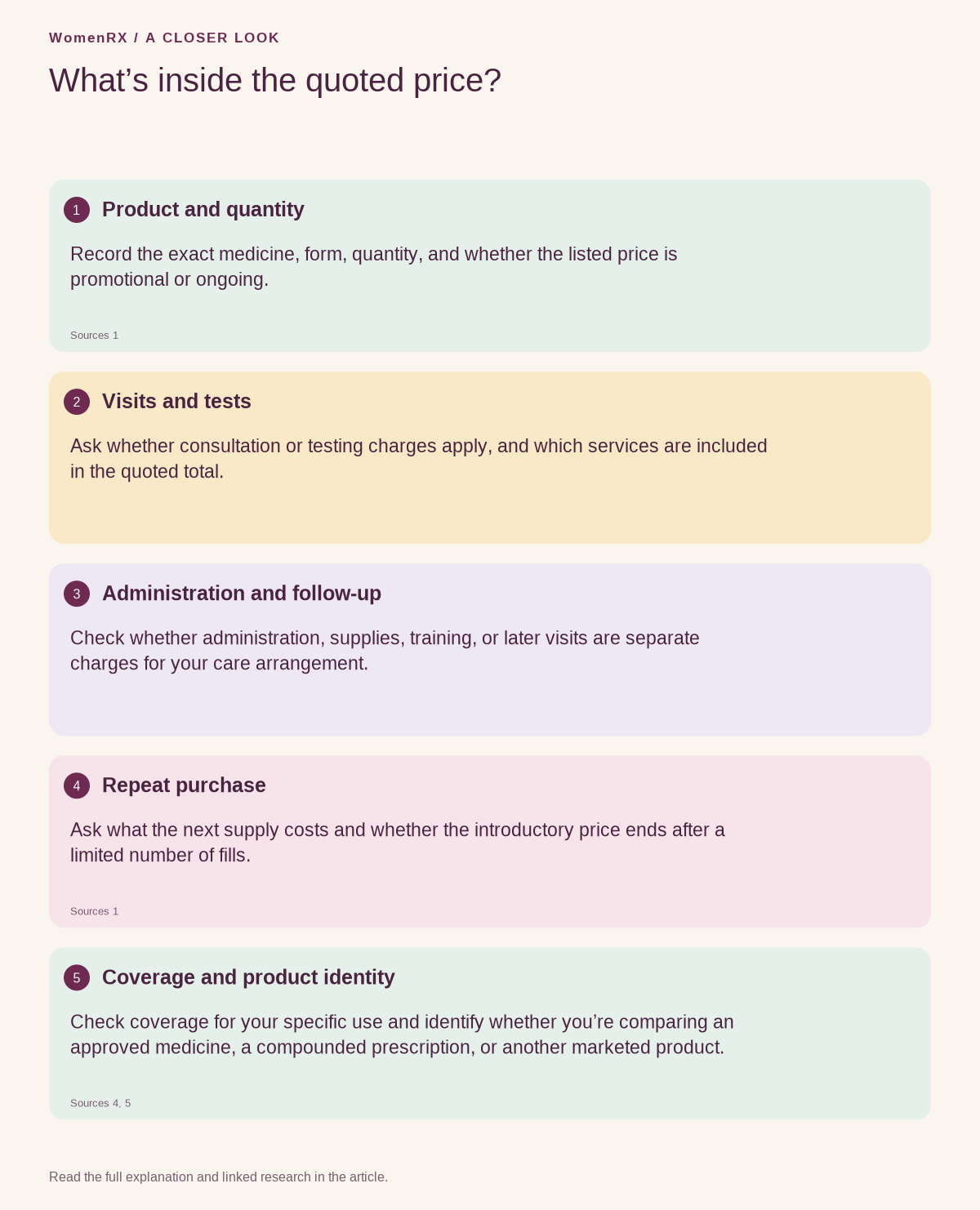
What’s inside the quoted price?
Product and quantity: Record the exact medicine, form, quantity, and whether the listed price is promotional or ongoing.1
Visits and tests: Ask whether consultation or testing charges apply, and which services are included in the quoted total.
Administration and follow-up: Check whether administration, supplies, training, or later visits are separate charges for your care arrangement.
Repeat purchase: Ask what the next supply costs and whether the introductory price ends after a limited number of fills.1
Coverage and product identity: Check coverage for your specific use and identify whether you’re comparing an approved medicine, a compounded prescription, or another marketed product.45
Read the figure as text
Compare the same product and quantity, then ask which care and repeat costs are included in your actual offer.- Product and quantity: Record the exact medicine, form, quantity, and whether the listed price is promotional or ongoing.1
- Visits and tests: Ask whether consultation or testing charges apply, and which services are included in the quoted total.
- Administration and follow-up: Check whether administration, supplies, training, or later visits are separate charges for your care arrangement.
- Repeat purchase: Ask what the next supply costs and whether the introductory price ends after a limited number of fills.1
- Coverage and product identity: Check coverage for your specific use and identify whether you’re comparing an approved medicine, a compounded prescription, or another marketed product.45
More questions, answered
Is the advertised medicine price the total cost?
Not necessarily. For example, NovoCare’s Wegovy prices are product prices, not a total telehealth-care package or an individualized insurance quote. Ask whether consultation, testing, administration, and follow-up charges apply to your offer. 1
Sources you can check
- NovoCare: Wegovy semaglutide self-pay pricesAccessed 2026-09-25Return to first citation
- Diabetes | Type 1 Diabetes | Type 2 Diabetes | MedlinePlusAccessed 2026-09-25Return to first citation
- Compounded Semaglutide and Tirzepatide Products Use Unique Formulations but Efficacy and Safety Largely Unknown.Belcourt J, Sapowadia A, White CM. · The Annals of pharmacotherapy · 2026Return to first citation
- Navigating compounded semaglutide: what health care providers need to know.Liu G, Jarema M, Mo M, Stievater T. · The American journal of managed care · 2025Return to first citation
- Understanding reasons for initiation and experience with tirzepatide among individuals with obesity or overweight: Results from the PERCEPTIONS survey.Gibble TH, Makin H, Gerber C, Bottomley C, He X, Pisani S, Shepherd M, Collins E, Golden A, Bays H. · Obesity pillars · 2026Return to first citation