Peptide Treatments: How to Check a Claim
The word “peptide” tells you little about a treatment’s benefits or risks; the exact substance, promised result, and product matter.
To assess a peptide claim, start with the exact substance and the result it’s supposed to produce. Look for human studies measuring that result in people like you, then check whether the product and route offered match what was studied. An established medicine and an unapproved injectable aren’t interchangeable, even when both are marketed as peptides. 2 3

Start with a name and a measurable promise
“Peptide therapy” isn’t one treatment. The label can refer to established medicines or to experimental substances sold with little human safety evidence. A review of injectable products, for example, distinguishes approved medicines such as semaglutide and tirzepatide from unapproved substances such as BPC-157 and TB-500. Evidence about one says nothing by itself about the others. 2
If you’re shown a claim for energy, body composition, hormones, skin, or sexual health, write down two things: What is the exact substance? What specific result is promised? “Balances hormones” needs a more precise answer. Does it mean a measured change in a hormone, more regular periods, or relief from a symptom? Those are different outcomes. If the seller can’t name the substance and the result, there’s no clear claim to check.
See whether the study answers your question
A useful study tests the named substance in people and measures the promised outcome. Check the comparison: was there a placebo, another treatment, or no comparison group? Also look at how long participants were followed. A biological explanation can be interesting, but a result in cells or animals doesn’t demonstrate that a treatment improves daily life in women.
Consider a claim about a GLP-1 medicine improving a skin condition. A review of its use in hidradenitis suppurativa found mostly case reports and a limited number of observational cohorts. Improvements in the condition were reported alongside weight loss, but the evidence could not establish whether the medicine has a separate, weight-independent effect on the skin disease. That’s a narrower finding than “peptides improve skin.” 4
The same distinction matters for reproductive claims. Reviews report promising findings for some GLP-1 medicines in women with PCOS and overweight or obesity, including menstrual and other reproductive outcomes. But the clinical studies are limited by factors including small samples, short duration, and differences between studies. These findings don’t establish GLP-1 medicines as fertility-restoration treatments, or tell you what they would do for someone without PCOS. 6 7
Check who was studied, not just what was studied
Ask whether women took part and whether results for women were reported separately. If results came from a mixed-sex group without a women’s analysis, you can’t tell from that report whether effects differed by sex. Then look at the participants’ circumstances. Evidence in women with PCOS who are trying to conceive addresses a different question from a claim about sexual desire after menopause.
Life stage helps define the outcome you need evidence for; it doesn’t automatically mean a peptide works differently. If the claim is about sexual health, be especially clear about the concern. Desire, comfort, and ability to enjoy sex aren’t the same outcome, and medicines and chronic conditions can also affect sexual health. 1
Make sure the product matches the evidence
Finding a study is only part of the check. Was it a study of the same substance, formulation, and route as the product being offered? Is that product an approved medicine, a medicine proposed for a different use, or an unapproved experimental substance? Approval for one condition does not establish a benefit for another. For example, GLP-1 receptor agonists have approved uses in type 2 diabetes and obesity, while a review describes their use in type 1 diabetes as off-label. 5
Product quality is a separate question from whether an ingredient might work. Reports of falsified biotechnology medicines, including peptide medicines, have identified products with the wrong active ingredient, the wrong amount, no active ingredient, or impurities. That doesn’t tell you the contents of any particular product, but it does mean a name on an online listing isn’t proof of what’s inside. 3 A review of unregulated injectables also identifies contamination, impurities, inaccurate dosing, and the lack of established human safety profiles as concerns for many experimental products. 2
Five questions that keep the claim grounded
Use the same questions whether the pitch is about energy, appearance, or reproductive health:
- What exactly is it? Get the full substance name and the formulation offered.
- What result is promised? Ask for an outcome specific enough to measure.
- What happened in people? Find out whether a controlled human study measured that outcome, who participated, and how long they were followed.
- Does the evidence fit me? Check whether women’s results were reported and whether participants shared the relevant condition or life stage.
- What product would I actually receive? Ask how its status, formulation, route, quality, and known risks compare with those in the research.
A vague answer at any step matters. It may mean the evidence supports a different substance, a different outcome, or a different product from the one being offered. You don’t have to settle for a general promise when the decision concerns something specific you might put in your body.
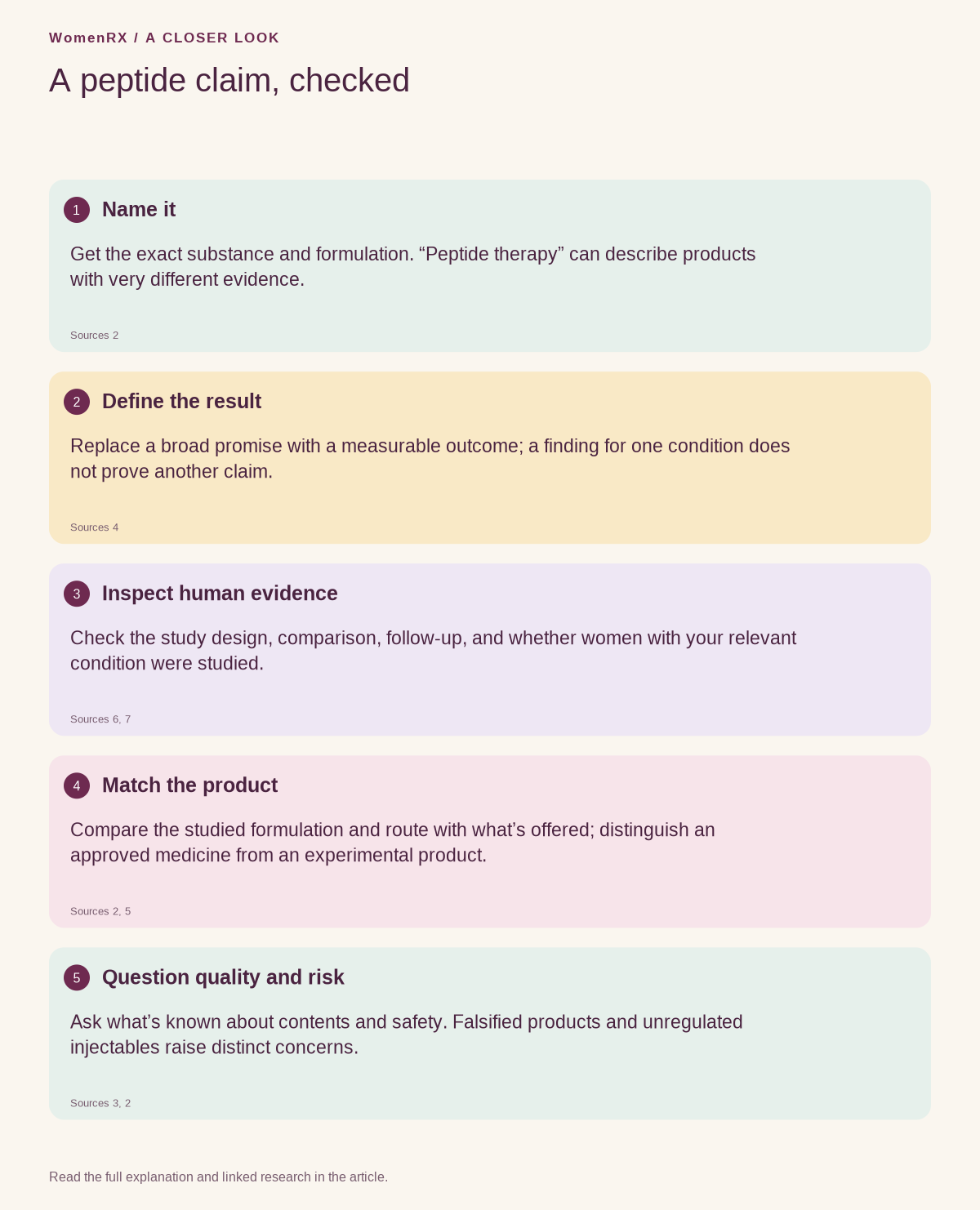
A peptide claim, checked
Name it: Get the exact substance and formulation. “Peptide therapy” can describe products with very different evidence.2
Define the result: Replace a broad promise with a measurable outcome; a finding for one condition does not prove another claim.4
Inspect human evidence: Check the study design, comparison, follow-up, and whether women with your relevant condition were studied.67
Match the product: Compare the studied formulation and route with what’s offered; distinguish an approved medicine from an experimental product.25
Question quality and risk: Ask what’s known about contents and safety. Falsified products and unregulated injectables raise distinct concerns.32
Read the figure as text
Use this sequence to test whether a promising study applies to the treatment actually being offered. The questions are explained in the article above.- Name it: Get the exact substance and formulation. “Peptide therapy” can describe products with very different evidence.2
- Define the result: Replace a broad promise with a measurable outcome; a finding for one condition does not prove another claim.4
- Inspect human evidence: Check the study design, comparison, follow-up, and whether women with your relevant condition were studied.67
- Match the product: Compare the studied formulation and route with what’s offered; distinguish an approved medicine from an experimental product.25
- Question quality and risk: Ask what’s known about contents and safety. Falsified products and unregulated injectables raise distinct concerns.32
More questions, answered
Is an off-label use the same as an unapproved peptide product?
No. Off-label describes use of an approved medicine for a purpose outside its approved uses; it doesn’t make that new purpose proven. An unapproved experimental substance raises a different set of evidence and product-quality questions. Reviews distinguish off-label GLP-1 use in type 1 diabetes from the market for unapproved experimental injectables. 5 2
Sources you can check
- Sexual Health | MedlinePlusAccessed 2026-09-25Return to first citation
- Dangers of Injectable Peptides and Other Unregulated "Biohacking" Drugs.Moiz A, O'Keefe EL, O'Keefe JH. · Missouri medicine · 2026Return to first citation
- Falsification of biotechnology drugs: current dangers and/or future disasters?Janvier S, De Spiegeleer B, Vanhee C, Deconinck E. · Journal of pharmaceutical and biomedical analysis · 2018Return to first citation
- Glucagon-Like Peptide-1 Receptor Agonists as Adjunctive Therapy for Hidradenitis Suppurativa in Patients With Overweight/Obesity: A Narrative Review of Efficacy, Safety, and Quality-of-Life Outcomes.Almukhadeb E, Nagshabandi KN, Alshehri N, Alosaimi K, Almusa HA, Almudimeegh A. · International journal of dermatology · 2026Return to first citation
- The Promise of Adjunct Medications in Improving Type 1 Diabetes Outcomes: Glucagon-Like Peptide Receptor Agonists.Seetharaman S, Cengiz E. · Journal of diabetes science and technology · 2025Return to first citation
- A Systematic Review on GLP-1 Receptor Agonists in Reproductive Health: Integrating IVF Data, Ovarian Physiology and Molecular Mechanisms.Voros C, Chatzinikolaou F, Papapanagiotou I, Polykalas S, Mavrogianni D, Koulakmanidis AM, Athanasiou D, Kanaka V, Bananis K, Athanasiou A, Athanasiou A, Papadimas G, Tsimpoukelis ... · International journal of molecular sciences · 2026Return to first citation
- Benefits of Incretin Therapy on Ovarian Function: A Scientific Literature Review.La Vignera S, Condorelli RA. · International journal of molecular sciences · 2026Return to first citation