Can Peptide Medicines Work When Taken by Mouth?
Some can, but an oral peptide must survive digestion and get across the gut lining before it can produce its intended effect.
Yes, a peptide medicine can work when taken by mouth, but swallowing it creates hurdles an injection bypasses. The peptide must survive digestion, be absorbed in a useful amount, and produce the intended effect. Whether that happens depends on the specific molecule and formulation; an absorption result for one peptide cannot establish that another product works. 4 5
Oral and injected peptides take different routes
A peptide medicine is a specific molecule, not a delivery method. When swallowed, it passes through the digestive tract, where acid, enzymes, and other conditions can change or break it down. Any peptide that remains intact may still need to cross the intestinal lining to reach the bloodstream and its intended target. 2 6
An injection bypasses digestion and the intestinal lining. That avoids two major hurdles for an oral peptide, but it doesn’t mean an injected medicine and an oral product containing a similar peptide will have the same effect. How much reaches the body, and whether it helps, must be established for the particular product. 4 5
Three hurdles between swallowing and benefit
Surviving digestion. Stomach conditions and digestive enzymes can break peptide bonds. Gut microbes may also alter some peptides. How much survives depends on the molecule and its surroundings, so it’s inaccurate to say every swallowed peptide is completely destroyed. 2 6
Crossing the intestinal lining. A peptide that survives digestion still faces mucus and a barrier of intestinal cells. Its size, charge, and other properties affect how readily it passes through. Laboratory tests can investigate possible routes across that barrier, but they cannot, on their own, establish how much of a particular product a person will absorb. 4 5 6
Producing a useful effect. Absorption is not the same as benefit. Finding a peptide in the blood answers a different question from whether a product improves the health outcome it claims to address. Reviews of food-derived peptides describe a gap between activity in laboratory tests and effects in the body; research on natural-source peptide medicines also identifies limited human evidence as a challenge. 3 4
A formulation can help, but results don’t transfer automatically
Formulations can be designed to protect a peptide, help it cross the gut lining, or change how it is released. Researchers are studying carriers, changes to peptide structure, and absorption-enhancing ingredients. These approaches have to be tested with the peptide they’re meant to deliver. 1 4 5
For example, researchers tested an oral insulin formulation paired with a specialized foil device in rats. They reported better bioavailability and biopotency than with a formulation control. That is evidence about the experimental formulation in animals, not proof that it benefits people or that a different oral peptide will work. 7
Likewise, “peptide-based” on a label tells you little about absorption or benefit. A food-derived peptide, a peptide medicine, and two formulations of the same peptide may behave differently after swallowing. Even the surrounding food mixture can influence a peptide’s stability and release. 2 3 5
How to assess a particular oral product
Match the evidence to the claim you’re trying to evaluate:
- Exact peptide and formulation: Was the molecule tested in the same delivery system as the product? A different carrier may change absorption. 1 5
- People, not just laboratory models: Were there human studies, or only cell and animal results? The rat insulin experiment, for instance, cannot establish human benefit. 4 7
- Health outcome, not just exposure: Did a study measure whether people improved in the way the product claims, rather than only measuring absorption or blood levels? 3 4
- Relevant comparison: What was the product compared with? Better absorption than another experimental formulation answers a narrower question than whether it helps people with a health condition. 7
- Women and life stage: Did the human study include women and report results by sex? Did it state whether pregnant or breastfeeding people were included or excluded? If those details aren’t reported, don’t assume the study establishes the product’s effects for those groups.
The key distinction is between possible oral delivery and demonstrated benefit from this product. Evidence for an injection, a different peptide, or an experimental formulation cannot fill in that last step. 4 5
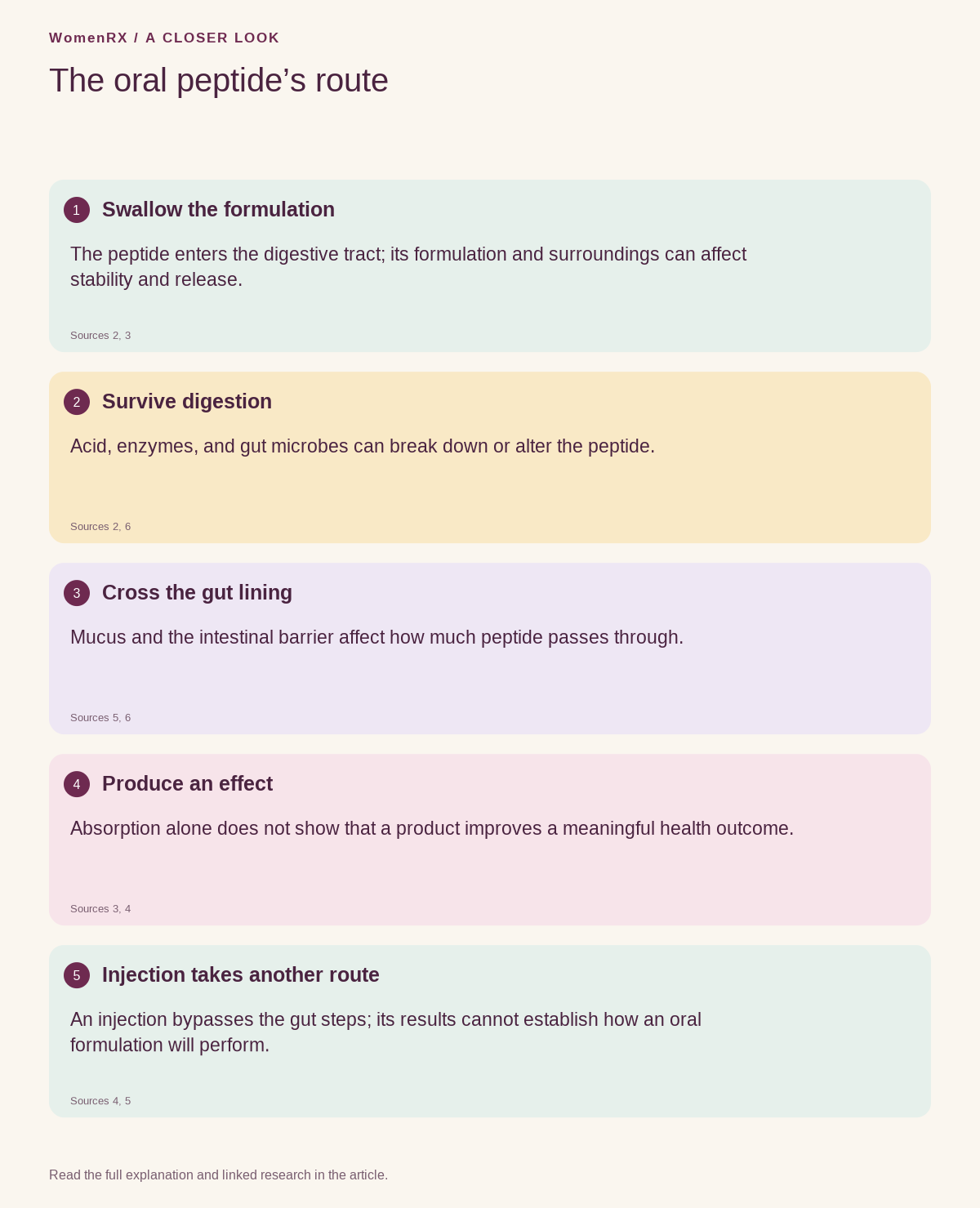
The oral peptide’s route
Swallow the formulation: The peptide enters the digestive tract; its formulation and surroundings can affect stability and release.23
Survive digestion: Acid, enzymes, and gut microbes can break down or alter the peptide.26
Cross the gut lining: Mucus and the intestinal barrier affect how much peptide passes through.56
Produce an effect: Absorption alone does not show that a product improves a meaningful health outcome.34
Injection takes another route: An injection bypasses the gut steps; its results cannot establish how an oral formulation will perform.45
Read the figure as text
Swallowing adds two gut hurdles before a peptide can produce an effect. An injection bypasses those hurdles, but neither route alone proves clinical benefit.- Swallow the formulation: The peptide enters the digestive tract; its formulation and surroundings can affect stability and release.23
- Survive digestion: Acid, enzymes, and gut microbes can break down or alter the peptide.26
- Cross the gut lining: Mucus and the intestinal barrier affect how much peptide passes through.56
- Produce an effect: Absorption alone does not show that a product improves a meaningful health outcome.34
- Injection takes another route: An injection bypasses the gut steps; its results cannot establish how an oral formulation will perform.45
More questions, answered
Does low oral bioavailability mean a peptide cannot work?
Not necessarily. Bioavailability describes how much reaches the circulation; benefit depends on the peptide, its target, and the outcome being measured. Neither low nor improved absorption settles the clinical question by itself. 4 5
Can a study of a food-derived peptide prove a peptide medicine works?
No. Peptides can differ in structure, formulation, and intended effect. A finding for one food-derived peptide does not establish the effectiveness of another product taken by mouth. 2 5
Sources you can check
- Recent Progress in Chitosan Nanoparticles for the Oral Delivery of Proteins and Peptides: Strategies to Improve Bioavailability.Varun, Singh N, Islam MM, Judder MI, Jain H, Khan MN. · Recent advances in drug delivery and formulation · 2026Return to first citation
- Oral Delivery Systems for Food-Derived Bioactive Peptides: Enhancing Stability, Bioavailability, and Health Benefits.Xu Y, Li F, Zhao R, Shu T, Min W, Zhu BW. · Advanced science (Weinheim, Baden-Wurttemberg, Germany) · 2026Return to first citation
- The role of the food matrix in peptide bioavailability: a review of interactions and their impact on absorption.Liu C, Wen C, Olatunji OJ, Ashaolu TJ. · Journal of the science of food and agriculture · 2026Return to first citation
- From bench to bedside: experimental pharmacology approaches to overcome bioavailability, stability, and translational barriers of bioactive peptides from natural sources.Hamadou M, Mishra SK, Abubakar AM, Başaran B, Martin Alain MM. · Frontiers in pharmacology · 2026Return to first citation
- Navigating the complexity of oral peptide delivery: challenges and strategies to enhance oral bioavailability.Khalid NU, Rivera-Delgado E, von Erlach T. · Frontiers in drug delivery · 2026Return to first citation
- Gastrointestinal fate of bioactive peptides: A mechanistic review of stability, transport, and bioavailability.Ha MKTT, Suttikhana I, Ashaolu TJ. · Food research international (Ottawa, Ont.) · 2026Return to first citation
- A self-unfolding polymer foil loaded with a permeation enhancer Ionogel for superior oral peptide delivery.Raptis K, McCabe R, Rubio-Huertas M, Rønholt S, Saaby L, Thamdrup LHE, Ghavami M, Kamguyan K, Nielsen HM, Boisen A. · Drug delivery and translational research · 2026Return to first citation