Peptide Medicines and Hormones: How to Check the Evidence
A peptide’s effect depends on the specific medicine, target, and condition studied, not a broad promise to “balance hormones.”
There isn’t one hormone effect shared by all peptide medicines. For example, an experimental octreotide analog was studied for its effect on IGF-1, while an investigational parathyroid hormone analog was developed for hypoparathyroidism. Those are different targets and questions. To judge a claim about your cycle, fertility, or menopause, check whether the named peptide was studied in people with that concern and whether the study measured an outcome that matters to you. 3 4
Start with the named medicine and its target
“Peptide” describes a broad type of molecule, not a single treatment or hormone effect. The useful question isn’t whether peptides affect hormones in general. It’s what a particular medicine is designed to act on, for which condition, and what outcome researchers measured.
Consider two examples from human research. TE-8214 is an experimental analog of octreotide designed to act through the somatostatin receptor 2 pathway. In a Phase 1 study in healthy adults, researchers measured safety, drug exposure, and IGF-1, a biomarker. IGF-1 fell after a single dose, but the study was not designed to show that the medicine treats a condition in patients. 3
Canvuparatide, by contrast, is an investigational parathyroid hormone (PTH) analog studied as a potential treatment for hypoparathyroidism, a condition involving low or absent PTH. Its early research included animal studies and a Phase 1 study of single doses in healthy volunteers. That is evidence about a different target and early-stage research, not evidence that it changes menstrual cycles, fertility, or menopause symptoms. 4
These examples show why a claim about “hormone balance” needs to name both the pathway and the intended result. A change in a lab marker can show biological activity without proving a meaningful improvement in symptoms or health.
Match the evidence to your question
Before treating a claim as relevant to you, ask:
- Which peptide and target? Look for the exact medicine name, not just “peptide therapy.” Find out which receptor, hormone, or other pathway it is meant to affect.
- Which condition was studied? Evidence for one endocrine disorder does not automatically apply to irregular periods, infertility, perimenopause, or another concern.
- Who took part? Was the research in people with the condition, healthy volunteers, animals, or cells? If it was a human study, check whether women were included and whether results were reported separately by sex.
- What changed? Was the result a hormone measurement, a symptom, fertility or pregnancy outcome, or another measure of health? A biomarker is not automatically a patient benefit.
- How advanced is the research? Lab and animal findings, early human studies, and studies testing treatment benefits answer different questions. An early study may show that a medicine reaches its target without establishing that it works for patients.
- What about interactions and pregnancy? Ask about interactions for the specific named medicine, rather than assuming they are the same across peptides. For a question involving pregnancy, trying to conceive, or menstrual changes, look for research that actually includes and reports those outcomes.
In the TE-8214 and canvuparatide reports, the described human studies do not establish effects on menstrual cycles, fertility, pregnancy, or menopause. That means those reproductive questions remain unanswered by these particular studies; it does not prove that no research on them exists. 3 4
Keep the condition in view
A hormone-related concern is not always best understood as a problem that needs a hormone-altering medicine. Treatments are evaluated for particular conditions and outcomes. For menopause symptoms, for instance, North American Menopause Society statements identify hormone therapy as the most effective treatment for vasomotor symptoms and describe evidence-supported nonhormone options for people who aren’t good candidates for it or prefer not to use it. Those recommendations are condition-specific, not proof for or against peptides as a whole. 1 2
That distinction can help you assess a pitch: does it identify a diagnosis and an outcome, or just promise to “balance” several hormones? A persuasive explanation should connect the named medicine to evidence for the concern you actually have. If the study measured only a laboratory marker, it’s fair to ask whether anyone has shown a meaningful change in symptoms or health for people like you.
A practical way to evaluate a claim
Write down the peptide’s exact name and the claimed benefit. Then compare that claim with the study population, condition, and outcome. For example, evidence that an experimental medicine lowered IGF-1 in healthy adults answers a question about a biomarker in those participants. It doesn’t, by itself, answer whether the medicine improves fertility or menopause symptoms. 3
For safety questions, bring the exact product name and a current list of medicines and supplements to a pharmacist or prescriber. Ask what interactions are known for that product, and whether pregnancy, trying to conceive, or a particular stage of menopause changes the evidence or safety considerations. The answer should be specific to the medicine and your situation, not a general claim about peptides.
Different peptides, different questions
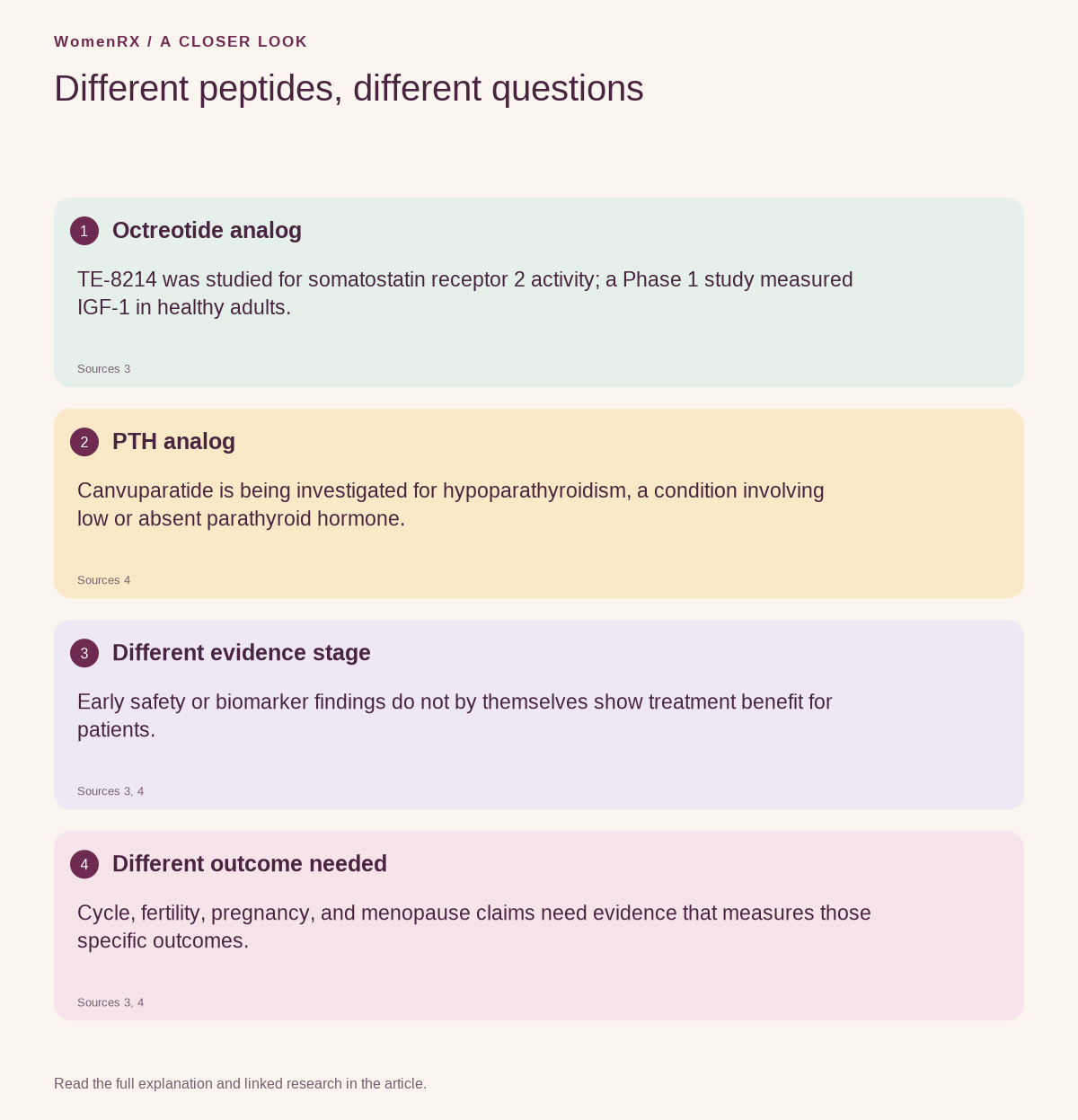
Octreotide analog: TE-8214 was studied for somatostatin receptor 2 activity; a Phase 1 study measured IGF-1 in healthy adults.3
PTH analog: Canvuparatide is being investigated for hypoparathyroidism, a condition involving low or absent parathyroid hormone.4
Different evidence stage: Early safety or biomarker findings do not by themselves show treatment benefit for patients.34
Different outcome needed: Cycle, fertility, pregnancy, and menopause claims need evidence that measures those specific outcomes.34
Read the figure as text
These examples show why a pathway or biomarker result should not be mistaken for evidence about every hormone-related concern.- Octreotide analog: TE-8214 was studied for somatostatin receptor 2 activity; a Phase 1 study measured IGF-1 in healthy adults.3
- PTH analog: Canvuparatide is being investigated for hypoparathyroidism, a condition involving low or absent parathyroid hormone.4
- Different evidence stage: Early safety or biomarker findings do not by themselves show treatment benefit for patients.34
- Different outcome needed: Cycle, fertility, pregnancy, and menopause claims need evidence that measures those specific outcomes.34
More questions, answered
Does a peptide that changes one hormone affect all hormones?
Not necessarily. The examples here were developed around different targets: an octreotide analog studied for effects including IGF-1, and a PTH analog studied for hypoparathyroidism. Evidence about one target or condition doesn’t establish effects on other hormone systems. 3 4
Does an early human study prove a peptide works for a condition?
No. The TE-8214 Phase 1 study measured safety, drug exposure, and IGF-1 in healthy adults, and was not designed to evaluate treatment efficacy in patients. A biomarker change alone doesn’t demonstrate a meaningful clinical benefit. 3
Sources you can check
- The 2022 hormone therapy position statement of The North American Menopause Society.“The 2022 Hormone Therapy Position Statement of The North American Menopause Society” Advisory Panel. · Menopause (New York, N.Y.) · 2022Return to first citation
- The 2023 nonhormone therapy position statement of The North American Menopause Society.Menopause (New York, N.Y.) · 2023Return to first citation
- A long-acting octreotide analog formed by conjugation with a peptide linker modified with two fatty acids.Yu YH, Chuang YS, Gehlert J, Peng CJ, Lin WC, Wong MT, Wright J, Chu HM, Lim C, Chang TW. · Frontiers in endocrinology · 2026Return to first citation
- Discovery and characterization of canvuparatide, a once-weekly parathyroid hormone analog for the treatment of hypoparathyroidism.Zhang F, Perez-Tilve D, Allen MR, Metzger CE, Dorato MA, Geiger MJ, DiMarchi RD. · Molecular metabolism · 2026Return to first citation