Peptide Medicines Around Pregnancy: What to Review
“Peptide” isn’t a safety category: the right plan depends on the exact medicine, why you take it, and whether you’re planning pregnancy, pregnant, or breastfeeding.
There isn’t one pregnancy or breastfeeding answer for every peptide medicine. For GLP-1 medicines specifically, reviews support avoiding use during pregnancy and breastfeeding, and a 2026 review says current clinical guidelines recommend stopping before conception. Newer human findings offer limited reassurance about some pregnancy outcomes, but don’t establish that planned use is safe. Don’t change prescribed treatment without a plan. 356
Start with the medicine, not the label
“Peptide” describes a broad group of substances, not a shared pregnancy-safety profile. The reproductive evidence here focuses mainly on GLP-1 receptor agonists, medicines used for conditions including type 2 diabetes and obesity. Findings about GLP-1 medicines can’t answer the safety question for every product called a peptide. 34
For a medication review, bring the exact product name and active ingredient, what it treats, when you last took it, and whether you’re trying to conceive, pregnant, or breastfeeding. If you don’t know the active ingredient, the package or a clear label photo can help identify it. The point is to review the substance you use and the health condition it treats, rather than make a decision from a broad category name.
Before trying to conceive
For GLP-1 medicines, plan the conversation before trying to conceive, if possible. A 2026 review reports that current clinical guidelines recommend discontinuing these medicines before conception. A 2023 systematic review also broadly supports avoiding GLP-1 agonists during pregnancy. These recommendations are specific to GLP-1 medicines, not every peptide product. The sources don’t establish one stopping interval that applies to every medicine, so ask about the specific product and timing rather than borrowing a rule from another drug. 36
Ask, too, how the condition being treated would be managed if the medicine changes. Stopping or starting a prescribed medicine during pregnancy should be discussed with the prescriber: an untreated health problem can sometimes pose more risk than taking a medicine, and the balance depends on the treatment and condition. 2
If your GLP-1 medicine is being used for weight management or metabolic health, mention your pregnancy plans early. A narrative review describes emerging evidence of improved ovulation or menstrual regularity in some women with obesity or polycystic ovary syndrome, but this doesn’t establish GLP-1 medicines as fertility treatments. It may be relevant when considering the possibility of becoming pregnant. 7
If you’re already pregnant
Share the medicine name and when you used it with the clinicians managing your treatment and pregnancy. Animal studies of GLP-1 medicines found reduced fetal growth or weight and other developmental findings. Those animal findings don’t predict what will happen in an individual human pregnancy; some occurred alongside reduced maternal food intake and weight gain, and the contribution of the medicine itself is uncertain. 36
Human data provide some context, but not a green light for planned use. A 2026 meta-analysis combined seven cohort studies with more than 40,000 pregnancies exposed to GLP-1 receptor agonists. It found no statistically significant increase in several measured outcomes, including major congenital malformations after first-trimester exposure. It also reported a urinary-malformation association based only on unadjusted data. The review rated the overall certainty as low. These results are cautiously reassuring about some outcomes after exposure, but don’t establish that starting or continuing a GLP-1 medicine during pregnancy is safe. 5
If you’re taking a prescribed medicine, don’t stop or change it on your own. Ask for a plan that weighs the medicine’s risks against the risks of leaving the treated condition unmanaged. 2
If you’re breastfeeding
For GLP-1 medicines, the 2023 systematic review supports avoiding use during lactation. Its evidence found these medicines in the milk of animals, but no human milk-excretion data; it also noted that human evidence about effects on breastfed infants was lacking. That leaves uncertainty about human exposure, rather than showing that every peptide medicine has the same effect. 3
Ask about evidence for your exact medicine and the condition it treats, including whether there are human data on milk transfer and infant effects. Medicines can pass into breast milk and cause harm, but many women with health conditions can breastfeed; the answer depends on the particular medicine and circumstances. 1
Make the review specific and actionable
You can keep the conversation focused with four questions:
- What is the exact active ingredient, and what condition is it treating?
- What evidence applies to my stage: before conception, pregnancy, or breastfeeding? Is it from human studies or animals?
- If a change is recommended, how will we manage the condition the medicine treats?
- Is there a medicine-specific timing recommendation, and what should I do if pregnancy happens before we’ve made a plan?
This approach helps separate a recommendation about GLP-1 medicines from assumptions about all peptides, and keeps any treatment change connected to your health needs.
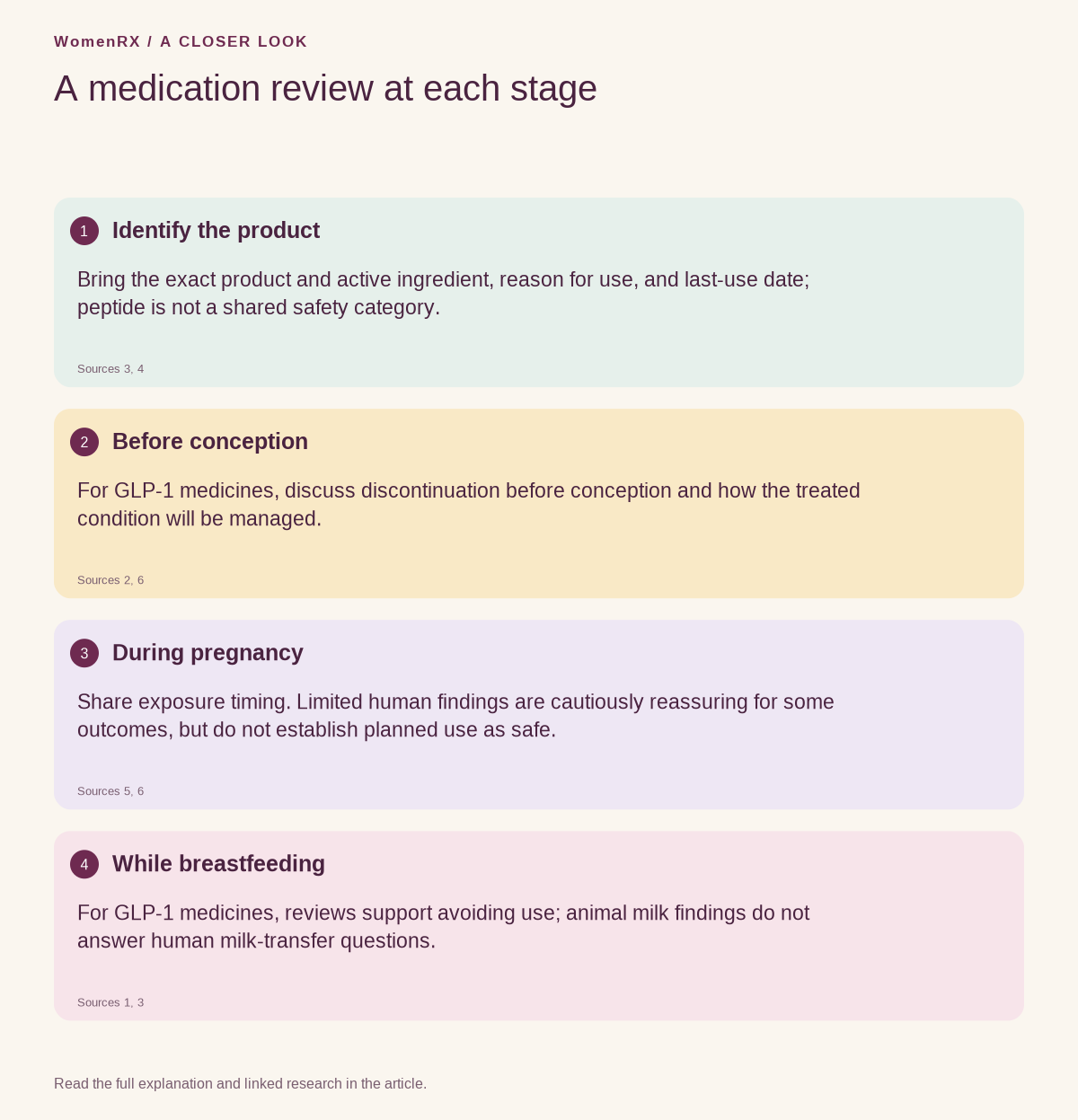
A medication review at each stage
Identify the product: Bring the exact product and active ingredient, reason for use, and last-use date; peptide is not a shared safety category.34
Before conception: For GLP-1 medicines, discuss discontinuation before conception and how the treated condition will be managed.26
During pregnancy: Share exposure timing. Limited human findings are cautiously reassuring for some outcomes, but do not establish planned use as safe.56
While breastfeeding: For GLP-1 medicines, reviews support avoiding use; animal milk findings do not answer human milk-transfer questions.13
Read the figure as text
The key questions shift with your plans, pregnancy status, or breastfeeding. For GLP-1 medicines, the review should include the recommendation to avoid use during pregnancy and lactation and plan discontinuation before conception.- Identify the product: Bring the exact product and active ingredient, reason for use, and last-use date; peptide is not a shared safety category.34
- Before conception: For GLP-1 medicines, discuss discontinuation before conception and how the treated condition will be managed.26
- During pregnancy: Share exposure timing. Limited human findings are cautiously reassuring for some outcomes, but do not establish planned use as safe.56
- While breastfeeding: For GLP-1 medicines, reviews support avoiding use; animal milk findings do not answer human milk-transfer questions.13
More questions, answered
Does early exposure to a GLP-1 medicine mean harm has occurred?
No. Available human findings don’t show a statistically significant increase in several measured outcomes, including major congenital malformations after first-trimester exposure, but the evidence is low certainty and can’t rule out every risk. Share the exact medicine and exposure timing with your care team so they can interpret the information for your situation. 56
Sources you can check
- Breastfeeding | Benefits of Breastfeeding | MedlinePlusAccessed 2026-09-25Return to first citation
- Pregnancy and Medicines | MedlinePlusAccessed 2026-09-25Return to first citation
- Effects of GLP-1 agonists and SGLT2 inhibitors during pregnancy and lactation on offspring outcomes: a systematic review of the evidence.Muller DRP, Stenvers DJ, Malekzadeh A, Holleman F, Painter RC, Siegelaar SE. · Frontiers in endocrinology · 2023Return to first citation
- Impact of GLP-1 and GLP-1/GIP receptor agonists before, during, and after pregnancy: a narrative review.Zajdenverg L, Santos VM, Rodrigues ACM, Previdelli LK, Negrato CA. · Diabetology & metabolic syndrome · 2026Return to first citation
- Pregnancy outcomes following maternal GLP-1 receptor agonist exposure: a systematic review and meta-analysis.Uysal N, Horoz E, Gungor M, Timarci I, Sozmen MK, Karadas B, Kaplan YC. · Scientific reports · 2026Return to first citation
- Semaglutide Exposure During Pregnancy: Results from the FAERS Database.Zinzi A, Gaio M, Mascolo A, Pieretti G, Cipriani M, Della Ragione JM, D'Amato R, Rossi F, Capuano A, Ruggiero R. · Pharmaceuticals (Basel, Switzerland) · 2026Return to first citation
- GLP-1 Receptor Agonists, Fertility Restoration, and Reproductive Safety in Women of Reproductive Age: A Narrative Review.Abedi MM, Patni MM, Shajahan ANB, Dube R, Khadeeja L, Alabid I, Kharoufeh A, Kar SS, George BT, Bahutair SN, Pandurangan T. · Journal of clinical medicine · 2026Return to first citation