Peptides by Mouth, Skin, or Injection: Why Route Matters
A peptide’s results belong to the specific medicine and formulation tested, not automatically to every product sold under the same broad label.
Route changes how much of a peptide reaches the body, where it acts, and what evidence is relevant. Oral peptides must get past digestion and the gut lining; topical products may be designed for a local target; injections bypass the gut. Even products containing the same peptide can produce different drug levels, so compare evidence for the exact product and route, not just the ingredient name. 1 3 5
The same ingredient name doesn’t make the same medicine
“Peptide” describes a broad family of molecules, not one treatment with interchangeable forms. A peptide medicine’s structure, formulation, intended target, and route all matter. An oral tablet, an injection, and a topical preparation should be treated as distinct products unless evidence directly compares those exact versions.
Semaglutide offers a useful example because it is available as both a tablet and an injection in the product information. In adults without type 2 diabetes, average blood concentrations after the specified tablet and injection regimens were similar. In adults with type 2 diabetes, average concentrations after the tablet were lower than after the injection, and tablet concentrations were more variable. Those findings show why a route comparison needs to name the population and product, rather than assuming that evidence for one form transfers unchanged to another. They don’t, by themselves, prove that the forms have identical effects for every person or use. 1
Why a peptide’s route can change exposure
Peptides often face two obstacles when swallowed: digestive enzymes can break them down, and their size and chemical properties can make it hard to cross the gut lining. As a result, oral absorption may be low or inconsistent. Some medicines are specifically designed to address those barriers, but the formulation is part of the treatment, not a detail that can be swapped out. 3 4
An injection avoids the need to cross the gut lining and can produce a different pattern of drug exposure. But “injection” isn’t a guarantee of better results: benefit depends on the particular peptide, formulation, condition, and evidence for that use. The relevant comparison is the studied product and regimen, not a general contest between needles and pills. 1 3
Topical products raise a different question: is the goal to act at the skin or wound surface, or to deliver enough medicine into the bloodstream for an effect elsewhere? Reviews of topical antimicrobial peptide formulations describe approaches intended to protect the peptide and keep it at a wound site. They also describe clinical translation as limited, with much of the evidence still preclinical. That work cannot establish that a topical peptide product will treat a condition inside the body, or that a cosmetic product has the same evidence as a wound formulation. 5
Ask what the evidence actually tested
When you see a peptide offered in more than one form, check these points:
- Exact product: Is the study about this molecule and formulation, or another peptide with a similar name or purpose?
- Route and use: Did researchers test a swallowed tablet, an injection, or a topical preparation, and for the same condition you’re considering?
- Absorption and variability: Were drug levels measured, and did the results differ across people or groups? A blood-level comparison is useful, but it doesn’t alone establish equal clinical outcomes. 1
- People in the study: Who was included, and were results reported by sex? Route alone doesn’t show that effects differ for women. For a specific product, look for product-specific guidance on pregnancy or breastfeeding rather than assuming one route’s information applies to another.
- Evidence stage: Was the finding from a human clinical trial, an animal study, or a lab experiment? For example, a proposed oral delivery device produced promising results with a model peptide in dogs; that is not evidence that the device works as a treatment in people. 2
A practical way to compare claims
Try rewriting a claim so it names the details that matter: “This exact product, taken by this route, was studied in this population for this outcome.” If the seller’s evidence leaves out the route, formulation, or study population, you don’t yet have a fair comparison. And if the evidence is for a different peptide, a laboratory model, or an animal study, treat it as an early clue, not proof that the product you’re considering has the same effect.
The useful question isn’t simply whether a peptide can be oral, topical, or injectable. It’s whether the specific product has evidence for the route and purpose being claimed.
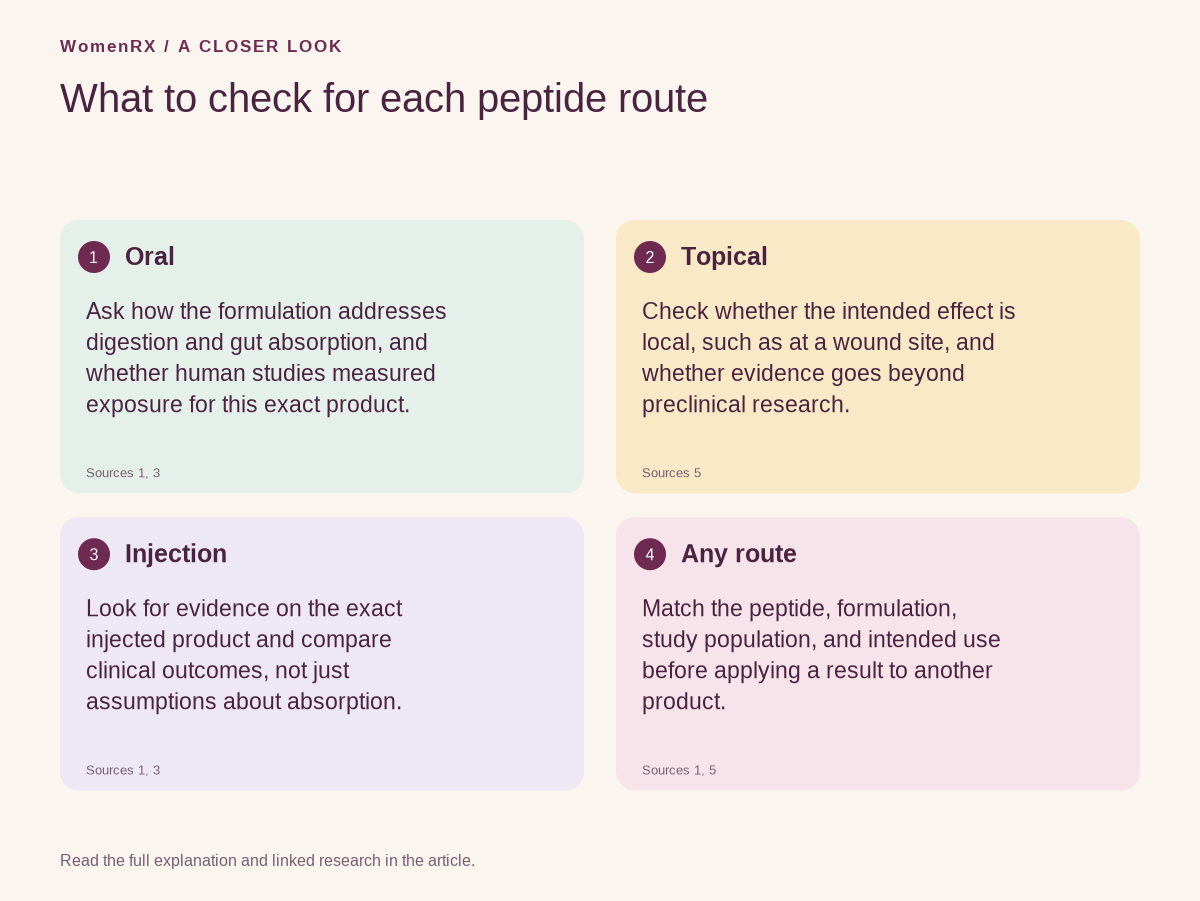
What to check for each peptide route
Oral: Ask how the formulation addresses digestion and gut absorption, and whether human studies measured exposure for this exact product.13
Topical: Check whether the intended effect is local, such as at a wound site, and whether evidence goes beyond preclinical research.5
Injection: Look for evidence on the exact injected product and compare clinical outcomes, not just assumptions about absorption.13
Any route: Match the peptide, formulation, study population, and intended use before applying a result to another product.15
Read the figure as text
Route helps determine the absorption question and what kind of evidence can support a product claim. These are prompts for comparison, not a ranking of routes.- Oral: Ask how the formulation addresses digestion and gut absorption, and whether human studies measured exposure for this exact product.13
- Topical: Check whether the intended effect is local, such as at a wound site, and whether evidence goes beyond preclinical research.5
- Injection: Look for evidence on the exact injected product and compare clinical outcomes, not just assumptions about absorption.13
- Any route: Match the peptide, formulation, study population, and intended use before applying a result to another product.15
More questions, answered
If two products contain semaglutide, can their results be compared directly?
Not without checking the exact formulation, route, population, and outcome. Product information reports different average blood concentrations for tablet and injection in adults with type 2 diabetes, as well as greater variability with the tablet. That supports comparing the specific forms, not assuming they are interchangeable. 1
Does an animal study of an oral peptide delivery device show it works in people?
No. The reported oral delivery-device result used a model peptide in dogs. It is proof of concept in that animal study, not a human treatment result. 2
Sources you can check
- WEGOVY (SEMAGLUTIDE) INJECTION, SOLUTION WEGOVY (SEMAGLUTIDE) TABLET [NOVO NORDISK PHARMACEUTICAL INDUSTRIES, LP] | US prescribing information and patient instructionsAccessed 2026-09-25Return to first citation
- Oral capsule administration of biomacromolecules that achieves bioavailability and pharmacokinetics comparable to subcutaneous injection in dogs - the BIONDD® technology.Skak N, Mertz N, Piwon N, Olsen MR, Caffarel-Salvador E, Brayden DJ, Østergaard J, Lindhardt K. · Drug delivery and translational research · 2026Return to first citation
- Navigating the complexity of oral peptide delivery: challenges and strategies to enhance oral bioavailability.Khalid NU, Rivera-Delgado E, von Erlach T. · Frontiers in drug delivery · 2026Return to first citation
- Systemic delivery of peptides by the oral route: Formulation and medicinal chemistry approaches.Brayden DJ, Hill TA, Fairlie DP, Maher S, Mrsny RJ. · Advanced drug delivery reviews · 2020Return to first citation
- Topical strategies for antimicrobial delivery of peptide medicines for the management of chronic wounds.Murthy S, Zhao TY, Neela VK, Hassan M, Selvaraja M, Palanirajan VK. · Discover nano · 2026Return to first citation