Melanotan II: What to Check Before You Trust a Tanning Claim
Melanotan II is not the same as an approved medicine for a specific medical condition, and a seller’s label cannot establish what a product contains or whether it is authorized where you live.
Melanotan II has limited human research and is not established as a safe tanning product. A small trial studied injections in men for erectile dysfunction, not tanning; reviews describe safety concerns and unreliable product quality. Don’t confuse it with afamelanotide, an authorized medicine for limited medical uses. Check the exact ingredient and product with your local medicines regulator, and don’t treat pigmentation as sun protection. 2 4 5 6
Start with the exact ingredient and claim
A product that says “Melanotan,” “Melanotan II,” or “tanning peptide” should prompt a basic question: what is the exact active ingredient, and what use is the seller claiming? A label, social media post, or “research use” statement doesn’t confirm what is in a vial or whether the product has been authorized for tanning.
This distinction matters because falsified peptide products may contain the wrong ingredient, the wrong amount, no active ingredient, or contaminants. A review of unregulated injectable peptides also identifies product contamination, manufacturing impurities, and inaccurate dosing as concerns. 4 6
Record the product name, active ingredient as written, seller, route shown on the label, and the country or region where it is being sold. These details help you ask a regulator or pharmacist a precise question. They don’t prove the product is genuine or safe.
The human evidence is not a tanning trial
One randomized, placebo-controlled crossover trial involved 10 men with erectile dysfunction. It examined injected Melanotan II for erections and sexual desire, not cosmetic tanning or long-term safety. Nausea and yawning or stretching were more frequent with the peptide, and severe nausea occurred after 4 of 19 Melanotan II injections. That small, short-term study cannot establish the safety or effectiveness of using it to tan. 2
A review of unregulated melanotan use describes reported adverse effects including changes in existing moles and new or atypical moles. It also notes case reports of melanoma appearing during or shortly after use, while stressing that a conclusive causal link has not been established. Treat changing or newly appearing moles as a reason to get medical attention, not as proof of what caused the change. 5
More recent reviews describe serious reported harms associated with unregulated melanotan use, including rhabdomyolysis, kidney infarction, and priapism. These reports raise safety concerns; they don’t tell us how often these events occur or establish a personal risk estimate. 3
Pregnancy and breastfeeding are another unanswered safety question. The human trial described above enrolled men, and the evidence cited here does not establish safety during pregnancy or breastfeeding. Don’t rely on a seller’s reassurance as evidence of reproductive safety. 2 4
Don’t mix up Melanotan II and afamelanotide
Melanotan II and afamelanotide are related melanocyte-stimulating substances, but they are not interchangeable products. A review describes afamelanotide as an approved medicine for a limited number of medical indications; that does not make it an approved cosmetic tanning treatment, or establish that a product sold as Melanotan II is equivalent. 5
Check a product’s exact name and claimed use against the official medicines regulator for the country where you live. If you’re in the United States, check current FDA product information and ask your state health department about any local rules that apply. If a product is absent from a database, don’t infer more than that: ask the regulator what the listing means for that particular ingredient, product, and use. Rules and product status can differ by jurisdiction and change over time.
Tanning is not skin protection
A tan from UV exposure is a sign that skin has responded to damaging radiation. UV exposure can contribute to skin cancer and premature skin aging. Indoor tanning also exposes skin to UV; a so-called base tan doesn’t prevent sunburn. 1
Sunless lotions, gels, and sprays that use DHA color the outer skin and don’t protect you from UV rays. MedlinePlus notes that DHA is considered safe for external use, while advising care to keep spray out of the nose, eyes, and mouth and not breathe it in. A cosmetic tan still calls for sun protection. 1
A practical product-status check
Before acting on a tanning claim, check five things: the exact active ingredient; whether the route is an injection, spray, or topical product; what use the seller claims; whether the exact product appears in the official medicines regulator’s records for your location; and whether the regulator or a pharmacist can clarify its status. A seller’s claim that a product is “legal,” “pharmaceutical grade,” or “research only” is not a substitute for that check.
For a UV-free cosmetic color, a sunless topical product is a separate option from an injectable peptide. It doesn’t supply UV protection, and the available evidence here does not establish that Melanotan II is a safe shortcut to a tan. 1 3 4
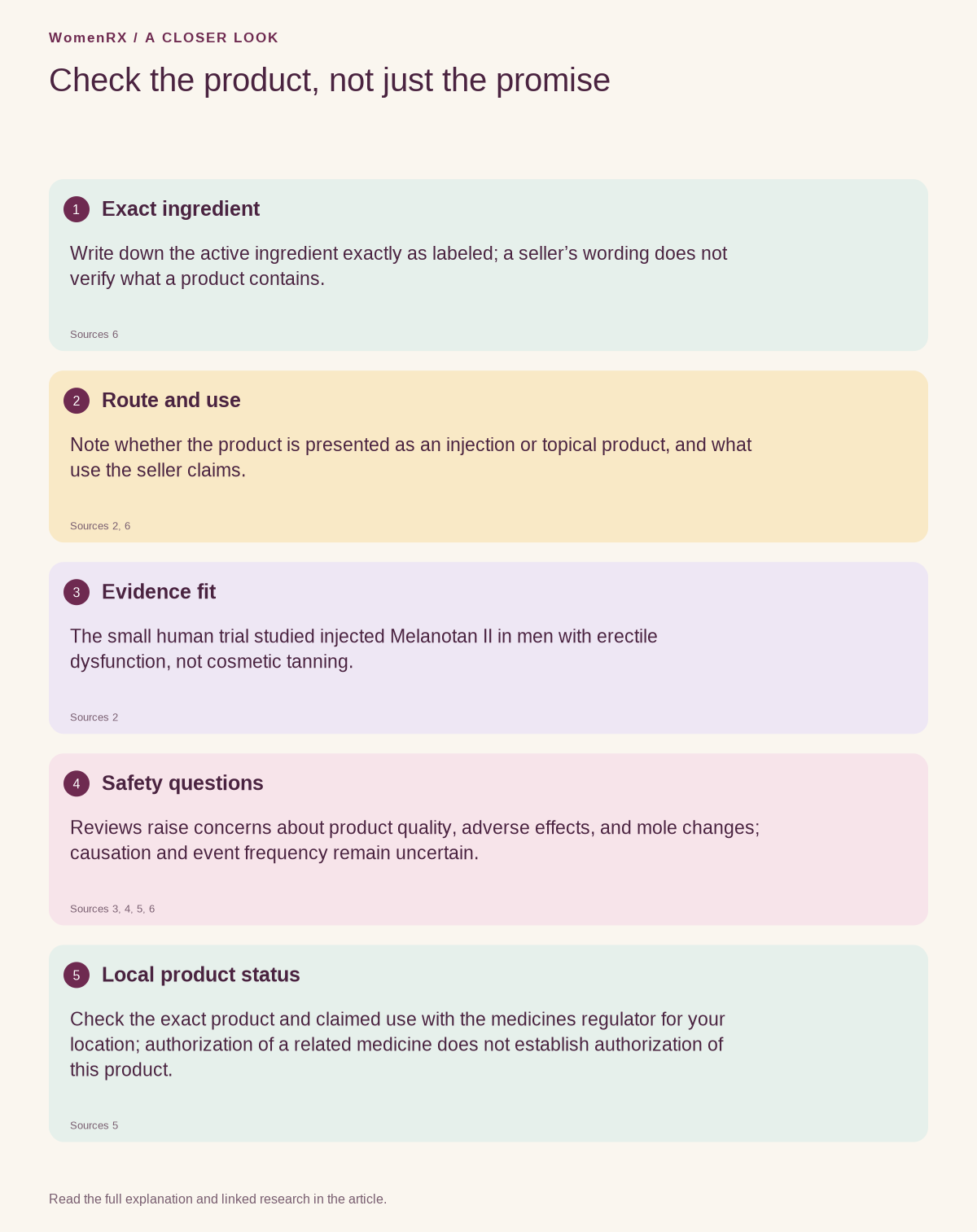
Check the product, not just the promise
Exact ingredient: Write down the active ingredient exactly as labeled; a seller’s wording does not verify what a product contains.6
Route and use: Note whether the product is presented as an injection or topical product, and what use the seller claims.26
Evidence fit: The small human trial studied injected Melanotan II in men with erectile dysfunction, not cosmetic tanning.2
Safety questions: Reviews raise concerns about product quality, adverse effects, and mole changes; causation and event frequency remain uncertain.3456
Local product status: Check the exact product and claimed use with the medicines regulator for your location; authorization of a related medicine does not establish authorization of this product.5
Read the figure as text
Use these checks to separate a tanning claim from what is known about the product, its evidence, and its local status.- Exact ingredient: Write down the active ingredient exactly as labeled; a seller’s wording does not verify what a product contains.6
- Route and use: Note whether the product is presented as an injection or topical product, and what use the seller claims.26
- Evidence fit: The small human trial studied injected Melanotan II in men with erectile dysfunction, not cosmetic tanning.2
- Safety questions: Reviews raise concerns about product quality, adverse effects, and mole changes; causation and event frequency remain uncertain.3456
- Local product status: Check the exact product and claimed use with the medicines regulator for your location; authorization of a related medicine does not establish authorization of this product.5
More questions, answered
Is Melanotan II the same as afamelanotide?
No. They are related substances, but they are not interchangeable. Afamelanotide is described as an approved medicine for a limited number of medical indications; that does not authorize Melanotan II for cosmetic tanning. 5
Can Melanotan II be considered safe during pregnancy or breastfeeding?
Safety in pregnancy and breastfeeding has not been established in this evidence. The small human trial cited involved men, and broader concerns about unregulated melanotan products do not answer reproductive-safety questions. 2 4
Does a tan from a tanning product protect against UV?
Don’t assume it does. MedlinePlus says sunless tanning products do not protect against UV rays, and UV tanning itself damages skin. 1
Sources you can check
- Tanning: MedlinePlusAccessed 2026-09-25Return to first citation
- Effect of an alpha-melanocyte stimulating hormone analog on penile erection and sexual desire in men with organic erectile dysfunction.Wessells H, Gralnek D, Dorr R, Hruby VJ, Hadley ME, Levine N. · Urology · 2000Return to first citation
- Insights into Tanning Biology and Tanning Products.Resnick G, Khajeh-Afzaly M, Yousefian F, Raza A, Issa NT. · The Journal of clinical and aesthetic dermatology · 2026Return to first citation
- Dangers of Injectable Peptides and Other Unregulated "Biohacking" Drugs.Moiz A, O'Keefe EL, O'Keefe JH. · Missouri medicine · 2026Return to first citation
- Risks of unregulated use of alpha-melanocyte-stimulating hormone analogues: a review.Habbema L, Halk AB, Neumann M, Bergman W. · International journal of dermatology · 2017Return to first citation
- Falsification of biotechnology drugs: current dangers and/or future disasters?Janvier S, De Spiegeleer B, Vanhee C, Deconinck E. · Journal of pharmaceutical and biomedical analysis · 2018Return to first citation