NAD Supplements: Check the Ingredient, Then the Claim
NR and NMN can change NAD-related lab measures, but that doesn’t establish that a supplement improves energy or slows aging.
NAD⁺ is a molecule involved in cellular metabolism, not a peptide. A product labeled “NAD” may name NAD⁺ itself or a precursor such as nicotinamide riboside (NR) or nicotinamide mononucleotide (NMN) on its ingredient panel. Human studies show that oral NR and NMN can raise NAD-related measures, but evidence for meaningful health benefits remains inconclusive. 13

The front label may not name the ingredient
NAD⁺ stands for nicotinamide adenine dinucleotide. Cells use it in metabolic processes. NR and NMN are different compounds that the body can use in NAD-related pathways; they’re called precursors. Nicotinic acid and nicotinamide are other precursors included in human research. NAD⁺ isn’t a peptide. 346
If you’re comparing products, turn to the ingredient panel. “NAD booster” doesn’t tell you whether the product names NAD⁺, NR, NMN, or something else. That distinction matters because a trial of one precursor doesn’t automatically establish what another ingredient will do. Studies that pool several precursors need the same careful reading. 26
What a higher NAD-related measure tells you
The most consistent finding in human studies is a change in lab measures. A systematic review found that oral NR and NMN raised NAD-related metabolites measured in blood or cells. It also found that results for functional, metabolic, vascular, and other health outcomes were mixed, often showing no effect or an effect limited to a particular measure. The studies generally found NR and NMN well tolerated over weeks to months, which doesn’t settle long-term safety. 1
Think of the lab result as evidence that the ingredient affected NAD biology, not as a stand-in for how you’ll feel. Higher NAD-related levels in blood or sampled cells don’t, by themselves, demonstrate more day-to-day energy, slower aging, or disease prevention. Research on NAD levels across human tissues is still sparse, so a blood measure also cannot tell the whole story about a particular organ. 13
Metabolic results illustrate the difference. A 2024 analysis of 19 randomized trials found lower total cholesterol and triglycerides among people given NAD precursors, but no significant effect on the other outcomes it analyzed. The researchers rated the evidence very low to low in quality. An earlier analysis reported changes in several lipid measures, but it combined different precursors; its abstract notes that nicotinic acid had the strongest lipid findings, while the evidence for NR and nicotinamide was limited. Those pooled results aren’t a demonstrated cholesterol benefit for an NR or NMN product. 26
What about benefits specifically for women?
The broad clinical reviews don’t establish whether NR or NMN works differently for women, or provide a clear answer for pregnancy, postpartum, or menopause. A small phase I study of oral NR or NMN included six healthy participants and six people with Parkinson’s disease. It reported no difference in NAD responses by sex, but it measured NAD responses, not a women-specific health benefit. Twelve participants cannot resolve questions about different life stages. 15
Match the claim to the outcome studied
A useful test is to finish this sentence: “This study found a change in…” Was it a blood or cellular NAD-related measure, cholesterol, or something a person could notice or experience? If the result was a biomarker, a claim about feeling more energetic asks for evidence the study didn’t provide. And if the study tested NR, check that the product you’re considering actually names NR rather than NAD⁺ or another precursor. Human research more clearly shows that oral NR and NMN affect NAD-related measures than that they deliver anti-aging or wellness benefits. 13
Ingredient name versus study result
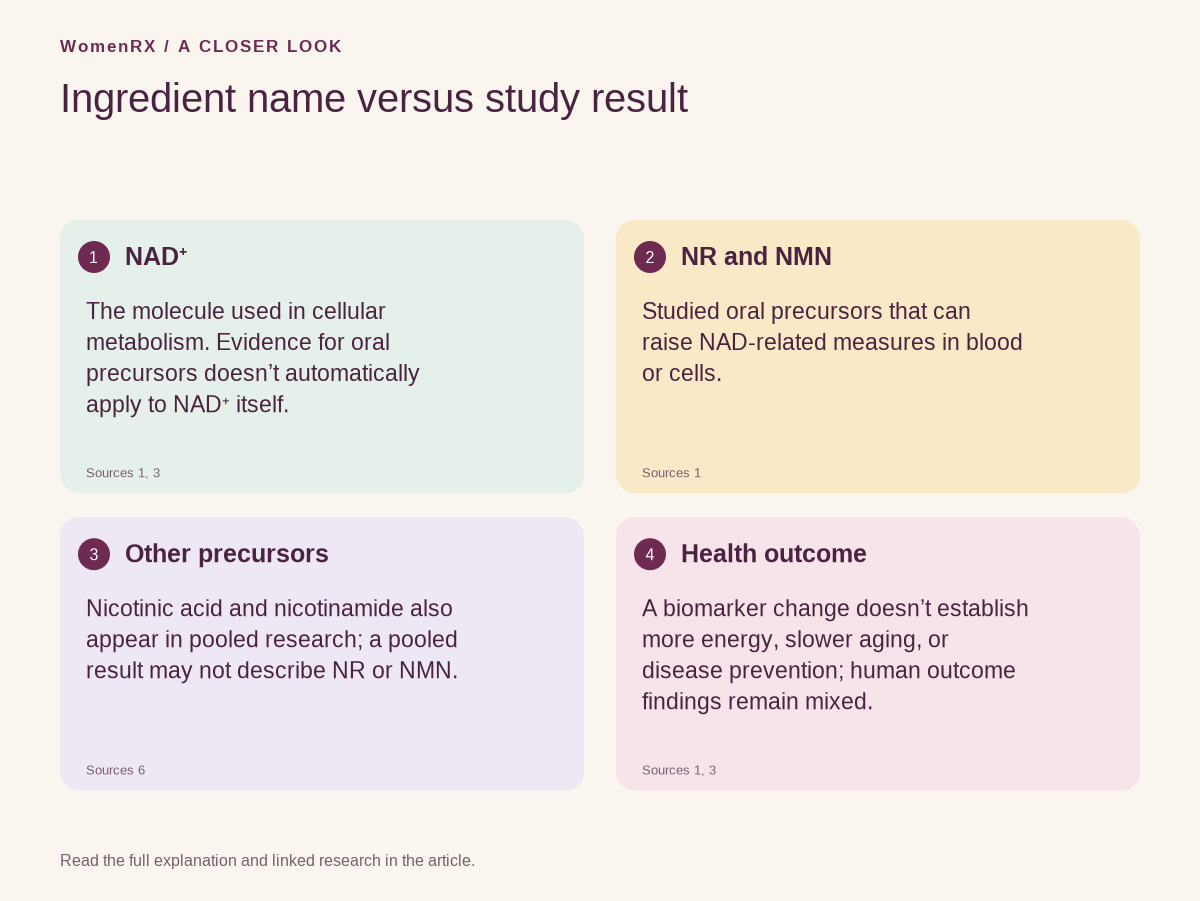
NAD⁺: The molecule used in cellular metabolism. Evidence for oral precursors doesn’t automatically apply to NAD⁺ itself.13
NR and NMN: Studied oral precursors that can raise NAD-related measures in blood or cells.1
Other precursors: Nicotinic acid and nicotinamide also appear in pooled research; a pooled result may not describe NR or NMN.6
Health outcome: A biomarker change doesn’t establish more energy, slower aging, or disease prevention; human outcome findings remain mixed.13
Read the figure as text
Read the ingredient name first, then check whether the research measured NAD biology or a health outcome.- NAD⁺: The molecule used in cellular metabolism. Evidence for oral precursors doesn’t automatically apply to NAD⁺ itself.13
- NR and NMN: Studied oral precursors that can raise NAD-related measures in blood or cells.1
- Other precursors: Nicotinic acid and nicotinamide also appear in pooled research; a pooled result may not describe NR or NMN.6
- Health outcome: A biomarker change doesn’t establish more energy, slower aging, or disease prevention; human outcome findings remain mixed.13
More questions, answered
Is an NAD⁺ injection backed by the same evidence as an oral NR supplement?
No. They’re different substances and routes of administration. A systematic review found no eligible outcomes trials of intravenous or intramuscular NAD⁺ itself for anti-aging or wellness. The biomarker findings for oral NR and NMN shouldn’t be treated as proof of benefit from injected NAD⁺. 1
Sources you can check
- NAD⁺ supplementation for anti-aging and wellness: A PRISMA-guided systematic review of preclinical and clinical evidence.Gallagher C, Emmanuel OO. · Ageing research reviews · 2026Return to first citation
- Effects of Supplementation with NAD + Precursors on Metabolic Syndrome Parameters: A Systematic Review and Meta-Analysis.Oliveira-Cruz A, Macedo-Silva A, Silva-Lima D, Sanchez-Almeida J, Cruz-Coutinho L, Santos Tavares MP, Majerowicz D. · Hormone and metabolic research = Hormon- und Stoffwechselforschung = Hormones et metabolisme · 2024Return to first citation
- NAD+ precursor supplementation in human ageing: clinical evidence and challenges.Vinten KT, Trętowicz MM, Coskun E, van Weeghel M, Cantó C, Zapata-Pérez R, Janssens GE, Houtkooper RH. · Nature metabolism · 2025Return to first citation
- NAD+ Precursors in Human Health and Disease: Current Status and Future Prospects.Yaku K, Nakagawa T. · Antioxidants & redox signaling · 2023Return to first citation
- The NAD-brain pharmacokinetic study of NAD augmentation in blood and brain using oral precursor supplementation.Berven H, Svensen M, Eikeland H, Tvedten N, Sheard EV, Af Geijerstam SA, Søgnen M, McCann A, Arnsten L, Årseth O, Skjeie V, Hjellbrekke A, Skeie GO, Torres Cleuren YN, Nido GS, Hau... · iScience · 2026Return to first citation
- Effects of NAD+ precursor supplementation on glucose and lipid metabolism in humans: a meta-analysis.Zhong O, Wang J, Tan Y, Lei X, Tang Z. · Nutrition & metabolism · 2022Return to first citation