NAD+ Supplements: How to Read the Label and Evidence
Products marketed as NAD+ boosters can contain different ingredients, and a rise in blood NAD+ doesn’t prove a health benefit.
Start with the Supplement Facts panel. NAD+, nicotinamide riboside (NR), nicotinamide mononucleotide (NMN), and forms of niacin are related, but a study of one isn’t evidence for all of them. Match the exact ingredient, amount, and formulation to the study, then check what researchers measured. A higher blood NAD+ reading alone doesn’t establish that you’ll feel better or age differently. 1 3

First, find out what’s in the bottle
“NAD+ booster” describes a goal, not a single ingredient. NAD+ is a coenzyme involved in how cells use energy. Your body makes it from nutrients including niacin. NR and NMN are NAD+ precursors, while nicotinic acid and nicotinamide are forms of niacin. They belong in the same conversation, but they aren’t interchangeable on a product label or in a clinical trial. 1 3
Turn the bottle around and read the full ingredient name in the Supplement Facts panel. If the front says “NAD+” but the panel lists NR, the relevant human research is on NR, not necessarily on a product containing NAD+ itself. The body converts NAD and NADP consumed in food to nicotinamide in the gut before absorption. That’s one reason not to assume that swallowing an ingredient labeled NAD+ has the same studied effects as taking a precursor. 1
NMN needs an additional check if you’re shopping in the US. The NIH Office of Dietary Supplements fact sheet reports that, in November 2022, the FDA determined NMN could not legally be marketed as a dietary supplement because it had been authorized for investigation as a new drug. That is a dated determination, not a verification of any particular product’s current status. Seeing NMN for sale doesn’t, by itself, establish its dietary-supplement status. 1
Compare a claim with the study behind it
Suppose a product promises “more NAD+.” Ask two separate questions: Did researchers test this ingredient and formulation? And did they measure something that matters to you? A blood measurement can answer the first part of a biological question without answering whether a supplement improves energy, symptoms, or long-term health.
For example, an eight-week randomized, placebo-controlled trial assigned 120 healthy adults ages 60 to 80 to placebo or one of two amounts of NR combined with pterostilbene. Whole-blood NAD+ rose in the combination groups. Because both ingredients were given together, the trial can’t tell you what NR alone would have done. Its blood result also doesn’t establish that participants felt better or gained a lasting health benefit. 2
A different randomized, placebo-controlled trial studied NMN in 66 healthy adults ages 40 to 65 for 60 days and reported changes in serum NAD+/NADH. That’s a different ingredient and a different blood measurement from the NR-plus-pterostilbene trial. Neither result should be copied onto a bottle with a different formula. 4 2
There’s a larger reason to keep the claim modest: blood or tissue NAD+ concentrations haven’t been established as predictors of disease risk. Whether raising those concentrations with precursors reduces disease risk in the general population remains unsettled. 3
Check the amount, then check the whole formula
Read the serving size and the amount of each named ingredient. A large number on the front of a bottle may describe an entire blend, not the amount of NR, NMN, or another ingredient within it. If individual amounts aren’t stated, you can’t make a clear amount-to-amount comparison with a study.
Formulation matters just as much. The NR trial tested NR with pterostilbene. It isn’t direct evidence for an NR-only product, a product with added ingredients, or an NAD+-labeled product containing neither ingredient. 2 Likewise, a study lasting weeks tells you about its measured period, not years of use.
If you’re looking at nicotinic acid because a label mentions cholesterol, don’t fold it into the NR or NMN evidence. In a large trial of people with established cardiovascular disease, adding extended-release niacin to cholesterol-lowering medication changed lipid measurements but did not reduce cardiovascular events over the roughly three years before the trial was stopped. That’s a reminder to check the outcome, not just an appealing lab result. 1
What safety and quality checks can tell you
The NR-plus-pterostilbene trial reported no serious adverse events over eight weeks, and adverse events were described as mild and distributed across supplement and placebo groups. That’s reassuring within the bounds of that trial. It doesn’t establish long-term safety or answer questions about a different formula. 2
Research on an ingredient also doesn’t verify what’s in a particular bottle. You can ask a manufacturer for documentation that identifies the ingredients, checks their amounts and contaminants, and applies to the lot you would buy. Such documentation helps you assess what the company can substantiate about its product; it isn’t evidence that the product delivers a health benefit.
If you take medication, have a health condition, or are pregnant or breastfeeding, the useful question is about the exact ingredient list and serving amount, not “NAD+ supplements” as a category. The trials described here don’t establish safety in pregnancy or breastfeeding or identify interactions for every product sold under the NAD+ name. 2 4
Finally, don’t assume a result applies especially to women. The reported NR-combination and NMN trial summaries don’t say whether women were enrolled. They also provide no results by sex or reproductive life stage, so they can’t tell you whether a product works differently during cycling years, perimenopause, or postmenopause. 2 4
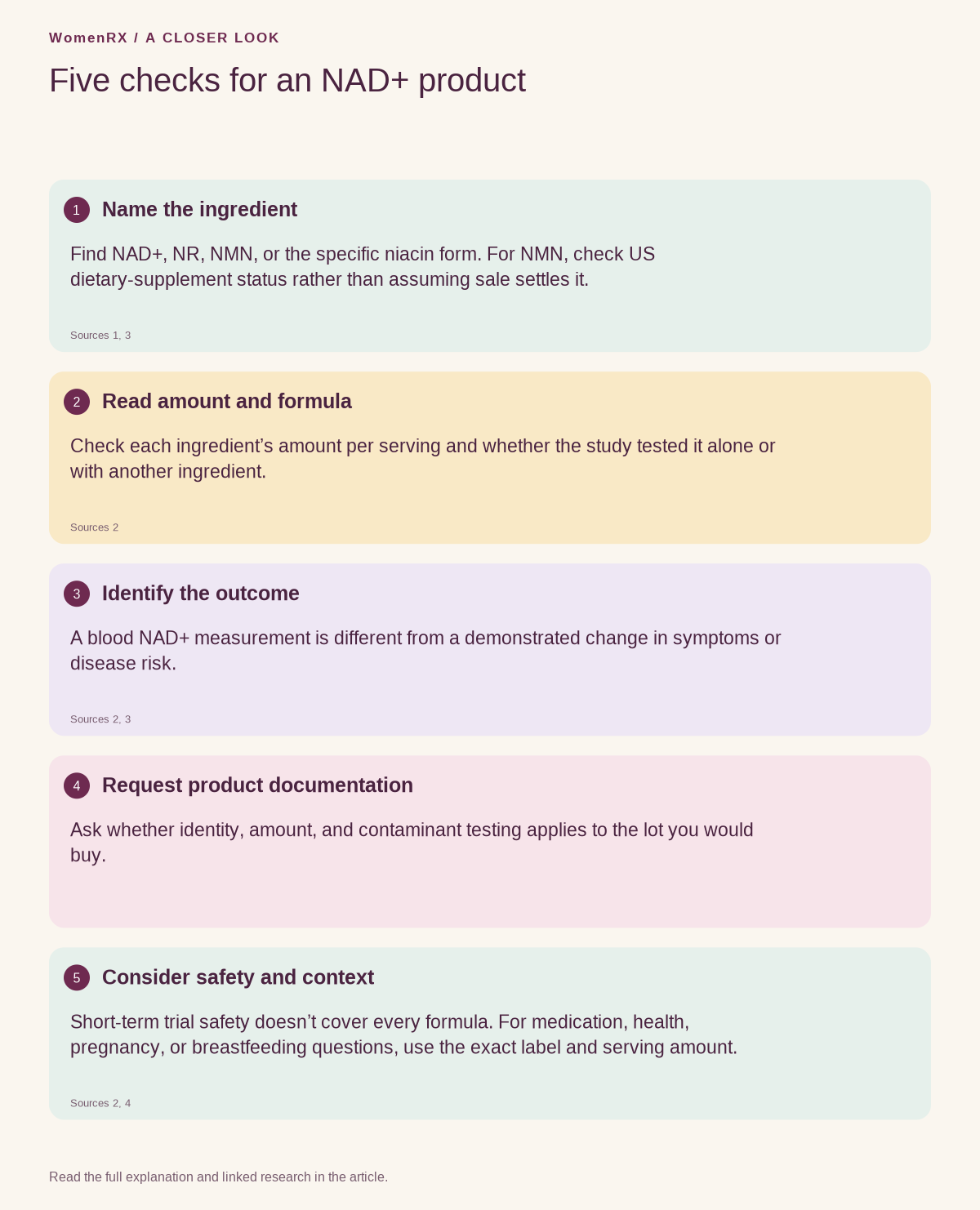
Five checks for an NAD+ product
Name the ingredient: Find NAD+, NR, NMN, or the specific niacin form. For NMN, check US dietary-supplement status rather than assuming sale settles it.13
Read amount and formula: Check each ingredient’s amount per serving and whether the study tested it alone or with another ingredient.2
Identify the outcome: A blood NAD+ measurement is different from a demonstrated change in symptoms or disease risk.23
Request product documentation: Ask whether identity, amount, and contaminant testing applies to the lot you would buy.
Consider safety and context: Short-term trial safety doesn’t cover every formula. For medication, health, pregnancy, or breastfeeding questions, use the exact label and serving amount.24
Read the figure as text
Use these checks to connect a bottle’s label to the evidence and questions that matter before purchase.- Name the ingredient: Find NAD+, NR, NMN, or the specific niacin form. For NMN, check US dietary-supplement status rather than assuming sale settles it.13
- Read amount and formula: Check each ingredient’s amount per serving and whether the study tested it alone or with another ingredient.2
- Identify the outcome: A blood NAD+ measurement is different from a demonstrated change in symptoms or disease risk.23
- Request product documentation: Ask whether identity, amount, and contaminant testing applies to the lot you would buy.
- Consider safety and context: Short-term trial safety doesn’t cover every formula. For medication, health, pregnancy, or breastfeeding questions, use the exact label and serving amount.24
More questions, answered
Does a higher blood NAD+ level mean a supplement slows aging?
No. A blood result shows a measured biological change in the studied group. Blood or tissue NAD+ concentrations haven’t been established as predictors of disease risk, and raising them hasn’t been shown by that measurement alone to slow aging. 3
Sources you can check
- Niacin - Health Professional Fact SheetAccessed 2026-09-25Return to first citation
- Repeat dose NRPT (nicotinamide riboside and pterostilbene) increases NAD+ levels in humans safely and sustainably: a randomized, double-blind, placebo-controlled study.Dellinger RW, Santos SR, Morris M, Evans M, Alminana D, Guarente L, Marcotulli E. · NPJ aging and mechanisms of disease · 2017Return to first citation
- The Safety and Antiaging Effects of Nicotinamide Mononucleotide in Human Clinical Trials: an Update.Song Q, Zhou X, Xu K, Liu S, Zhu X, Yang J. · Advances in nutrition (Bethesda, Md.) · 2023Return to first citation
- A Multicentre, Randomised, Double Blind, Parallel Design, Placebo Controlled Study to Evaluate the Efficacy and Safety of Uthever (NMN Supplement), an Orally Administered Supplementation in Middle Aged and Older Adults.Huang H. · Frontiers in aging · 2022Return to first citation