NAD+: What Human Studies Show About Benefits and Safety
Oral NAD+ precursors can change blood markers, but that’s a different result from feeling better or living healthier.
Human studies of oral NAD+ precursors, mainly nicotinamide riboside (NR) and nicotinamide mononucleotide (NMN), show changes in NAD-related blood or cell markers. Benefits for health and function are less consistent. A systematic review found no eligible clinical-outcomes trials of IV or intramuscular NAD+ itself for anti-aging or wellness. Short-term tolerability findings for pills cannot establish injection safety or long-term safety. 1
A rise in NAD+ is a starting point, not a health outcome
Nicotinamide adenine dinucleotide, or NAD+, helps cells carry out energy metabolism and other processes. That makes it a reasonable subject for research. But the fact that your cells use NAD+ doesn’t tell you whether adding an NAD-related product will ease fatigue, improve strength, or slow aging. Those are separate questions that need to be tested in people. 31
The distinction matters when you see a claim that a product “boosts NAD+.” In human trials, oral NR and NMN have generally changed NAD-related markers measured in blood or cells. In a systematic review covering human intervention studies through October 2025, results for functional, metabolic, vascular, and other health-related outcomes were mixed, often showing no benefit or one limited to a particular measure. A changed lab result is evidence that a compound had a biological effect, not proof that you’ll notice a benefit. 1
An NAD+ injection isn’t the same intervention as an NR pill
Most of the human wellness research in that review concerned oral precursors: compounds the body can use in NAD metabolism. It did not establish that swallowing NR or NMN has the same effects as receiving NAD+ by IV or intramuscular injection. The review found no eligible trials measuring clinical outcomes from IV or intramuscular NAD+ itself for anti-aging or wellness. It identified an IV NAD+ pilot focused on how the substance moved through the body, rather than whether people felt or functioned better. One nonrandomized IV NMN study contributed mainly short-term safety and biomarker information; NMN is a precursor, not NAD+ itself. 1
So if an injection service points to a study of oral NR, look at the intervention before the result. Even a well-measured improvement from a pill wouldn’t, on its own, support a claim about an injection. And a study showing a change in blood markers wouldn’t answer whether either product improves your symptoms. 1
What safety findings can and can’t tell you
Oral NR and NMN were generally well tolerated in the human studies reviewed over periods of weeks to months. That is useful, but narrower than a finding that either product is safe for long-term use. It also says little about the safety of IV or intramuscular NAD+, for which the review found no eligible anti-aging or wellness outcomes trials. 1
Injection raises a separate question about how the product is made. The FDA has received reports of severe chills, shaking, vomiting, and fatigue after NAD+ injectable drugs; some people needed medical treatment. The agency says these reactions are consistent with excessive endotoxins, and warns that food-grade NAD+ ingredients are not suitable for sterile drugs without appropriate processing because of contamination risks. These reports don’t tell us how often such reactions occur. 5
NAD-related compounds aren’t interchangeable across health conditions, either. A review of human glaucoma studies examined nicotinamide, another NAD precursor. It found preliminary short-term signals in some measures of retinal function, but inconsistent visual-field findings and insufficient evidence of lasting protection against glaucoma progression. The authors did not support routine high-dose nicotinamide supplementation for glaucoma. That research cannot be used to claim that an NAD+ drip treats eye disease, or that every NAD-related product has the same safety profile. 2
What does US compounding status tell you?
NAD+ appears in the FDA’s category 1 interim list of bulk substances being evaluated for use in certain pharmacy compounding. It does not appear on the final list of bulk substances authorized through that particular 503A pathway. Category 1 describes a conditional interim enforcement policy, not FDA approval of a finished NAD+ injection. Absence from the final list does not, by itself, mean every compounded NAD+ product is illegal. These lists also do not establish whether a particular product qualifies under another compounding pathway, such as 503B. 764
If you’re offered an injection, ask for the exact ingredient and formulation, who makes it, and which compounding pathway the provider says applies. The list status alone cannot verify that the product in front of you meets the applicable requirements. It also cannot answer the separate question of whether that injection improves the outcome you want. 471
What this means if you’re considering it for fatigue or aging
Start with the outcome you’re hoping for, not the name of the molecule. For example, “Will this help me get through the afternoon without feeling wiped out?” calls for evidence about fatigue or day-to-day function in people like you. A blood-marker result, or a benefit seen in rodents, doesn’t answer it. The review found clear biological activity from NAD-boosting approaches, while clinical effectiveness for anti-aging and wellness remained inconclusive. 1
The reviewed results also don’t establish whether benefits or harms differ for women, including during pregnancy, postpartum, perimenopause, or postmenopause. Don’t assume an average result from a mixed group answers a question about your life stage. If you’re discussing a product with a clinician, the most useful specifics are its exact ingredient, how it’s given, the outcome you want to improve, and whether that same intervention and route has shown that outcome in humans. 1
For an injection, also ask what is known about its safety, including whether its ingredients are suitable for a sterile product. For an oral precursor, ask how long people were followed and whether the study measured something you would actually notice. Those questions get closer to a decision than a promise to “raise NAD+.” 15
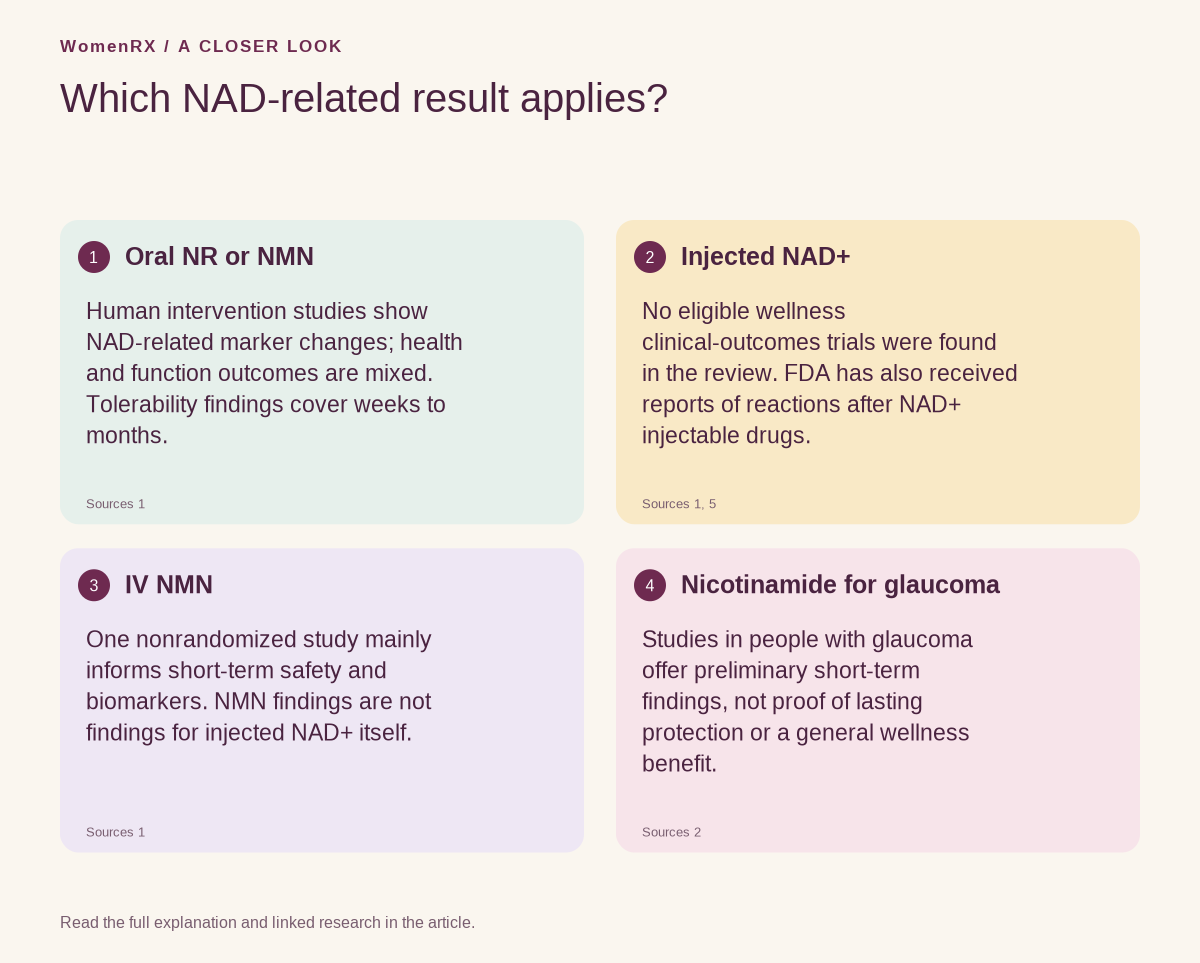
Which NAD-related result applies?
Oral NR or NMN: Human intervention studies show NAD-related marker changes; health and function outcomes are mixed. Tolerability findings cover weeks to months.1
Injected NAD+: No eligible wellness clinical-outcomes trials were found in the review. FDA has also received reports of reactions after NAD+ injectable drugs.15
IV NMN: One nonrandomized study mainly informs short-term safety and biomarkers. NMN findings are not findings for injected NAD+ itself.1
Nicotinamide for glaucoma: Studies in people with glaucoma offer preliminary short-term findings, not proof of lasting protection or a general wellness benefit.2
Read the figure as text
Compare the ingredient, route, participants, and outcome before applying a study result to a product.- Oral NR or NMN: Human intervention studies show NAD-related marker changes; health and function outcomes are mixed. Tolerability findings cover weeks to months.1
- Injected NAD+: No eligible wellness clinical-outcomes trials were found in the review. FDA has also received reports of reactions after NAD+ injectable drugs.15
- IV NMN: One nonrandomized study mainly informs short-term safety and biomarkers. NMN findings are not findings for injected NAD+ itself.1
- Nicotinamide for glaucoma: Studies in people with glaucoma offer preliminary short-term findings, not proof of lasting protection or a general wellness benefit.2
More questions, answered
Does raising NAD+ mean I’ll have more energy?
Not necessarily. Oral NR and NMN have changed NAD-related markers in human studies, but the review found mixed and often null results for health-related outcomes. A marker change alone doesn’t establish that you’ll feel more energetic. 1
Sources you can check
- NAD⁺ supplementation for anti-aging and wellness: A PRISMA-guided systematic review of preclinical and clinical evidence.Gallagher C, Emmanuel OO. · Ageing research reviews · 2026Return to first citation
- Nicotinamide Supplementation in Glaucoma: A Systematic Review of Human Studies.Giudiceandrea A, Cocuzza M, Gravina G, Silvestri V, Amore F, Sulfaro M, De Dominicis F, Bruzio S, Giudiceandrea E, Salgarello M, Cozzupoli GM, Savastano MC, Falsini B, Rizzo S, Sal... · Nutrients · 2026Return to first citation
- Implications of altered NAD metabolism in metabolic disorders.Okabe K, Yaku K, Tobe K, Nakagawa T. · Journal of biomedical science · 2019Return to first citation
- Bulk Drug Substances Used in Compounding Under Section 503A of the FD&C Act | FDAAccessed 2026-09-26Return to first citation
- FDA reminds compounders to use ingredients suitable for sterile compounding | FDAAccessed 2026-09-26Return to first citation
- 21CFR216.23, displayed current through September24,2026Accessed 2026-09-26Return to first citation
- FDA503A nominated substances: current linked May14,2026 listAccessed 2026-09-26Return to first citation