MOTS-c Benefits and Safety: What the Evidence Shows
MOTS-c affects cells in experiments, but human blood-level studies cannot tell you whether taking it will improve your health.
MOTS-c is a peptide made from instructions in mitochondrial DNA. Researchers have measured it in people and tested added MOTS-c in cells and animals, but those findings don’t establish a metabolic or longevity benefit from using a MOTS-c product. They don’t establish safety for women, either. The FDA has flagged safety uncertainties about compounded MOTS-c, so a clinic offer isn’t proof that a product is safe or effective.246
What a metabolic claim is built on
MOTS-c attracts interest because it’s involved in how cells respond to metabolic stress. That’s a reason to study it, not evidence that taking more will improve your blood sugar, weight, energy, or lifespan. The distinction matters if a clinic describes MOTS-c as a way to “optimize metabolism”: it may be pointing to a cell signal while promising a result in your whole body.2
In one experiment, researchers collected fat-derived repair cells from six donors with obesity and six lean donors, then exposed the cells to MOTS-c in a lab. MOTS-c activated a metabolic signaling pathway in cells from donors with obesity. But those cells also proliferated less and showed increased expression of genes associated with cellular aging. When researchers pretreated cells with MOTS-c and tested their repair capacity in mice with kidney injury, the treatment did not restore the impaired cells’ repair effect and blunted the effect of cells from lean donors. This was a cell-and-mouse experiment, not a test of MOTS-c treatment in the donors.2
Another study found that MOTS-c reduced cartilage damage in a mouse model of osteoarthritis and affected cartilage cells under experimental conditions. It doesn’t tell us whether a product helps a person’s joints, much less whether it improves general health.5
Human measurements aren’t human treatment results
Human research adds a different kind of information. In an exploratory study comparing 32 adults with obesity who were scheduled for bariatric surgery with 22 lean controls, circulating MOTS-c was higher in the group with obesity. Among 10 participants measured again six months after surgery, MOTS-c levels did not significantly change despite weight loss. The researchers measured the peptide; they did not give participants MOTS-c.4
A separate cross-sectional study of people with Hashimoto’s thyroiditis reported associations between lower circulating MOTS-c and markers of insulin resistance and thyroid autoimmunity. That finding also concerns naturally circulating levels, not the effects of a product. Together, these studies show why a claim such as “low MOTS-c causes metabolic problems, so replacing it will fix them” gets ahead of the evidence. Blood levels vary across the conditions studied, and an association cannot establish what adding MOTS-c would do.34
The reported results also don’t establish a benefit specific to women. Neither the cell and mouse findings nor the human blood-level associations demonstrate that administering MOTS-c improves an outcome in women.234
What is known about taking a product
A product’s safety cannot be read from a study of cells or from the fact that your body makes the peptide. On its compounding safety-risk page, the FDA says compounded products containing MOTS-c may present an immune-reaction risk for certain routes of administration and may have peptide-related impurities or difficulties in characterizing the active ingredient. The agency says it has not identified human exposure data for drug products containing MOTS-c by any route and lacks information needed to know whether administering it would cause harm. That is a statement about the FDA’s assessment, not proof that no one has ever used it.6
Before considering a product, ask who makes it, how it would be given, and which human study measured the result being promised. A claim about women, weight loss or better insulin sensitivity needs evidence for that outcome and population. 234
If your underlying concern is blood sugar, cholesterol, blood pressure, or waist-related risk, you don’t need to settle for a vague promise about metabolism. Those are measurable parts of metabolic health, and established care can address the risks they reveal.1
Which kind of evidence is the offer using?
| Evidence used in a pitch | What was actually done | What it cannot establish |
|---|---|---|
| A metabolic effect in donor cells | Cells were exposed to MOTS-c in a laboratory. 2 | What happens when a woman takes a product |
| Blood levels in people with obesity | Researchers compared circulating levels; they did not administer MOTS-c. 4 | That supplementation causes weight loss |
| A link with insulin resistance in Hashimoto’s thyroiditis | The study measured associations. 3 | That raising the peptide level improves thyroid or glucose outcomes |
| Less cartilage damage in mice | Researchers used an experimental osteoarthritis model. 5 | Relief of joint symptoms in people |
Ask the seller to point to the row that describes its evidence. A human treatment claim needs a human treatment study, not simply a study that mentions the same molecule.
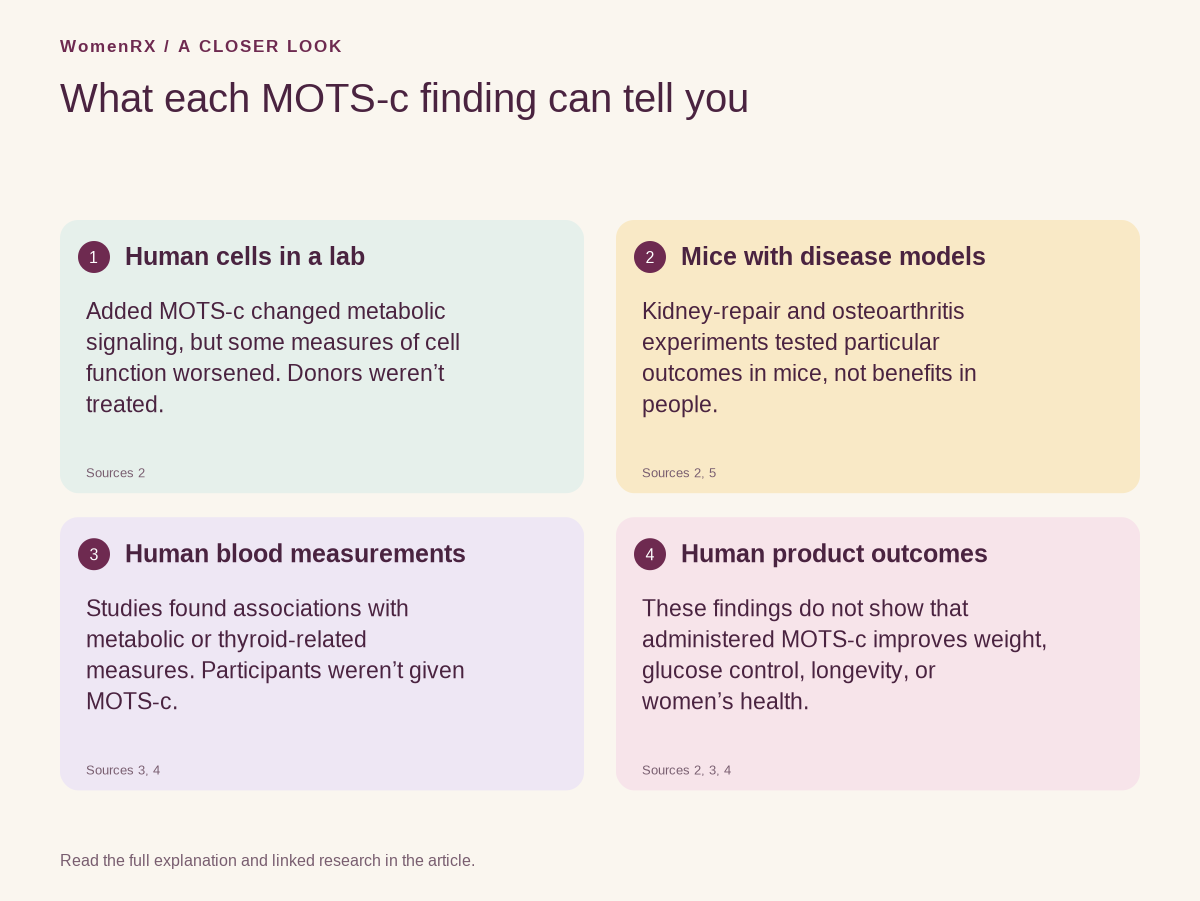
What each MOTS-c finding can tell you
Human cells in a lab: Added MOTS-c changed metabolic signaling, but some measures of cell function worsened. Donors weren’t treated.2
Mice with disease models: Kidney-repair and osteoarthritis experiments tested particular outcomes in mice, not benefits in people.25
Human blood measurements: Studies found associations with metabolic or thyroid-related measures. Participants weren’t given MOTS-c.34
Human product outcomes: These findings do not show that administered MOTS-c improves weight, glucose control, longevity, or women’s health.234
Read the figure as text
The type of study determines whether a result supports a biological idea, describes people’s blood levels, or tests a product’s benefit.- Human cells in a lab: Added MOTS-c changed metabolic signaling, but some measures of cell function worsened. Donors weren’t treated.2
- Mice with disease models: Kidney-repair and osteoarthritis experiments tested particular outcomes in mice, not benefits in people.25
- Human blood measurements: Studies found associations with metabolic or thyroid-related measures. Participants weren’t given MOTS-c.34
- Human product outcomes: These findings do not show that administered MOTS-c improves weight, glucose control, longevity, or women’s health.234
Sources you can check
- Metabolic Syndrome | MedlinePlusAccessed 2026-09-25Return to first citation
- Mitochondrial-derived peptide MOTS-c activates metabolic signaling but blunts reparative function in human mesenchymal stromal cells.Xing L, Lu B, Zhu X, Al Saeedi M, Lerman A, Eirin A, Cohen P, Lerman LO. · Inflammation and regeneration · 2026Return to first citation
- Reduced Circulating MOTS-c Levels in Hashimoto's Thyroiditis Reflect Integrated Autoimmune and Metabolic Dysregulation: A Cross-Sectional Study.Sonay HO, Duran EN, Algemi M, Sahtiyanci B, Utku IK, Çokiçli E, Misirlioglu NF, Simsek G, Uzun H, Tabak O. · Journal of clinical medicine · 2026Return to first citation
- Systemic MOTS-c levels are increased in adults with obesity in association with metabolic dysregulation and remain unchanged after weight loss.Yoon SH, Yuan F, Zhu X, Tang H, Abdurakhimoova D, Krier J, Eirin A, Lerman A, Cohen P, Lerman LO. · Journal of clinical & translational endocrinology · 2026Return to first citation
- MOTS-c attenuates mitochondrial dysfunction induces pyroptosis and cartilage degradation in osteoarthritis via an Nrf2-Dependent Mechanism.Li K, Yang T, Chen F, Lou C, Chen Y, Chen Z, Ye L, Sun X, Liu G, Xie C, Fang J, Hu X, Zhu Y, Liu B, He D, Ma H. · Free radical biology & medicine · 2025Return to first citation
- Certain Bulk Drug Substances for Use in Compounding that May Present Significant Safety Risks | FDAAccessed 2026-09-26Return to first citation