Visceral Fat: What a Waist Measurement Can Tell You
A larger waist can be a clue to higher metabolic risk, but it does not measure visceral fat or diagnose a health problem on its own.
Visceral fat sits around abdominal organs; subcutaneous fat lies just beneath the skin. A waist measurement is a convenient risk clue, not a direct reading of either fat depot. A larger waist can be one part of a broader cardiometabolic risk pattern, so blood pressure and blood tests add useful context. Sustainable lifestyle changes can help improve risk, without needing a promise of targeted belly-fat loss. 1 2 5 6
Two kinds of abdominal fat, in different places
Visceral adipose tissue (VAT), often called visceral fat, is inside the abdominal cavity around the organs. Abdominal subcutaneous fat sits below the skin. They can both contribute to abdominal size, but a waist measurement cannot tell you how much of your fat is in either location. A person’s appearance is not a reliable way to see what is inside the abdomen. 5
This distinction matters because fat distribution is associated with health risk. A larger waist is one risk factor used in assessing metabolic syndrome, a group of factors linked to heart disease and diabetes. It is not the whole assessment: blood fats, blood sugar, and other findings matter too. 1 2
What your waist measurement can and can’t say
MedlinePlus lists a waist measurement of 35 inches or more for women as one of the risk-factor criteria used in diagnosing metabolic syndrome. But a waist measurement by itself does not establish that diagnosis: the criteria require at least three risk factors, including items such as high triglycerides, low HDL cholesterol, and high fasting blood sugar. The number is a screening clue, not a scan of visceral fat or a verdict about your health. The listed criterion does not tell us how well that cutoff applies across racial or ethnic groups or menopause stages. 1
Body size measures also have limits. BMI, for example, does not distinguish fat from muscle or bone, and it can misrepresent body fat in some people. Waist size adds information about where fat is carried, but it still doesn’t show the exact amount or location of abdominal fat. 3
For a fuller picture, pair the measurement with the rest of the risk pattern. Blood pressure and blood tests for glucose and blood fats are among the checks used when assessing metabolic syndrome. These can help show whether a larger waist is accompanied by other cardiometabolic risk factors. 1 2
What imaging adds, and when it helps
MRI can measure fat distribution more precisely than ordinary body measurements, and can distinguish visceral from abdominal subcutaneous fat. That makes imaging useful in research, but it is a different kind of assessment from measuring your waist. 5
More precision does not automatically make a scan necessary for routine risk assessment. A larger waist is a risk factor used in assessing metabolic syndrome; it does not measure visceral fat. 1 Separately, an imaging study found associations between visceral fat and cardiovascular ageing and events, but it did not establish that every person with a larger waist needs imaging. The practical question is usually whether the broader risk picture needs attention, not whether you can obtain a precise visceral-fat number. 7
What changes can help
A heart-healthy eating pattern and regular physical activity are practical starting points. For people being treated for metabolic syndrome, NHS guidance describes lifestyle changes that include eating less saturated fat and adding fruit, vegetables, and whole grains, along with regular exercise. 2
A review of fat distribution and metabolism reported that, among people with visceral obesity in a weight-loss program, visceral fat could decrease and that this reduction was associated with improved blood-fat profiles and insulin sensitivity. That supports focusing on sustainable changes that improve overall health, rather than promising that a particular food or exercise will burn fat from one chosen spot. 6
If you have obesity, MedlinePlus says losing 5% to 10% of body weight can delay or prevent some related diseases. That is not a guarantee for any individual, and it is not a target everyone needs; the appropriate approach depends on your health and circumstances. 3
Menopause can change the pattern, but the details vary
Fat distribution can shift around menopause, but changes in weight and body composition are not identical for everyone. In a prospective study of women who underwent risk-reducing ovary removal and a comparison group, both groups gained weight over 24 months, with no significant difference in weight between groups. A smaller body-composition subgroup showed a modestly greater gain in visceral fat after surgery. Because this was a study of surgical menopause in women at elevated ovarian-cancer risk, it shouldn’t be treated as a precise forecast for natural menopause. 4
If your waist changes during midlife, that measurement alone can’t tell you why or determine your risk. Looking at it alongside blood pressure, glucose, and blood fats gives more useful context than trying to infer visceral fat from appearance. 1 2
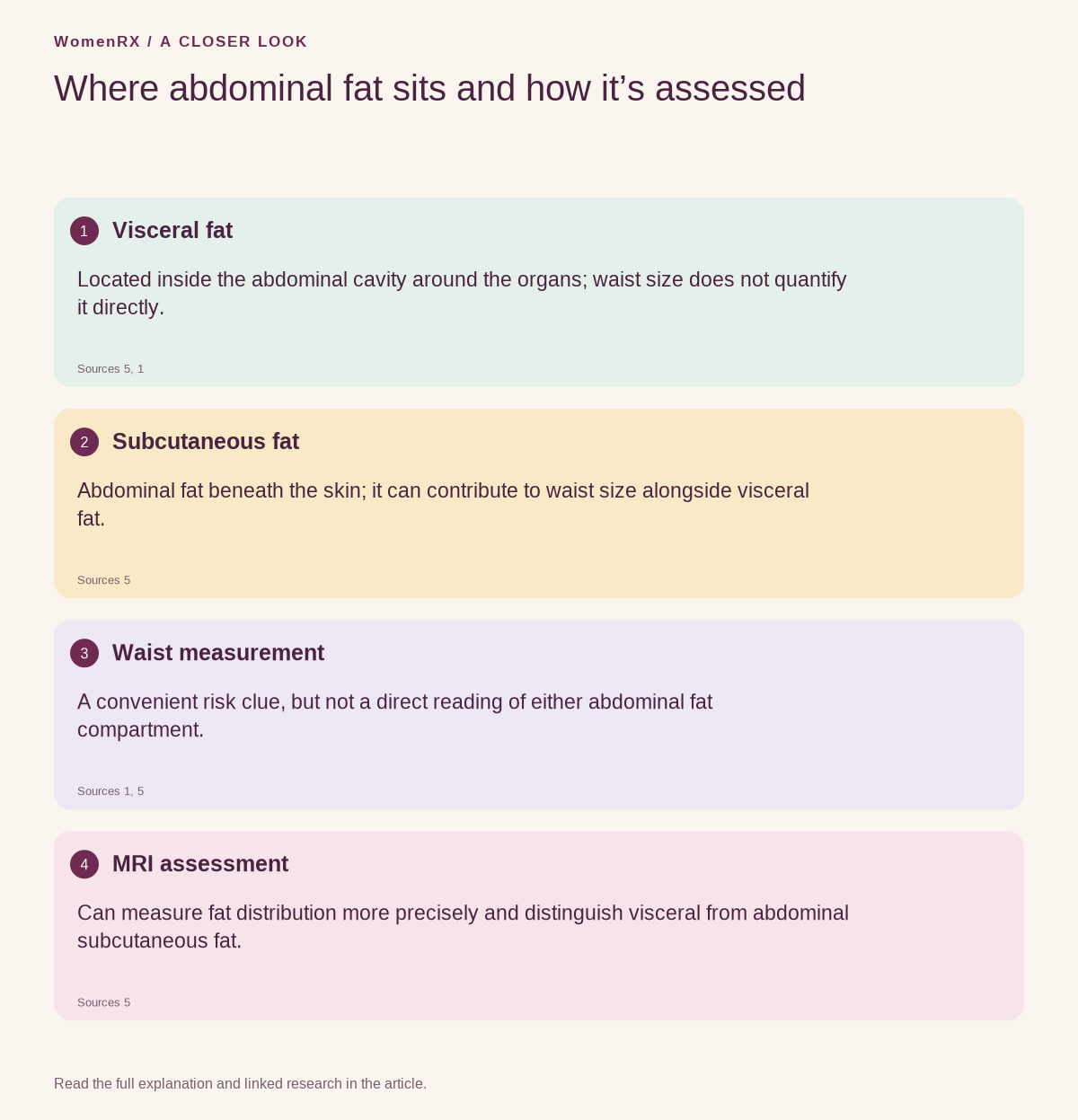
Where abdominal fat sits and how it’s assessed
Visceral fat: Located inside the abdominal cavity around the organs; waist size does not quantify it directly.51
Subcutaneous fat: Abdominal fat beneath the skin; it can contribute to waist size alongside visceral fat.5
Waist measurement: A convenient risk clue, but not a direct reading of either abdominal fat compartment.15
MRI assessment: Can measure fat distribution more precisely and distinguish visceral from abdominal subcutaneous fat.5
Read the figure as text
A waist measurement reflects abdominal size, while imaging can distinguish fat compartments. The figure separates location from what a measurement can tell you.- Visceral fat: Located inside the abdominal cavity around the organs; waist size does not quantify it directly.51
- Subcutaneous fat: Abdominal fat beneath the skin; it can contribute to waist size alongside visceral fat.5
- Waist measurement: A convenient risk clue, but not a direct reading of either abdominal fat compartment.15
- MRI assessment: Can measure fat distribution more precisely and distinguish visceral from abdominal subcutaneous fat.5
More questions, answered
Does a larger waist prove I have too much visceral fat?
No. Waist size is a risk clue, not a direct measurement of visceral fat. MRI can distinguish visceral from abdominal subcutaneous fat more precisely, but a waist measurement cannot tell you how much of each type you have. 1 5
Can I lose fat only from my stomach?
The evidence cited here supports overall lifestyle-based weight reduction, not a promise that a particular food or exercise selectively removes abdominal fat. A review reported that visceral fat decreased in viscerally obese participants in weight-loss programs, alongside improvements in some metabolic measures. 6
Sources you can check
- Metabolic Syndrome | MedlinePlusAccessed 2026-09-25Return to first citation
- Metabolic syndrome - NHSAccessed 2026-09-25Return to first citation
- Obesity: MedlinePlusAccessed 2026-09-25Return to first citation
- WHAM-A Prospective Study of Weight and Body Composition After Risk-Reducing Bilateral Salpingo-oophorectomy.Price SAL, Finch S, Krejany E, Jiang H, Kale A, Domchek S, Wrede D, Wark JD, Hickey M. · The Journal of clinical endocrinology and metabolism · 2023Return to first citation
- Associations between abdominal adipose tissue, reproductive span, and brain characteristics in post-menopausal women.Schindler LS, Subramaniapillai S, Barth C, van der Meer D, Pedersen ML, Kaufmann T, Maximov II, Linge J, Leinhard OD, Beck D, Gurholt TP, Voldsbekk I, Suri S, Ebmeier KP, Draganski... · NeuroImage. Clinical · 2022Return to first citation
- [Fat distribution and metabolism].Després JP, Lemieux I, Tchernof A, Couillard C, Pascot A, Lemieux S. · Diabetes & metabolism · 2001Return to first citation
- Distinct relationships of compartment-specific fat distribution profiles with cardiovascular ageing and future cardiovascular events.Maldonado-Garcia C, Salih AM, Neubauer S, Petersen SE, Raisi-Estabragh Z. · Heart (British Cardiac Society) · 2026Return to first citation