Waistline Fat, Exercise, and What Clothing Fit Can Tell You
Abdominal exercises can train your core, but they can’t promise fat loss from the exact area under your waistband.
You can strengthen your abdominal muscles with core exercises, but that does not guarantee fat will come off your waist specifically. Overall body-fat change may affect your waist measurement and how some clothes fit, but neither a clothing size nor a single measurement tells the whole story about your health. One small trial in women suggests regional exercise may have a role alongside general exercise, but it does not establish reliable spot reduction. 1 2 3
What a core workout can, and can’t, change
Crunches, planks, and other abdominal exercises work the muscles in your trunk. That can be a worthwhile reason to include them in a routine, but doing an exercise for one area isn’t a promise that fat will come off that area. Exercise can support weight management, and physical activity has health benefits beyond weight. 1
There is a wrinkle in the evidence: a 12-week randomized trial assigned 60 women with obesity to general aerobic exercise, regional aerobic exercises targeting abdominal or lower-body areas, or a combination. The groups all improved on several measures, and the combined program had the greatest reported improvements. But the study’s reported measurements included weight, BMI, waist-to-hip ratio, and blood markers. Those results don’t show clearly that exercises made fat disappear only from the area being worked. It’s a promising question for research, not a dependable promise about your waistband. 3
Four things that can change independently
Waist measurement: A tape measure records circumference, not a precise amount of fat or a diagnosis. Waist size can be useful in assessing health because carrying more body fat around the abdomen is associated with weight-related health risks. It’s one piece of context, not a complete picture. 2
Clothing fit: A waistband may feel different as your body changes, but fit also depends on the garment’s cut, fabric, and where it sits on your body. A tag size is not a health measurement. You can choose a clothing-fit goal because comfort matters to you without treating that goal as proof of a health problem or its solution.
Abdominal muscle: Core exercises train the muscles you use to brace, bend, and stabilize your trunk. That is a distinct goal from reducing the fat over those muscles. A change in strength or how your midsection feels doesn’t necessarily mean a particular amount of localized fat has changed.
Overall body-fat change: Changes in overall body fat can happen alongside changes in waist size, but you can’t use a clothing label or waist measurement alone to determine exactly what changed. BMI has limits too: it doesn’t distinguish fat from muscle and bone. 2
Choose the goal that matters to you
If you want more strength or a steadier core, include exercises you enjoy and can do consistently. You don’t need to judge that effort by whether one patch of your waist changes. Regular activity can support weight management and has other benefits, including for heart health, blood glucose, mood, bones, and muscles. 1
If you want a change in waist size or overall body fat, think in terms of broader, sustainable changes rather than a special set of moves for one area. Exercise plays a role in weight management, and healthy eating patterns and regular physical activity can support weight loss and lower the chance of obesity-related complications. 1 2
If your main goal is clothes feeling more comfortable, it’s reasonable to focus on fit and comfort rather than the number on the tag. You might prefer a different waistband or cut while your body is changing, or simply because it suits you better. That choice doesn’t need to stand in for a health assessment.
What we know about women, and what’s missing
The regional-exercise trial included women ages 25 to 50 with obesity. The reported results don’t establish whether exercise effects differ during pregnancy, postpartum, the cycling years, perimenopause, or postmenopause. They also can’t predict how abdominal fat or clothing fit might change for you after pregnancy or around menopause. 3
For now, a practical takeaway is to separate your goals: train your core for strength, use measurements only as one health clue, and treat clothing fit as a personal comfort preference. The evidence doesn’t support promising that targeted exercises will remove fat from precisely the area under your waistband.
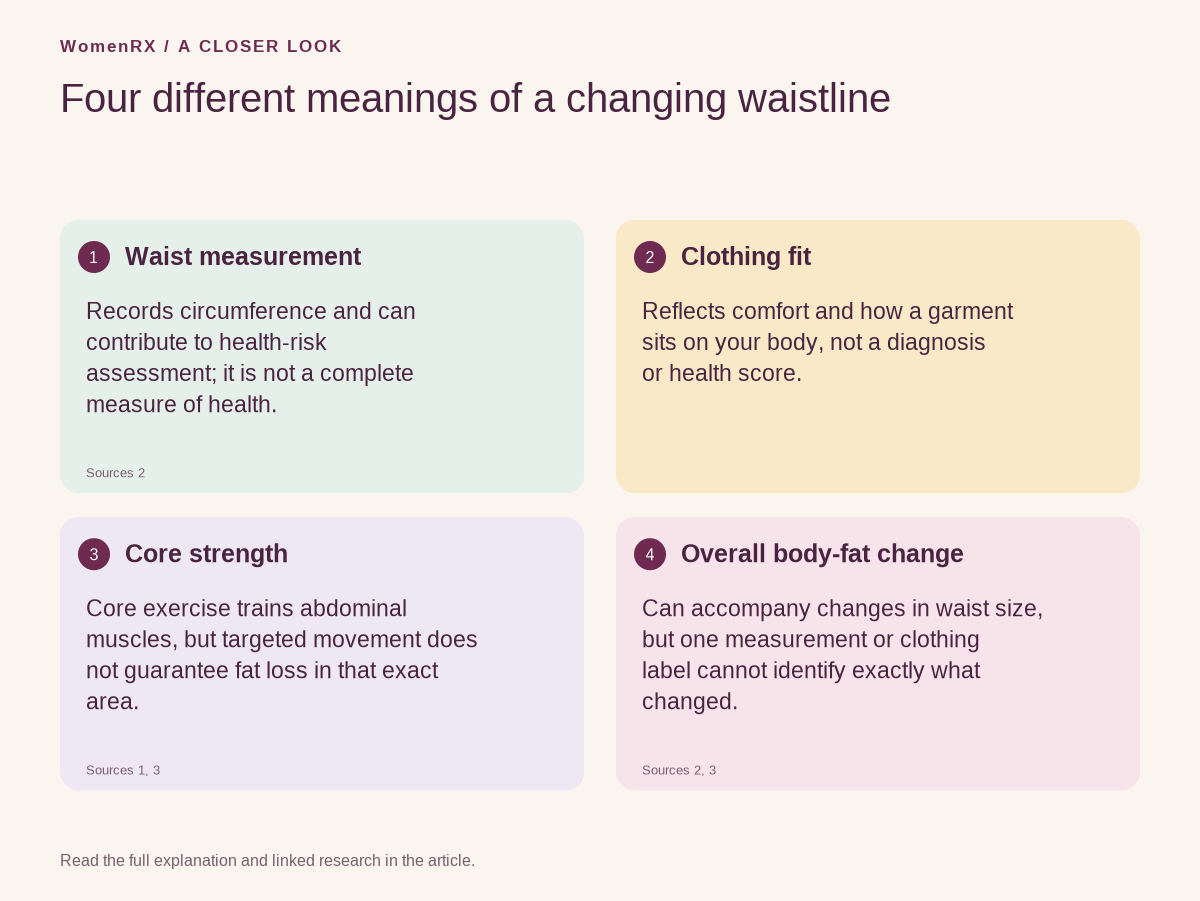
Four different meanings of a changing waistline
Waist measurement: Records circumference and can contribute to health-risk assessment; it is not a complete measure of health.2
Clothing fit: Reflects comfort and how a garment sits on your body, not a diagnosis or health score.
Core strength: Core exercise trains abdominal muscles, but targeted movement does not guarantee fat loss in that exact area.13
Overall body-fat change: Can accompany changes in waist size, but one measurement or clothing label cannot identify exactly what changed.23
Read the figure as text
A waist measurement, clothing fit, muscle strength, and overall body-fat change describe different things; none should be used as a substitute for all the others.- Waist measurement: Records circumference and can contribute to health-risk assessment; it is not a complete measure of health.2
- Clothing fit: Reflects comfort and how a garment sits on your body, not a diagnosis or health score.
- Core strength: Core exercise trains abdominal muscles, but targeted movement does not guarantee fat loss in that exact area.13
- Overall body-fat change: Can accompany changes in waist size, but one measurement or clothing label cannot identify exactly what changed.23
More questions, answered
Does a smaller waist measurement prove I lost belly fat?
Not by itself. A tape measure records circumference, and waist size is one clue used in assessing abdominal body fat and related health risk. It doesn’t identify exactly what changed or provide a complete health assessment. 2
Sources you can check
- Benefits of Exercise: MedlinePlusAccessed 2026-09-25Return to first citation
- Obesity: MedlinePlusAccessed 2026-09-25Return to first citation
- Impact of regional and general aerobic exercise on molecular regulators of lipolysis and adipose tissue composition in obese women.Zourmand G, Shaabani Ezdini E, Taheri M, Irandoust K. · Cellular and molecular biology (Noisy-le-Grand, France) · 2025Return to first citation