Can Hip Exercises Reduce Fat at Your Hips?
Hip exercises can build muscle, but they aren’t a reliable way to choose where your body loses fat.
If your goal is less fat specifically at your hips, hip exercises aren’t a dependable shortcut. Exercise can help with overall weight management and build muscle, which may change how the area looks and feels.1 Research on local fat loss is mixed: one small trial found an effect at the trunk in men, but it doesn’t establish that hip workouts reduce hip fat in women.3
What a hip workout can change
A squat or other lower-body exercise works muscles in and around your hips. Muscle-strengthening activity can increase or maintain muscle mass and strength.1 That’s a real change, but it isn’t the same thing as removing the fat over those muscles.
This distinction helps when you’re choosing a goal. If you want stronger legs or find it easier to climb stairs, lower-body strength work fits the goal. If you want a particular hip measurement, strength gains alone won’t tell you what will happen to it. Exercise can also contribute to overall weight management, but an overall change doesn’t specify where fat will be lost.1
Does working one area make it lose more fat?
The research doesn’t support a reliable promise of hip-specific fat loss, though it’s more nuanced than saying local effects never happen.
In a randomized trial of 16 men with overweight, researchers compared treadmill exercise alone with treadmill exercise plus abdominal endurance exercises. After 10 weeks, the group doing abdominal work had a greater reduction in trunk fat measured by DXA, while total fat loss was similar between groups.3 It’s an intriguing result, not a tested hip-fat plan: the participants were men, the exercises targeted the trunk, and the trial was small.
A separate 12-week trial assigned 60 women with obesity to general aerobic exercise, regional aerobic exercise, or a combination. All groups had reductions in weight and waist-to-hip ratio; the combination group had the largest reported changes in those measures.2 But waist-to-hip ratio compares two circumferences. A change in that ratio doesn’t show that fat disappeared specifically from the hips. The researchers called for imaging-based measurements to clarify what happened in individual fat depots.2
Together, these studies leave room for local effects under some exercise conditions. They don’t show that adding hip exercises will predictably shrink hip fat, or that one woman’s results can be inferred from a group average.23
Why a changing shape isn’t a map of fat loss
Appearance, circumference, muscle, and fat are related, but they aren’t interchangeable measures. Body weight includes bone, muscle, fat, and water, so a change on the scale can’t isolate a change in hip fat.5
For example, strengthening can change hip-area muscle mass or strength, but neither change by itself demonstrates local fat loss.1 Likewise, a smaller waist-to-hip ratio could reflect a change at the waist, the hips, or both. It can’t identify which tissue changed at either site.2
Research in postmenopausal women offers another useful distinction. In a study of 60 women with overweight, both weight-loss groups lost about 8% of body weight over six months. Only the group that also did aerobic exercise had a reported reduction in its android-to-gynoid fat-mass ratio, a measure comparing fat in broader body regions. The study also found changes in abdominal and gluteal fat-cell size.4 Those findings show that regional fat patterns can change during an overall weight-loss intervention. They don’t show that exercise aimed at the hips selectively removes hip fat.
This evidence also shouldn’t be stretched into a rule about what women’s hips are supposed to look like. The trials involved particular groups, including women with obesity and postmenopausal women with overweight. None of these studies compares baseline hip or gluteofemoral fat distribution between women and men, so they don’t establish sex differences in those patterns.234 Their average responses can’t predict your starting shape or where you’ll notice a change.24
Pick the goal that matches the tool
For strength, choose lower-body exercises because you want the muscles to do more, not because each repetition promises to burn nearby fat.1 For a broader weight-management goal, regular physical activity can help, alongside eating patterns; judge its value by changes that matter to you beyond one body measurement.1 And if your concern is specifically whether a hip workout will make your hips smaller, treat that as an uncertain outcome, not the test of whether the workout is working.23
Your hips don’t need to become smaller for stronger muscles or regular activity to be worthwhile.1
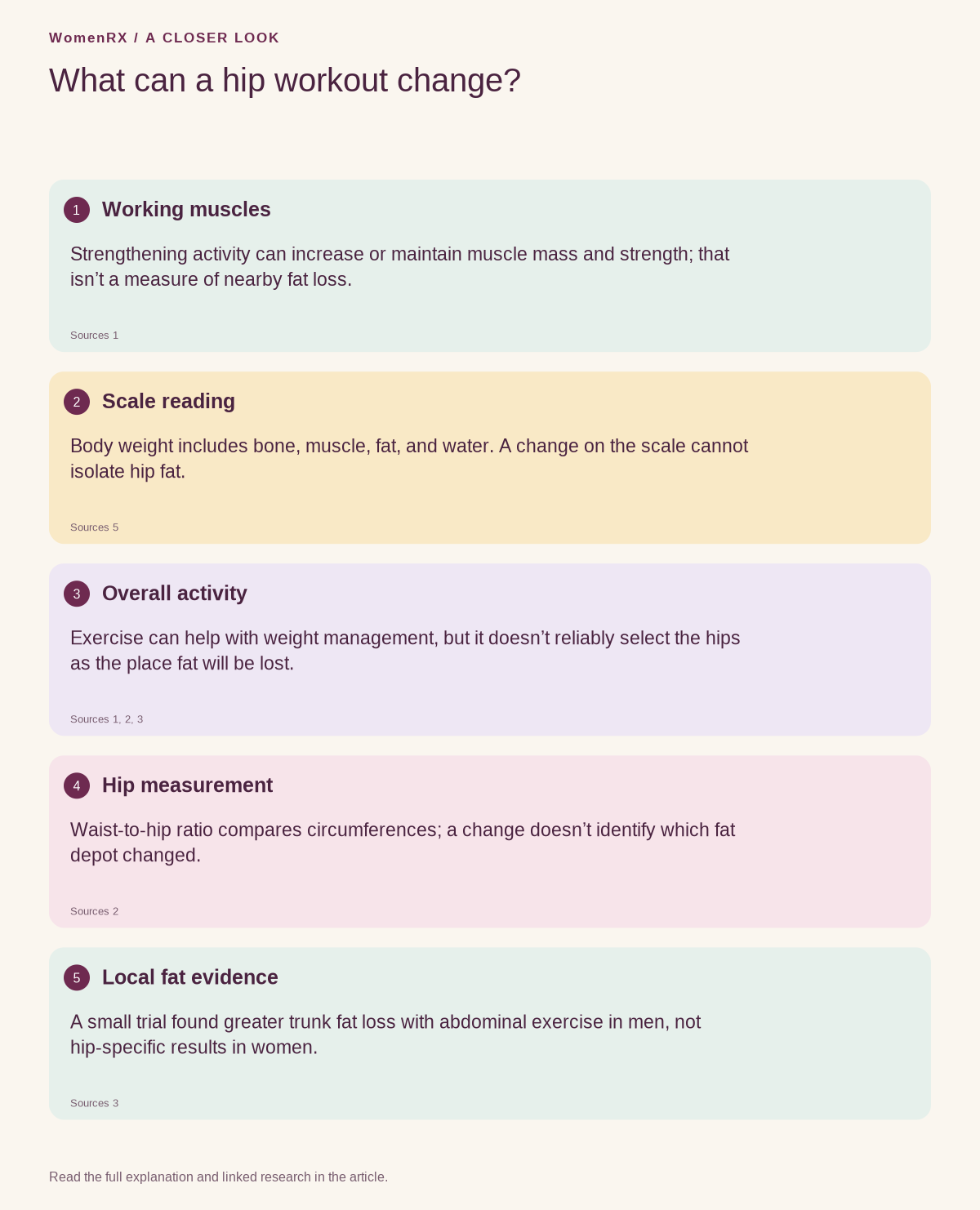
What can a hip workout change?
Working muscles: Strengthening activity can increase or maintain muscle mass and strength; that isn’t a measure of nearby fat loss.1
Scale reading: Body weight includes bone, muscle, fat, and water. A change on the scale cannot isolate hip fat.5
Overall activity: Exercise can help with weight management, but it doesn’t reliably select the hips as the place fat will be lost.123
Hip measurement: Waist-to-hip ratio compares circumferences; a change doesn’t identify which fat depot changed.2
Local fat evidence: A small trial found greater trunk fat loss with abdominal exercise in men, not hip-specific results in women.3
Read the figure as text
Muscle, body weight, and hip measurements tell you different things; none alone shows that exercise removed fat specifically at the hips.- Working muscles: Strengthening activity can increase or maintain muscle mass and strength; that isn’t a measure of nearby fat loss.1
- Scale reading: Body weight includes bone, muscle, fat, and water. A change on the scale cannot isolate hip fat.5
- Overall activity: Exercise can help with weight management, but it doesn’t reliably select the hips as the place fat will be lost.123
- Hip measurement: Waist-to-hip ratio compares circumferences; a change doesn’t identify which fat depot changed.2
- Local fat evidence: A small trial found greater trunk fat loss with abdominal exercise in men, not hip-specific results in women.3
More questions, answered
Does a smaller waist-to-hip ratio mean I lost hip fat?
No. The ratio changes when waist or hip circumference changes, and it doesn’t identify how much fat changed at either location. The women’s exercise trial reported ratio changes but called for imaging-based fat measurements to clarify regional effects.2
Sources you can check
- Benefits of Exercise: MedlinePlusAccessed 2026-09-25Return to first citation
- Impact of regional and general aerobic exercise on molecular regulators of lipolysis and adipose tissue composition in obese women.Zourmand G, Shaabani Ezdini E, Taheri M, Irandoust K. · Cellular and molecular biology (Noisy-le-Grand, France) · 2025Return to first citation
- Abdominal aerobic endurance exercise reveals spot reduction exists: A randomized controlled trial.Brobakken MF, Krogsaeter I, Helgerud J, Wang E, Hoff J. · Physiological reports · 2023Return to first citation
- Effects of Weight Loss with and without Exercise on Regional Body Fat Distribution in Postmenopausal Women.Serra MC, Blumenthal JB, Addison OR, Miller AJ, Goldberg AP, Ryan AS. · Annals of nutrition & metabolism · 2017Return to first citation
- Body Weight: MedlinePlusAccessed 2026-09-25Return to first citation