Do Fat-Burning Supplements Actually Reduce Body Fat?
A product can briefly raise energy use without producing a lasting change in body fat or weight.
Some thermogenic products raise resting energy expenditure for a short time, but that isn’t proof of fat loss. In a four-week trial that included women, the tested product showed no added body-composition benefit; a review of longer studies did not establish a clear overall benefit. To judge a product’s claim, look for human studies measuring body fat or weight over time, then check the ingredients for safety concerns. 3 4 5
“Fat burning” sounds like an outcome. In supplement research, it may refer instead to a short-term measurement of how much energy your body uses. If you’re considering a product, the useful question is not simply whether it affects metabolism. It’s whether people taking that product ended up with less body fat or weight than people in a comparison group.
The gap between using energy and losing fat
Resting energy expenditure, or REE, measures energy use while your body is at rest. In a randomized study, 28 adults, including 14 women, drank a thermogenic beverage and a placebo on separate visits. Their REE was higher after the beverage at measurements taken within about 100 minutes. That shows a short-term response to that beverage, not what would happen to body fat after weeks or months of use. 5
A short study can be useful for testing whether a product does something. It cannot turn an REE result into a weight-loss result. The same goes for a claim based only on feeling more alert: alertness and body composition are different outcomes. 5
What happened when researchers measured body composition?
In a four-week randomized trial, 52 healthy, exercise-trained adults, half of them women, received whey protein alone, whey protein plus a multi-ingredient thermogenic supplement, or no supplement. REE changed more in the protein-plus-thermogenic group than in the no-supplement group. But the groups did not differ in body-composition or body-measurement changes. The REE result was not matched by a demonstrated fat-loss benefit in that trial. 4
For a broader view, a systematic review and meta-analysis examined 21 studies lasting more than eight weeks in people with a BMI above 24.9. Its pooled estimates leaned toward benefit, but the confidence intervals crossed zero, so they did not establish a clear overall benefit. Its study-level comparisons found supplement responses less effective than exercise, or diet combined with exercise, without added weight-loss supplements. That does not rule out an effect from every possible formula. It does put the burden of proof on a product making a fat-loss claim. 3
There’s a women-specific limit, too. The four-week trial included women, but its body-composition finding was reported for participants together. The acute beverage study included women but did not test lasting fat loss. These studies do not establish a clear long-term fat-loss effect specifically for women. 4 5
A quick way to test a product’s claim
When you see “clinically studied” on a label, look past the phrase:
- Find the outcome. Was the result a change in body fat or weight, or only REE, alertness, or another short-term measure? Scale weight is useful but includes more than fat, including muscle and water. 2 5
- Check the timeframe and comparison. A reading taken after one drink cannot answer a question about sustained fat loss. Look for a comparison group and results measured over time. 3 5
- Match the formula. A finding for one beverage or ingredient blend does not establish that a different product works. The four-week trial tested a thermogenic product alongside whey protein, not every product sold as a fat burner. 4 5
- Check who was studied. If a study included women, ask whether it gives a body-fat or weight result for women separately. An average result across participants may not answer that question. 4
Safety belongs in the same decision
Read the ingredient list for stimulants as well as the promised benefit. Caffeine can raise blood pressure and, in excess, cause restlessness or shakiness. It can also be found in drinks, medicines, and other supplements, so a capsule may not be your only source. MedlinePlus advises checking whether to limit or avoid caffeine during pregnancy, if you have high blood pressure, or if you take certain medicines, including stimulants and some antibiotics, asthma medicines, or heart medicines. 1
Synephrine is another stimulant found in some weight-loss supplements. A laboratory study of products marketed online in Brazil identified caffeine, synephrine, or ephedrine in some samples. That finding cannot tell you what is in a particular US product, or establish its safety. It’s a reason to assess the actual formula rather than rely on the word “natural.” 6
If you’re pregnant, the usual fat-loss pitch is an especially poor basis for choosing a product: caffeine crosses the placenta, and the studies above do not establish benefits during pregnancy. Nor should their findings be taken as evidence that weight-loss blends are safe during breastfeeding. 1 3 4 5
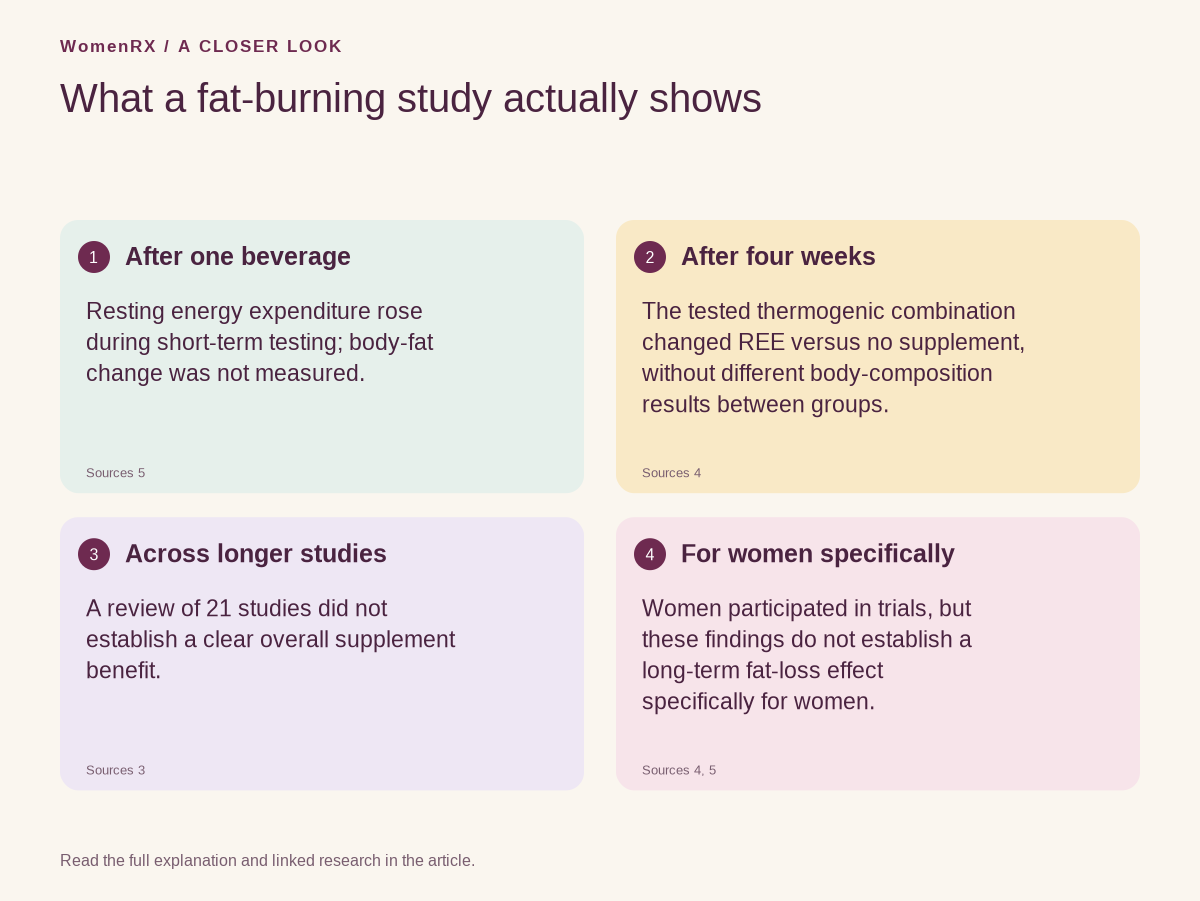
What a fat-burning study actually shows
After one beverage: Resting energy expenditure rose during short-term testing; body-fat change was not measured.5
After four weeks: The tested thermogenic combination changed REE versus no supplement, without different body-composition results between groups.4
Across longer studies: A review of 21 studies did not establish a clear overall supplement benefit.3
For women specifically: Women participated in trials, but these findings do not establish a long-term fat-loss effect specifically for women.45
Read the figure as text
The outcome and timeframe determine how much a study can tell you about a fat-loss claim.- After one beverage: Resting energy expenditure rose during short-term testing; body-fat change was not measured.5
- After four weeks: The tested thermogenic combination changed REE versus no supplement, without different body-composition results between groups.4
- Across longer studies: A review of 21 studies did not establish a clear overall supplement benefit.3
- For women specifically: Women participated in trials, but these findings do not establish a long-term fat-loss effect specifically for women.45
Sources you can check
- Caffeine: MedlinePlusAccessed 2026-09-25Return to first citation
- Body Weight: MedlinePlusAccessed 2026-09-25Return to first citation
- Comparing effectiveness of fat burners and thermogenic supplements to diet and exercise for weight loss and cardiometabolic health: Systematic review and meta-analysis.Clark JE, Welch S. · Nutrition and health · 2021Return to first citation
- Chronic Thermogenic Dietary Supplement Consumption: Effects on Body Composition, Anthropometrics, and Metabolism.Siedler MR, Rodriguez C, White SJ, Tinoco E, DeHaven B, Brojanac A, LaValle C, Rasco J, Taylor LW, Tinsley GM. · Nutrients · 2023Return to first citation
- Effects of a ready-to-drink thermogenic beverage on resting energy expenditure, hemodynamic function, and subjective outcomes.Rodriguez C, Stratton MT, Harty PS, Siedler MR, Boykin JR, Green JJ, Keith DS, White SJ, DeHaven B, Brojanac A, Tinoco E, Taylor LW, Tinsley GM. · Journal of the International Society of Sports Nutrition · 2023Return to first citation
- Liquid chromatographic determination of caffeine and adrenergic stimulants in food supplements sold in Brazilian e-commerce for weight loss and physical fitness.Viana C, Zemolin GM, Müller LS, Dal Molin TR, Seiffert H, de Carvalho LM. · Food additives & contaminants. Part A, Chemistry, analysis, control, exposure & risk assessment · 2016Return to first citation