Does Collagen Change Your Weight or Body Composition?
A small trial in women compared collagen with whey, but it couldn’t show whether collagen alone changes weight, fat, or appetite.
There’s no clear evidence here that collagen supplements cause weight loss or weight gain. In an eight-week trial of 37 women, the collagen group had a small reported BMI increase, while the whey group had a decrease in android fat compared with collagen. The trial found no significant difference in recorded calorie intake, but it didn’t directly measure hunger or fullness. 2
What the trial in women actually compared
If you’ve seen collagen described as helpful for weight or body composition, the comparison matters as much as the result. In a randomized trial, 37 women the researchers characterized as overweight took either hydrolyzed collagen or whey protein with an afternoon snack for eight weeks. Their average age was about 41. The supplements provided similar amounts of calories and total protein; researchers assessed body composition with a body scan and estimated dietary intake using food records. There was no group taking no supplement. 2
The collagen group had a reported mean BMI increase of 0.2 kg/m² over the study. That is a BMI finding, not a separately reported change in pounds on the scale. Because the trial compared collagen with whey rather than with no supplement, the result doesn’t establish that collagen causes weight gain. 2
The whey group had a decrease in android fat compared with the collagen group. That comparison does not mean collagen caused fat gain. The researchers also reported no change in lean body mass at the end of the study, but they did not attribute that finding to a specific group. 2
Why the outcome changes the answer
Body weight includes fat, muscle, bone, and water. BMI uses height and weight but cannot tell those tissues apart. A body-composition measurement asks a different question from a scale reading, and a finding about fat in one measured region is not the same as a finding about total body fat. 12
So before accepting a claim that collagen “changes your body,” look for the measured outcome. This trial reported a BMI change in the collagen group and an android-fat difference favoring whey. Neither finding shows that collagen reduces total body fat or builds lean mass. 2
Did collagen affect appetite?
The study used six-day food records to estimate what participants ate. It found no statistically significant difference in recorded calorie intake between the collagen and whey groups. That does not answer whether either supplement changed how hungry or full the women felt: hunger and fullness were not directly measured in the reported methods. A blood marker measured in the trial is not a substitute for the experience of appetite. 2
What about collagen alongside exercise or dieting?
The trial authors discuss earlier research that combined collagen with resistance training in older adults, as well as research during energy restriction and physical inactivity. Those are different situations from adding collagen to an otherwise unchanged routine. A study that gives both groups the same exercise program can test whether collagen adds something during that program, but a change seen while training cannot simply be credited to collagen taken alone. The findings discussed by the authors were mixed. 2
This distinction is especially useful in midlife. The direct trial enrolled women with an average age around 41, but it did not report menopause status. It therefore does not establish whether the findings apply specifically to perimenopausal or postmenopausal women. 2
For a practical read on any collagen claim, ask three questions: Was the outcome scale weight, BMI, fat, or lean mass? Was collagen compared with no supplement or with another protein? And did participants also change their exercise or eating? Those details tell you far more than the word “protein” on a tub can. 12
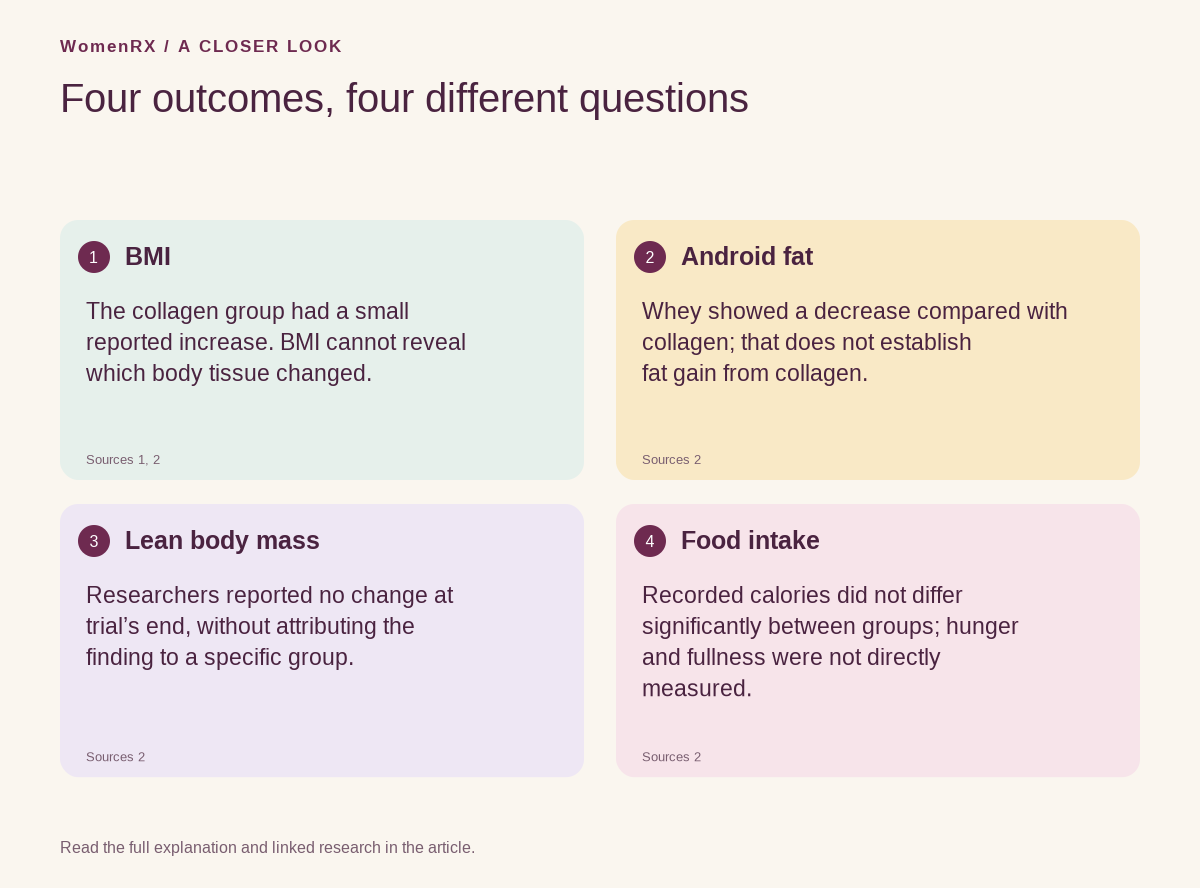
Four outcomes, four different questions
BMI: The collagen group had a small reported increase. BMI cannot reveal which body tissue changed.12
Android fat: Whey showed a decrease compared with collagen; that does not establish fat gain from collagen.2
Lean body mass: Researchers reported no change at trial’s end, without attributing the finding to a specific group.2
Food intake: Recorded calories did not differ significantly between groups; hunger and fullness were not directly measured.2
Read the figure as text
The eight-week trial compared collagen with whey in women. Its reported measures should not be combined into a single weight-loss or weight-gain claim.- BMI: The collagen group had a small reported increase. BMI cannot reveal which body tissue changed.12
- Android fat: Whey showed a decrease compared with collagen; that does not establish fat gain from collagen.2
- Lean body mass: Researchers reported no change at trial’s end, without attributing the finding to a specific group.2
- Food intake: Recorded calories did not differ significantly between groups; hunger and fullness were not directly measured.2
Sources you can check
- Body Weight: MedlinePlusAccessed 2026-09-25Return to first citation
- Whey Protein Supplementation Compared to Collagen Increases Blood Nesfatin Concentrations and Decreases Android Fat in Overweight Women: A Randomized Double-Blind Study.Giglio BM, Schincaglia RM, da Silva AS, Fazani ICS, Monteiro PA, Mota JF, Cunha JP, Pichard C, Pimentel GD. · Nutrients · 2019Return to first citation