Menopause-Related Weight Changes: What Can You Actually Change?
You may not be able to return to a particular past weight, but you can choose goals that support strength, body composition and health without making the scale the only measure.
There’s no guaranteed way to reverse menopause-related weight changes, and weight isn’t the whole picture. Midlife changes can include more fat around the abdomen and less lean mass, while age, habits and health also matter. Depending on your goal, a manageable next step might be strength-focused activity, a sustainable change to your eating pattern, or support for symptoms that make those habits harder. 1 2 4

Start with what you want to change
A scale measures your total body weight, not how much is fat, muscle, bone or water. Waist size and strength offer different information: more abdominal fat can be associated with higher risk of heart disease and type 2 diabetes, while maintaining muscle and strength matters as you get older. BMI has limits too; it can’t distinguish fat from muscle and may miss muscle loss in older adults. None of these measures, by itself, tells your whole health story. 1
During the menopausal transition and into early menopause, women can gain body fat, particularly around the middle, and lose lean mass. These changes don’t mean every woman will gain weight, or that menopause is the only cause. Your overall health, history and circumstances matter too. 1 4
It can help to choose one goal before choosing an approach: build or maintain strength, reduce waist size, improve a health risk, or pursue weight loss because it fits your own priorities. Weight loss isn’t necessary for everyone, and a change in body composition or strength may matter even if the number on the scale barely moves.
Choose a first step that fits the goal
If strength or muscle is your priority: Consider making resistance or strength-focused activity a manageable part of your week. A systematic review of 34 studies involving 1,541 postmenopausal women found that structured strength training consistently improved body composition, strength and bone mineral density. That supports strength training as an option, not a promise of a specific result or a one-size-fits-all schedule. 2
If reducing body fat or weight is your priority: Look for a sustainable change to your eating pattern that you can maintain, rather than a rigid plan you already expect to abandon. MedlinePlus identifies nutrition and exercise as ways to support weight loss, and the postmenopausal-women review found that adding a calorie deficit to strength-training interventions enhanced fat-mass reduction in some studies. Those studies don’t establish one best diet or a personal calorie target. 1 2
If waist size or health risk is your concern: You might track waist size or discuss it alongside your health history and other risk factors, rather than treating weight alone as the verdict. Abdominal fat can signal higher risk, but waist size is only one part of an individual assessment. 1
If sleep or menopause symptoms are getting in the way: Consider raising the specific problem, such as disruptive hot flashes or persistent poor sleep, when you discuss what’s making activity or food changes difficult. Menopause symptoms can affect sleep and quality of life; hormone therapy is not a weight-loss treatment, though it may be considered for established menopause-related indications after an individualized discussion. 3 5 6
You don’t have to start all of these at once. Choose an action that feels realistic now, then decide whether it’s helping with the goal you chose. If weight is the goal, you can still pay attention to strength and waist size so that progress isn’t reduced to one number.
When clinical support can add value
A clinician or registered dietitian can help if you’re unsure what a reasonable goal is for your health, want support making a food or activity plan, or have health conditions that affect what’s practical. MedlinePlus notes that a clinician may refer you to a dietitian when weight change is recommended. 1
A discussion is also useful when menopause symptoms are disrupting sleep or daily routines. If you’re considering hormone therapy, the reason to discuss it is symptom relief or another established indication, not a promise of weight loss. Menopause hormone therapy’s benefits and risks vary by factors including age, timing, type and duration, so decisions are individualized. 3 5
If weight changes suddenly or without trying, don’t assume menopause explains them. MedlinePlus recommends discussing unexpected weight gain or loss with a health care provider. 1
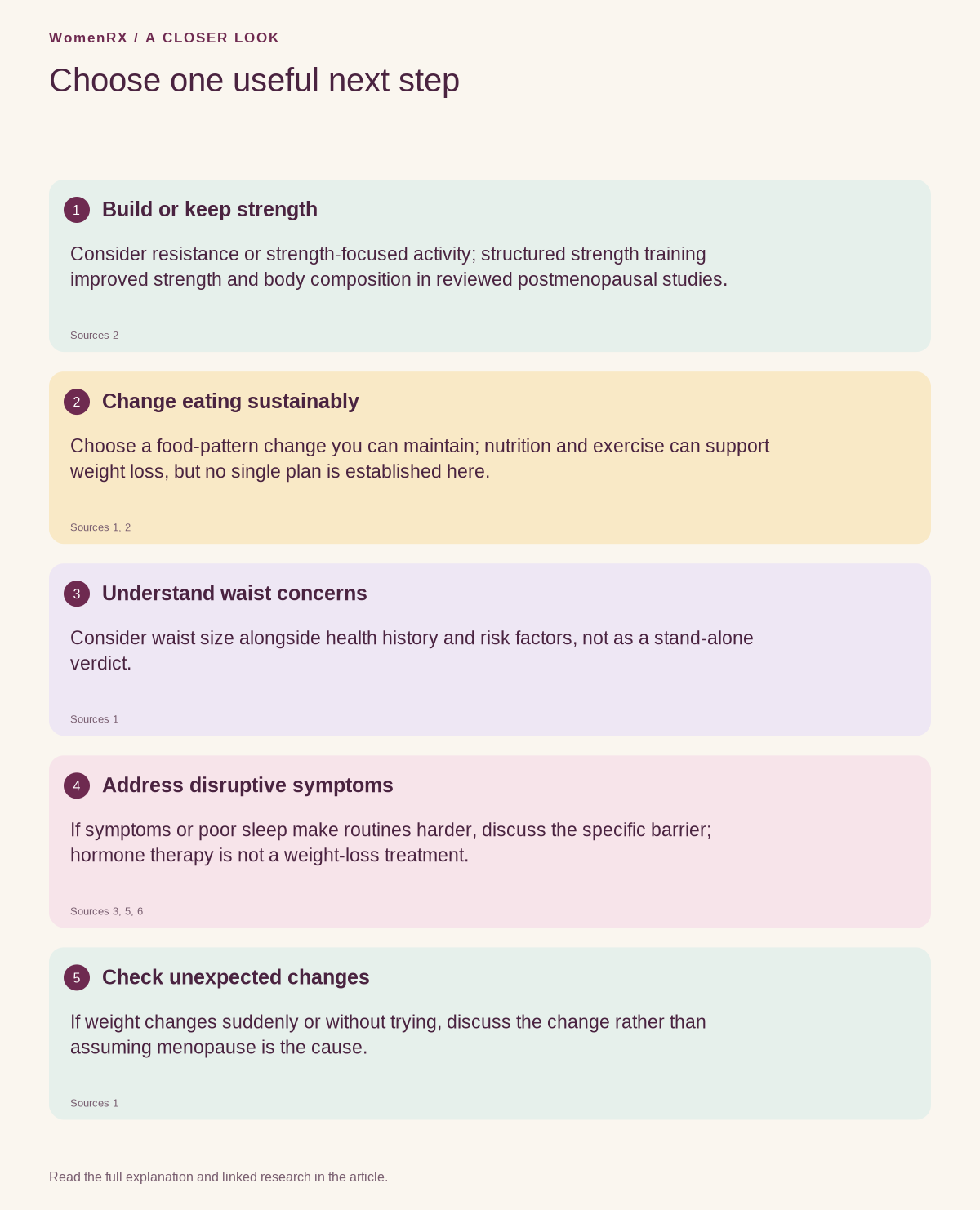
Choose one useful next step
Build or keep strength: Consider resistance or strength-focused activity; structured strength training improved strength and body composition in reviewed postmenopausal studies.2
Change eating sustainably: Choose a food-pattern change you can maintain; nutrition and exercise can support weight loss, but no single plan is established here.12
Understand waist concerns: Consider waist size alongside health history and risk factors, not as a stand-alone verdict.1
Address disruptive symptoms: If symptoms or poor sleep make routines harder, discuss the specific barrier; hormone therapy is not a weight-loss treatment.356
Check unexpected changes: If weight changes suddenly or without trying, discuss the change rather than assuming menopause is the cause.1
Read the figure as text
Match your main concern with a practical starting point. These are options to consider, not a required sequence or a measure of whether your body is healthy.- Build or keep strength: Consider resistance or strength-focused activity; structured strength training improved strength and body composition in reviewed postmenopausal studies.2
- Change eating sustainably: Choose a food-pattern change you can maintain; nutrition and exercise can support weight loss, but no single plan is established here.12
- Understand waist concerns: Consider waist size alongside health history and risk factors, not as a stand-alone verdict.1
- Address disruptive symptoms: If symptoms or poor sleep make routines harder, discuss the specific barrier; hormone therapy is not a weight-loss treatment.356
- Check unexpected changes: If weight changes suddenly or without trying, discuss the change rather than assuming menopause is the cause.1
More questions, answered
Can hormone therapy reverse menopause-related weight gain?
No. Hormone therapy isn’t indicated as a weight-loss treatment. It may be considered for established reasons such as bothersome hot flashes, with an individualized review of benefits and risks. 3 5
What if I get stronger but my weight stays the same?
That can still be meaningful progress. Weight includes muscle, fat, bone and water, so the scale alone can’t show whether strength or body composition has changed. 1 2
Sources you can check
- Body Weight: MedlinePlusAccessed 2026-09-25Return to first citation
- Analysis of the Additive Effects of Nutritional Strategies in Strength Training Interventions on Body Composition, Muscle Strength and Bone Mineral Density in Postmenopausal Women: A Systematic Review.Walter F, Schalla J, Bloch W, Diel P, Geisler S, Isenmann E. · Sports medicine - open · 2026Return to first citation
- The 2022 hormone therapy position statement of The North American Menopause Society.“The 2022 Hormone Therapy Position Statement of The North American Menopause Society” Advisory Panel. · Menopause (New York, N.Y.) · 2022Return to first citation
- Weight Management in Menopause: Diet, Physical Activity, Medication, and Surgery.Lu V, Tayachew B, Chevtsov A, Nicklas JM. · Obstetrics and gynecology clinics of North America · 2026Return to first citation
- Clinical review: Menopause hormone therapy in weight management.Younglove C. · Obesity pillars · 2026Return to first citation
- Management of obesity in the menopause transition and postmenopausal period.Allen JT, Zahler-Miller C, Lough M, Titus H. · Surgery for obesity and related diseases : official journal of the American Society for Bariatric Surgery · 2026Return to first citation