Menopause Weight Changes: Habits That Support Health
Weight, waist size, and muscle tell different parts of the story, so a useful plan looks beyond the scale.
During the menopause transition and early menopause, some women gain fat, often around the middle, and lose lean mass, though patterns vary. Scale weight alone can’t show what changed. Manageable eating habits and regular activity may support weight and body composition, but they don’t guarantee weight loss. It can help to choose a goal, such as steadier weight, muscle maintenance, or broader health, and match your approach to it. 1 2 5
The scale can’t show what changed
Body weight includes fat, muscle, bone, and water. A change on the scale doesn’t tell you which part shifted. Sleep, stress, eating habits, and other factors can affect weight too. 1
During the menopausal transition and early menopause, women may gain body fat, particularly around the middle, while losing lean mass. That pattern isn’t inevitable, and menopause isn’t the only influence on body composition. 5
Waist measurement adds a different kind of information: more fat around the abdomen, rather than the hips, is associated with higher risk of heart disease and type 2 diabetes. It’s one piece of the picture, not a complete measure of health. 1
Choose habits for the outcome you want
If your goal is weight or waist management: A 2026 review reports that combining diet and physical activity can improve weight, body composition, and metabolic risk factors, particularly when used during the menopause transition. Its summary doesn’t identify one best eating pattern. 5
For a manageable starting point, try one change you can repeat. For example, you might plan a simple lunch for busy days instead of waiting until you’re very hungry to decide what to eat. That’s a practical example, not a proven menopause-specific diet or a guarantee of weight change. A sustainable approach is more realistic than severe restriction.
If your goal is maintaining muscle: Regular activity, including muscle-strengthening activity, can help maintain muscle mass and strength. In an eight-week trial involving 66 early postmenopausal women, muscle mass increased modestly in the exercise groups, while differences in body fat between groups were negligible. A separate one-year study found greater lean-mass gains with weight-bearing and resistance exercise than with control, among postmenopausal women with osteopenia. These studies measured muscle or lean mass, not strength, and their results don’t promise the same change for everyone. 2 4 6
If your goal is broader health: Physical activity can support blood sugar management, sleep, and muscle strength, as well as weight management. Those benefits can matter even if your weight doesn’t change. 2
Keep expectations tied to the evidence
Lifestyle habits can support health, but they can’t guarantee that your weight or body shape will return to an earlier pattern. Weight maintenance may also take more support than a self-directed effort. In a US trial of 535 premenopausal women ages 44 to 50, those assigned to a structured 15-session diet-and-exercise program had an average weight change of −0.1 kg over 54 months, compared with an average gain of 2.4 kg in the assessment-only group. That result shows what happened in one structured program, not what any individual should expect. 3
You don’t have to change everything at once. Pick a measure that fits your aim: scale weight for overall change, waist measurement for abdominal change, or how everyday activities feel as one practical way to notice function. If your goal is weight management and you’d like help finding an eating approach that fits your life, a dietitian may be an option. 1
Weight can shift for reasons beyond menopause. A sudden, unexplained gain or loss is worth checking rather than assuming it’s part of the transition. 1
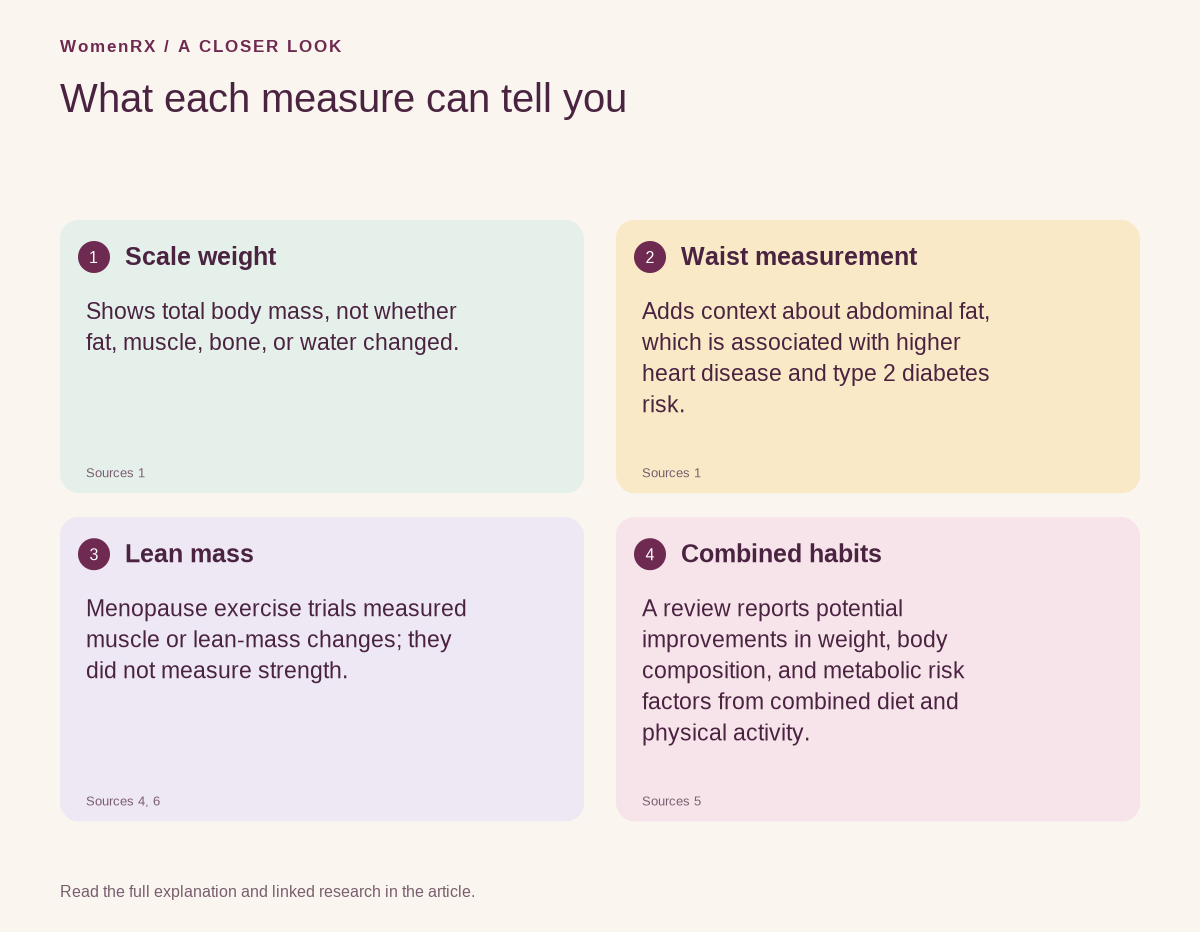
What each measure can tell you
Scale weight: Shows total body mass, not whether fat, muscle, bone, or water changed.1
Waist measurement: Adds context about abdominal fat, which is associated with higher heart disease and type 2 diabetes risk.1
Lean mass: Menopause exercise trials measured muscle or lean-mass changes; they did not measure strength.46
Combined habits: A review reports potential improvements in weight, body composition, and metabolic risk factors from combined diet and physical activity.5
Read the figure as text
Scale weight, waist measurement, and lean mass describe different outcomes. Lifestyle research also varies in which outcomes it measures.- Scale weight: Shows total body mass, not whether fat, muscle, bone, or water changed.1
- Waist measurement: Adds context about abdominal fat, which is associated with higher heart disease and type 2 diabetes risk.1
- Lean mass: Menopause exercise trials measured muscle or lean-mass changes; they did not measure strength.46
- Combined habits: A review reports potential improvements in weight, body composition, and metabolic risk factors from combined diet and physical activity.5
Sources you can check
- Body Weight: MedlinePlusAccessed 2026-09-25Return to first citation
- Benefits of Exercise: MedlinePlusAccessed 2026-09-25Return to first citation
- The 40-Something randomized controlled trial to prevent weight gain in mid-age women.Williams LT, Hollis JL, Collins CE, Morgan PJ. · BMC public health · 2013Return to first citation
- Effectiveness of face-to-face and web-based exercise programs on health outcomes in early postmenopausal women: a randomized trial.Kurç D, Tunalı Van Den Berg AN. · BMC women's health · 2026Return to first citation
- Weight Management in Menopause: Diet, Physical Activity, Medication, and Surgery.Lu V, Tayachew B, Chevtsov A, Nicklas JM. · Obstetrics and gynecology clinics of North America · 2026Return to first citation
- Risedronate or Exercise for Lean Mass Preservation During Menopause: Secondary Analysis of a Randomized Controlled Trial.Flores LE, Kupzyk K, Waltman N, Beavers KM, Bilek L. · JCSM rapid communications · 2022Return to first citation