Perimenopause and Weight: What Changes, and Why
The scale, your waist, and your body composition can tell different stories as aging and the menopause transition overlap.
Weight gain isn’t inevitable in perimenopause. Midlife weight changes are more closely associated with chronological aging, while changes in body composition and fat distribution are more closely associated with ovarian aging. Reviews also link the transition with more fat around the waist and less lean mass, but these patterns don’t explain any one person’s change or make its cause clear. 3 4
The scale can’t show the whole change
Your weight is your body’s total mass, including muscle, bone, fat, and water. It can go up or down without telling you which part changed. Body shape can shift, too: your waist may change even if the number on the scale doesn’t move much. These are related measures, but they aren’t interchangeable. 1
That distinction is useful in midlife. A change in weight doesn’t, by itself, show whether it’s related to aging, the menopausal transition, or something else. And a change in waist size doesn’t identify its cause either.
Aging and ovarian aging overlap
A review of midlife research describes a general pattern: overall weight changes appear more closely related to chronological aging, while changes in body composition and where fat is stored appear more closely related to ovarian aging during the transition. Because these processes happen at the same time, this distinction helps interpret research but can’t pinpoint why one woman’s body is changing. 4
Another review describes the menopause transition as associated with an increase in fat mass, often around the waist, and a decrease in lean mass. It also concludes that hormonal changes alone don’t fully explain the changes observed in clinical studies. So menopause may be part of the picture, but it isn’t a simple or inevitable explanation for weight gain. 3
In everyday terms, a similar scale reading can come with a different balance of fat and lean tissue, while weight can also change for reasons that have little to do with the transition. The scale won’t distinguish these possibilities. BMI has a related limitation: it compares weight with height but doesn’t separate fat, muscle, and bone. 1
What intervention studies can tell you
There’s limited research on programs specifically intended to change weight or body composition during the menopause transition. A systematic review found just three eligible intervention studies, with study quality ranging from low to high risk of bias. One lower-risk trial suggested that combined exercise and dietary changes might mitigate increases in body adiposity. That’s encouraging evidence for a possible approach, not proof of a single program that will work for everyone. 2
You can note changes in activity, sleep, and daily routines alongside weight and waist trends if that context is useful to you. Treat those notes as observations, not proof that a particular change caused a shift in weight or shape. The studies in the intervention review assessed exercise and nutrition, so they don’t establish sleep’s independent contribution to weight or body-composition changes during the transition. 2
Track two measures, not one explanation
If you want to keep an eye on changes, record weight and waist separately rather than treating either as a verdict. Weight gives one measure of total body mass; waist circumference can add information about abdominal fat distribution. Neither tells you why a change happened, and neither captures every aspect of health. 1
Look at the pattern over time, and consider whether changes in routine or activity happened around the same period. You don’t need to assume that menopause caused a change just because it happened during perimenopause. If you’re gaining or losing weight without trying, especially if the change is sudden and unexpected, MedlinePlus advises contacting a health care provider. 1
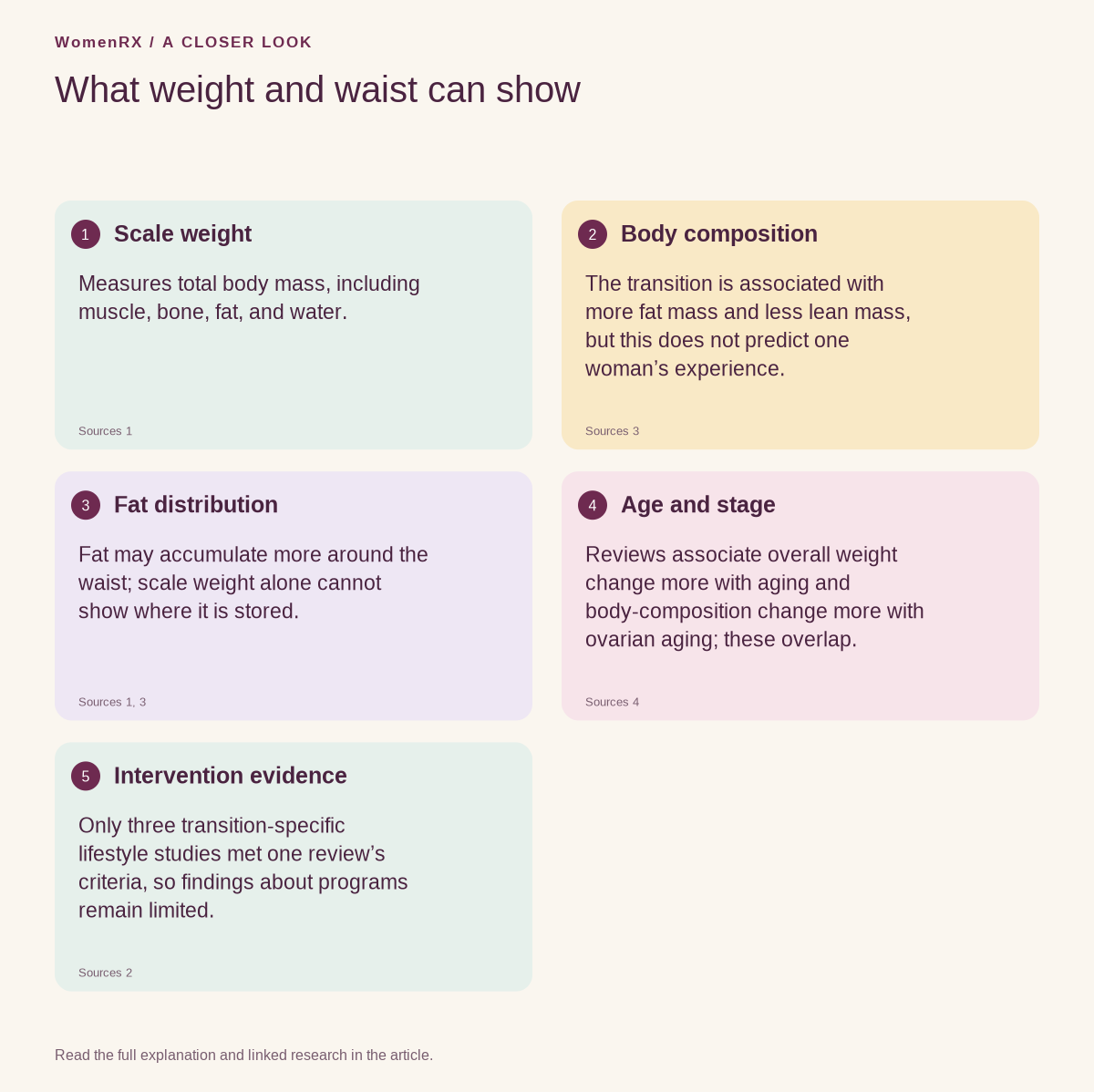
What weight and waist can show
Scale weight: Measures total body mass, including muscle, bone, fat, and water.1
Body composition: The transition is associated with more fat mass and less lean mass, but this does not predict one woman’s experience.3
Fat distribution: Fat may accumulate more around the waist; scale weight alone cannot show where it is stored.13
Age and stage: Reviews associate overall weight change more with aging and body-composition change more with ovarian aging; these overlap.4
Intervention evidence: Only three transition-specific lifestyle studies met one review’s criteria, so findings about programs remain limited.2
Read the figure as text
These measures describe different parts of midlife change. None can identify the cause of an individual change by itself.- Scale weight: Measures total body mass, including muscle, bone, fat, and water.1
- Body composition: The transition is associated with more fat mass and less lean mass, but this does not predict one woman’s experience.3
- Fat distribution: Fat may accumulate more around the waist; scale weight alone cannot show where it is stored.13
- Age and stage: Reviews associate overall weight change more with aging and body-composition change more with ovarian aging; these overlap.4
- Intervention evidence: Only three transition-specific lifestyle studies met one review’s criteria, so findings about programs remain limited.2
More questions, answered
Can my waist change even if my weight stays about the same?
Yes. Weight measures total body mass, not how much of that mass is fat or muscle or where fat is stored. A waist measurement can add information about abdominal fat distribution, but it can’t explain the reason for a change on its own. 1
Sources you can check
- Body Weight: MedlinePlusAccessed 2026-09-25Return to first citation
- Lifestyle interventions targeting body weight changes during the menopause transition: a systematic review.Jull J, Stacey D, Beach S, Dumas A, Strychar I, Ufholz LA, Prince S, Abdulnour J, Prud'homme D. · Journal of obesity · 2014Return to first citation
- Body weight and fat mass across the menopausal transition: hormonal modulators.Moccia P, Belda-Montesinos R, Monllor-Tormos A, Chedraui P, Cano A. · Gynecological endocrinology : the official journal of the International Society of Gynecological Endocrinology · 2022Return to first citation
- Association of Mid-Life Changes in Body Size, Body Composition and Obesity Status with the Menopausal Transition.Karvonen-Gutierrez C, Kim C. · Healthcare (Basel, Switzerland) · 2016Return to first citation