Menopause Hormones, Weight Gain, and Where Body Fat Goes
At midlife, the scale and your body shape can change for different reasons: aging is closely linked to weight gain, while ovarian aging is more closely linked to changes in fat distribution.
Menopause-related hormone changes may be part of why body fat shifts toward the abdomen, but they don’t explain every midlife change. A review concluded that overall weight gain is more closely associated with chronological aging, while changes in body composition and fat distribution are more closely associated with ovarian aging. These are population patterns, not proof of what caused a change for you. 3
The scale and your shape tell different stories
Body weight is the combined mass of fat, muscle, bone, and water. A change on the scale can’t tell you which of those changed, or where body fat is stored. Waist size offers a different clue: more fat around the abdomen, rather than the hips, is associated with higher risk of heart disease and type 2 diabetes. 1
That distinction helps make sense of midlife changes. You might notice a fuller waist without much change in total weight, or a rising number on the scale without knowing whether it reflects fat, muscle, or something else. Neither pattern, by itself, identifies menopause as the cause.
What ovarian aging may help explain
A 2016 review of research on the menopause transition concluded that chronological aging accounts for more of the evidence on weight gain, while ovarian aging is more closely associated with changes in body composition and fat distribution. In everyday terms, aging may be more relevant to the number on the scale, while changing ovarian function and hormones such as estradiol may be more relevant to where fat is carried. 3
That’s a useful distinction, not a clean division of causes. Aging and hormonal changes happen at the same time, and an association between hormone patterns and body fat doesn’t prove that hormones alone caused a change in any one woman.
A prospective observational study illustrates why a single menopause pattern shouldn’t be assumed. It followed Black and white women and analyzed 94 who transitioned through menopause. Before menopause, white participants gained weight and several measures of abdominal fat; Black participants had more abdominal fat before menopause, which was maintained across the transition. The authors suggested that differences in sex-hormone patterns might partly contribute, but the study can’t establish that explanation as the cause. Its findings also shouldn’t be used to predict an individual woman’s experience. 2
Aging and other midlife influences still matter
Hormones are one part of a wider picture. The review describes regular physical activity during midlife as a potential way to counter age- and menopause-related changes in resting energy expenditure and abdominal fat. That’s a possible health-supporting approach, not a promise that activity will prevent every change. 3
Diet and family history can also play a role in body weight. 1 The practical point is to avoid making the scale carry more meaning than it can: weight doesn’t show body composition, and body shape alone doesn’t reveal why it changed.
A change worth checking
If weight gain or loss is sudden and unexpected, don’t automatically chalk it up to menopause. MedlinePlus notes that an unexpected change can be a sign of a medical problem. 1 For gradual changes, separating total weight from waist or clothing-fit changes can help you describe what you’ve noticed without assuming there’s a single hormonal explanation.
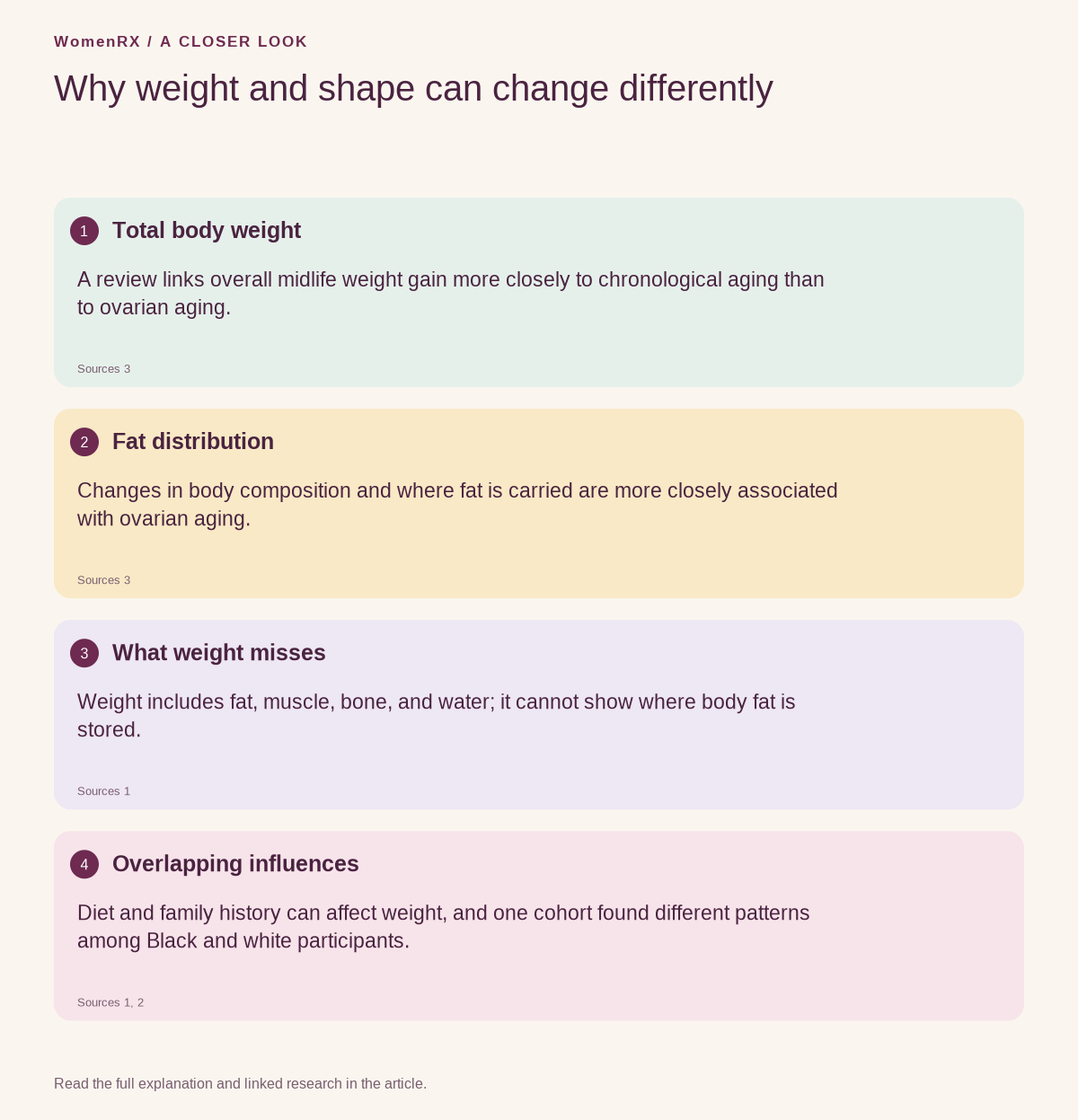
Why weight and shape can change differently
Total body weight: A review links overall midlife weight gain more closely to chronological aging than to ovarian aging.3
Fat distribution: Changes in body composition and where fat is carried are more closely associated with ovarian aging.3
What weight misses: Weight includes fat, muscle, bone, and water; it cannot show where body fat is stored.1
Overlapping influences: Diet and family history can affect weight, and one cohort found different patterns among Black and white participants.12
Read the figure as text
A simple map of how aging and ovarian aging are associated with different kinds of midlife body change, alongside other influences.- Total body weight: A review links overall midlife weight gain more closely to chronological aging than to ovarian aging.3
- Fat distribution: Changes in body composition and where fat is carried are more closely associated with ovarian aging.3
- What weight misses: Weight includes fat, muscle, bone, and water; it cannot show where body fat is stored.1
- Overlapping influences: Diet and family history can affect weight, and one cohort found different patterns among Black and white participants.12
Sources you can check
- Body Weight: MedlinePlusAccessed 2026-09-25Return to first citation
- Racial differences in body composition and cardiometabolic risk during the menopause transition: a prospective, observational cohort study.Marlatt KL, Redman LM, Beyl RA, Smith SR, Champagne CM, Yi F, Lovejoy JC. · American journal of obstetrics and gynecology · 2020Return to first citation
- Association of Mid-Life Changes in Body Size, Body Composition and Obesity Status with the Menopausal Transition.Karvonen-Gutierrez C, Kim C. · Healthcare (Basel, Switzerland) · 2016Return to first citation