Can Menopause Hormone Therapy Prevent Weight Gain?
Hormone therapy may affect where fat is stored, but it hasn’t been shown to prevent the scale changes many women experience around menopause.
No. Menopause hormone therapy isn’t a weight-loss treatment, and research hasn’t shown that it prevents the weight gain commonly seen around menopause. It may help limit central fat accumulation or support body composition for some women, but that’s different from reliably preventing pounds on the scale. Its established role is treating menopause symptoms and, for some women, preventing bone loss, not managing weight. 2 3
The scale can miss what’s changing
Weight can change around the menopause transition, but the number on the scale doesn’t explain what changed. It combines fat, muscle, bone, and water, so it can’t show whether body composition or fat distribution has shifted. Waist circumference can add context: more fat around the abdomen than the hips is associated with higher risk of heart disease and type 2 diabetes. 1
A clinical review describes changes during the transition that include more total body fat and visceral fat, alongside less lean body mass. It reports that these changes aren’t explained by chronological age alone. That doesn’t mean menopause is the only influence, or that every woman will have the same changes. 3
What hormone therapy can, and can’t, do
Menopause hormone therapy (MHT) can be very effective for bothersome hot flashes and other vasomotor symptoms, and for genitourinary symptoms. It also prevents bone loss and fracture. These are established reasons to consider treatment; weight loss or weight-gain prevention isn’t. Whether MHT is a good fit depends on factors including a woman’s age, time since menopause, health history, and the type and route of therapy. 2
The distinction between body composition and scale weight matters here. Trial and review evidence suggests MHT may lessen central fat accumulation or help preserve favorable body composition. But those possible effects don’t amount to reliable weight loss, and they don’t mean treatment will prevent weight gain. 3
A Cochrane review of 28 randomized trials involving 28,559 women found no evidence that estrogen alone or estrogen combined with a progestogen prevents the weight gain commonly experienced around menopause. The finding doesn’t rule out every possible effect on fat distribution; it does mean MHT shouldn’t be chosen with the expectation that it will keep weight off. 3
Menopause is one influence, not a full explanation
Weight is shaped by more than hormone levels. MedlinePlus lists diet among everyday influences on body weight. A longitudinal study summarized in a clinical review found exercise and alcohol more strongly related to weight than menopause or MHT. Because that was an observational study, it shows an association, not proof that any one factor caused an individual’s weight change. 1 3
It’s reasonable to consider whether symptoms are changing your daily routines, too. For example, if hot flashes are disrupting sleep or leaving you drained, treating those symptoms may make day-to-day activities easier. That is a possible indirect benefit, not evidence that MHT itself causes weight loss. 3
A useful way to weigh the decision
If you’re considering hormone therapy, start with the reason you want treatment. If hot flashes, genitourinary symptoms, or bone health are the concern, ask about the likely benefits and risks for your circumstances. If weight is the main concern, MHT isn’t a supported solution. Instead of judging change by the scale alone, consider weight trends alongside waist circumference and discuss other influences, such as diet, activity, and symptoms that affect your routine. 1 2 3
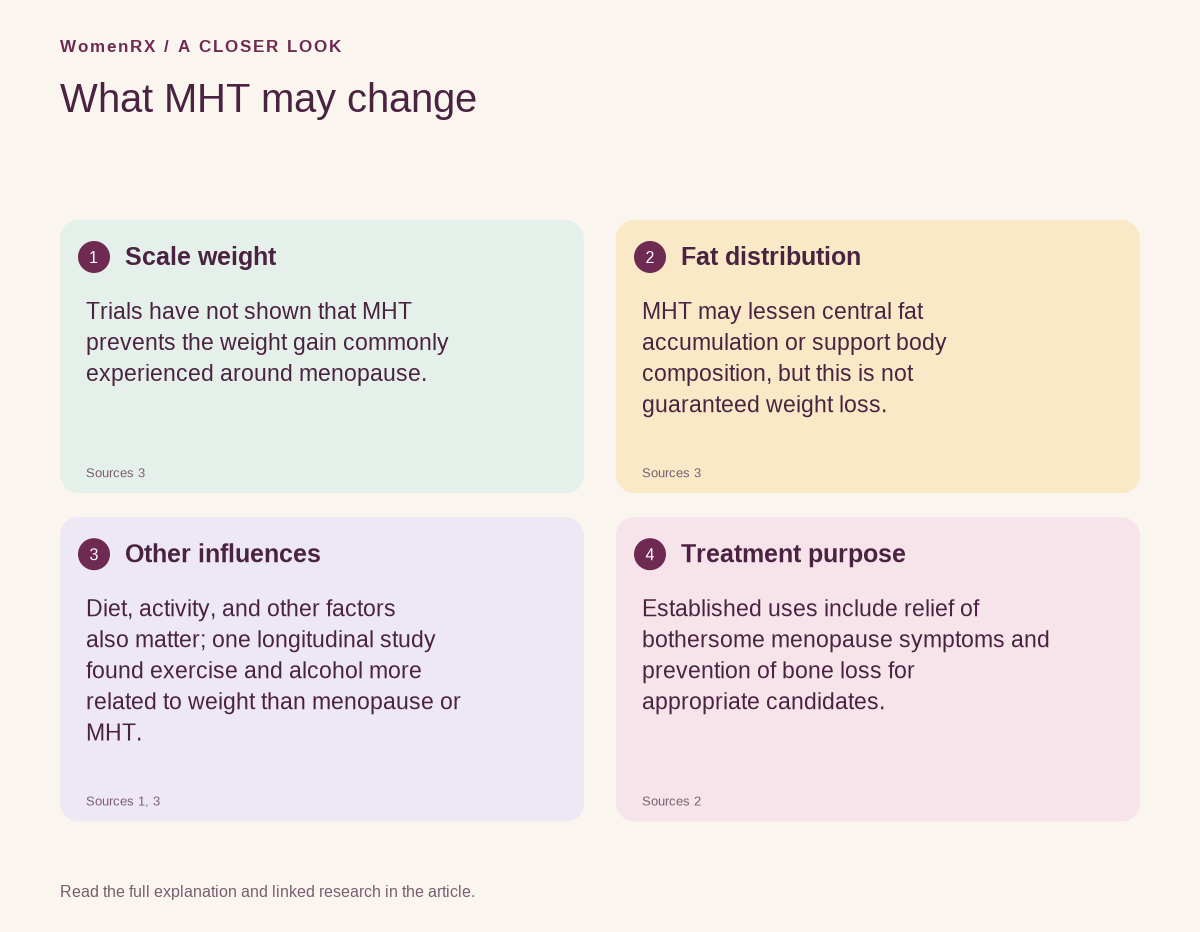
What MHT may change
Scale weight: Trials have not shown that MHT prevents the weight gain commonly experienced around menopause.3
Fat distribution: MHT may lessen central fat accumulation or support body composition, but this is not guaranteed weight loss.3
Other influences: Diet, activity, and other factors also matter; one longitudinal study found exercise and alcohol more related to weight than menopause or MHT.13
Treatment purpose: Established uses include relief of bothersome menopause symptoms and prevention of bone loss for appropriate candidates.2
Read the figure as text
Scale weight, fat distribution, other influences, and treatment purpose are related questions, but they are not the same outcome.- Scale weight: Trials have not shown that MHT prevents the weight gain commonly experienced around menopause.3
- Fat distribution: MHT may lessen central fat accumulation or support body composition, but this is not guaranteed weight loss.3
- Other influences: Diet, activity, and other factors also matter; one longitudinal study found exercise and alcohol more related to weight than menopause or MHT.13
- Treatment purpose: Established uses include relief of bothersome menopause symptoms and prevention of bone loss for appropriate candidates.2
More questions, answered
Could hormone therapy change my waist or fat distribution without changing my weight?
Possibly. Evidence suggests MHT may lessen central fat accumulation or help preserve body composition, but those effects aren’t the same as weight loss and aren’t guaranteed for an individual woman. 3
Should I use hormone therapy mainly to avoid gaining weight?
No. Research hasn’t shown that it prevents the weight gain commonly experienced around menopause. Its established uses include treating bothersome menopause symptoms and preventing bone loss for appropriate candidates. 2 3
Sources you can check
- Body Weight: MedlinePlusAccessed 2026-09-25Return to first citation
- The 2022 hormone therapy position statement of The North American Menopause Society.“The 2022 Hormone Therapy Position Statement of The North American Menopause Society” Advisory Panel. · Menopause (New York, N.Y.) · 2022Return to first citation
- Clinical review: Menopause hormone therapy in weight management.Younglove C. · Obesity pillars · 2026Return to first citation